Church Leadership Series: Part 2: A Good Reputation

So a church leader must be a man whose life is above reproach… He must exercise self-control, live wisely, and have a good reputation.

Also, people outside the church must speak well of him so that he will not be disgraced and fall into the devil’s trap.

1 Timothy 3: 2, 7 (NLT)

An elder must live a blameless life.

Titus 1: 6 (NLT)

I have spent much of my life in small towns, towns where it seemed everyone knew who you were, especially if you were the new pastor in town. In smaller places, people know more about you than you realize. They see you around town, they hear the gossip about you. It doesn’t take long for a person to get a reputation. The thing about a reputation is that it can be good or bad, and while a reputation may be influence by others, you have a large part to play in the reputation you earn.

And often that is the case: you have earned your reputation. You have said things or done things that people saw or heard about later, which formed their opinion of you. Your reputation is one you should guard carefully. It is hard to reverse a bad reputation because first impressions make a huge impact.

The Bible tells us that church leaders need to have a good reputation. The two verses above tell us some of what that reputation should look like.

Timothy tells us the leader needs to live a life that is “above reproach” while Titus tells us the leader must live a blameless life. 1 Timothy talks about overseers and bishops, Titus addresses elders, but I will combine those to say they should influence all church leaders, whatever your role may be. If you are leading people, you need to have a good reputation. You need to be above reproach and live a blameless life.

Now, I want to be clear, I do not believe that you or I will lead a completely sinless perfect life, but we can live a life that is generally God-honoring. And when we give in to sin, whether privately or something others see, we address it quickly by confessing our sin, asking for forgiveness from all involved and make right what we can.

If you have a reputation for quickly trying to resolve issues, admitting when you have done wrong and looking to correct that, you may not be blameless, but you will have a reputation that says you long to do what is right. Choose that reputation and work towards it.

1 Timothy 3:2 shows us how to gain and maintain a good reputation: “exercise self-control, live wisely.” Self-control means we are in control of our self. That sounds so simple and yet is so difficult. We so easily allow the actions and words of others to affect how we act. When someone accuses us of poor leadership or belittles something we have poured a lot of time and energy and prayer into, it is easy to respond with frustration and anger. We are called to control our selfish response and love them. Further, we need to recognize that our value is not found in the approval of others but in the approval of God. “Our purpose is to please God, not people. He alone examines the motives of our hearts. (1 Thessalonians 2:4) Self-control must be a self controlled by the God we serve, a submitted heart helps self-control to work.

And then we come to the phrase: “live wisely”. If you desire a good reputation, you need to live wisely, and lead wisely. You need to be careful about what you say and do so that you are seen as someone who is living wisely.

It might be good to be silent and listen more often rather than be quick to speak and end up saying something that is not good. All of us probably have memories of saying something we would like to take back. It may have been said in jest or in anger but did not reflect “living wisely”. Take care that your words and actions reflect wise living.

If you desire to be a church leader, as a volunteer leading a program or as a pastor, guard your reputation. It’s quite okay if people talk about me when they are saying good things, it’s another when they are passing along negative gossip. And unfortunately, the hurtful gossip spreads quickly. Do your part to squash the negative gossip by living in such a way that it has no element of truth in it.

A church leader needs to have a good reputation.

Keep looking up,

Andy Wiebe

Antidotes to Stress

More than three-quarters of adults report symptoms of stress, including headache, tiredness, or sleeping problems.

American Psychological Association, 2019

Everyone knows what stress is, and many people experience it often. We feel we are facing more than we can handle. The expectations on us are too much, or we are in uncomfortable situations without a way to gain control or get out of it. It affects our mind, our emotions, and our bodies. Some of our medical issues are even caused by stress.  And just because you attend church does not mean you immune to stress. Many of us even experience stress as we serve in the church.

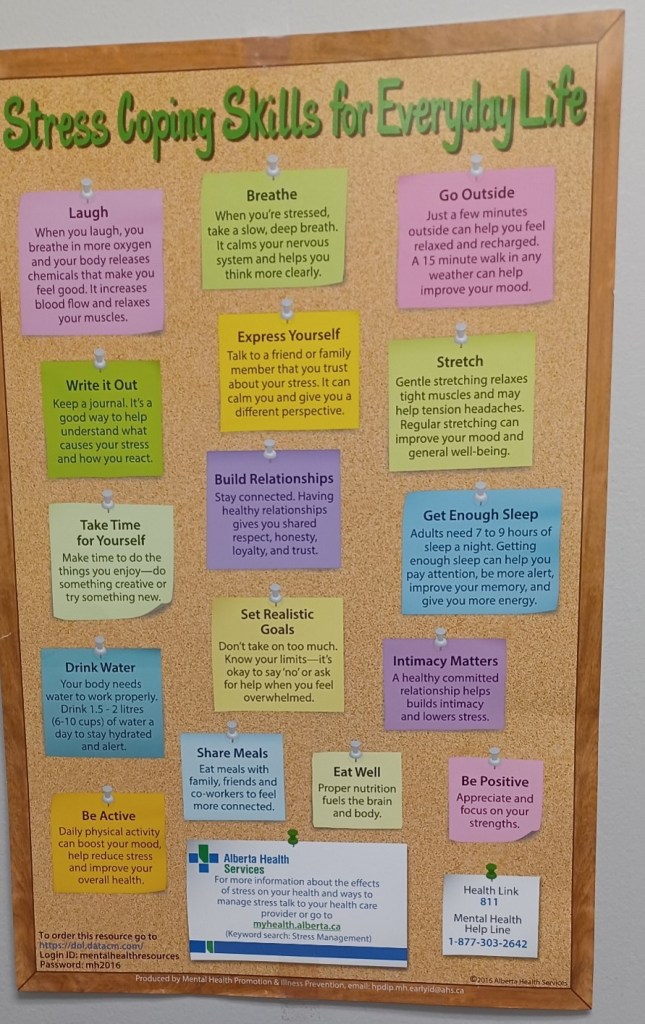
At a recent visit to the doctor I saw this poster on the wall: Stress Coping Skills for Everyday Life.

There are a number of great ideas to put into practice when we are experiencing stress. Some of them are physical exercises such as “go outside” or “stretch”. Others are mental exercises such as “be positive”. There are social exercises and suggestions for eating better and drinking enough water.

These might all be good ideas. They cover most aspects of a person’s life – social, physical, emotional, and mental. But I couldn’t help noticing that there was something missing. Where is the spiritual aspect?

As people who know God, we should recognize the value of going to God in our times of stress. In fact, if we have put our faith in Christ for salvation, then we have also received His Spirit that lives within us. He is God within us. He wants us to have life and have it to the full. (John 10:10)

Like the psalmist David, we can cry out to God in our times of need.

When my spirit grows faint within me,
    it is you who watch over my way.
(Psalm 142: 3)

 Lord, you are the God who saves me;
    day and night I cry out to you.
May my prayer come before you;
    turn your ear to my cry.

 I am overwhelmed with troubles
    and my life draws near to death.
(Psalm 88: 1-3)

Yes, there are many different things we can do to try to alleviate the feelings of stress, but why not call on God to help?

Call out to God for help. Pray. Spend time reading scripture. Allow God to speak. Meditate on passages of scripture or dwell on God’s attributes. Spend time in worship. Sing songs of praise. Listen to songs of praise. Ask God to calm your spirit and empower you by His Spirit to tackle the day with confidence.

When stressed, do what you can to trust God to walk you through it.

Keep looking up,

Andy Wiebe

Book Reviews: Andy’s 2023 Reading Experience

I will be sharing a brief review of every book I read this year. Hope you enjoy and hope it encourages you to keep reading.


7 FRIENDSHIPS EVERY MAN NEEDS – by Justin Erickson

Erickson suggests that every man needs these 7 friends in their life to live a full life. Here are his seven friends: a mentor to disciple you, a Peter to encourage you, a best friend to uphold you, a courageous brother to confront you, a faithful disciple to follow you, a lost seeker to hear you, and a gracious Savior to befriend you. He presents some well though out chapters on the value of each one, comparing them to the value of a pit crew to a Nascar driver. While I do agree that most of us men could use more friends, I think it is highly unlikely that any man will have seven solid friendships in their life at the same time. Some of those roles may be played by the same person, or at times we may have a friend in a certain role for a season, yet his premise holds true: Men need to find more good friends to walk through life with.

Book Reviews: Andy’s 2023 Reading Experience

I will be sharing a brief review of every book I read this year. Hope you enjoy and hope it encourages you to keep reading.


LEADING WITH A LIMP – by Dan B. Allender, PhD.

Allender states this as his core assumption for the book: “To the degree you face and name and deal with your failures as a leader, to that same extent you will create an environment conducive to growing and retaining productive and committed colleagues.” If you try to hide your failures as a leader, you will need to be more controlling of others around you. He says that in God’s leadership model, “He calls us to brokenness, not performance; to relationships, not commotion; to grace, not success.” While leaders often feel compelled to show they know everything and are definitely the right people for the job, they would be better off admitting their weaknesses since  everybody else can see them anyway, and work more on a good relationship with people than just trying to get the most out of them for the task at hand. Allender offers this great quote as he talks about the difficulty of being a leader and casting vision. “One can speak of vision and mission, calling and opportunity until the cows come home, but when the day ends, most people want nothing more demanding than some television and a few uncomplicated laughs.” He speaks honestly of the hard work of being a leader while giving hope from God’s perspective. A great leadership book that makes one think.

The Inadequate Leader

If anyone is following you, then you are a leader.

Some of us are natural leaders. Our personality and character attracted others who willingly followed us even as a child.

Some of us are reluctant leaders. We have been pushed into positions that we were not looking for. Maybe we were just a little more qualified than others, or the only one who said yes. But all of us are “inadequate leaders”.

Inadequate leaders are those who recognize that they don’t have all the answers, or all the skills needed for their position.

Many leaders lack experience. You only get experience by doing something. That means there is always a first time, a time when you have no experience, but you lead anyway. You may have experience in similar situations or in a similar role with less responsibility, but all of us at some point will be moving beyond the experience we have. If you never get to that place, then you are never growing as a leader. Maybe you are okay with that, but you still had to do something for the first time to even get to the level you are at.

If you lack experience, that means you may be inadequate for the task. So, what can you do? If you are an analytical person, you can try to come up with a perfect way to move even if you haven’t been in that situation before. You could ask for advice from others who have experience where you are lacking. Invite them to speak into your situation, and even though their experience isn’t yours, find some ideas to try in your own case. Gather your team and invite them to collaborate with you to find the right way ahead, and build on the experience you – and those around you – already have.

What if you realize you don’t have the skills you need to lead? Not only do you not have the experience to lead in this situation, you also lack the skills needed. There may be some ways to learn and develop those skills. Education is always an option. Find a seminar or a book or a class that will train you in this new skill. Again, as in the situation of lacking experience, invite someone who has the skills to train you. Ask for time with them to talk through how the skill works and spend time observing and learning from their example. Another option may be to bring in someone on a short-term contract or invite someone to join your team who can fill in the areas you lack. There may be times you step away from a situation to allow someone more suited to lead.

You may feel like an inadequate leader because you are responsible for more than you can accomplish in the time you have. First, make sure you are not carrying responsibilities that are not yours and hand them off to the appropriate people on your team. Second, find someone to work with you. May leaders have strong assistants who may be good leaders in their own right, but who love supporting you in your leadership role. You need someone who will respond to delegation, and who gets to know you well enough to do things the way you would if you had the time.

Sometimes we feel inadequate because of what people say to us or about us. There are times to listen to others and times to recognize if they are an authority in your life or not. No one can please everyone all the time. Be clear on what your role is, your job description, the vision you are pursuing, and don’t be distracted by those who want to speak into your life but truly have no right to.

Every leader will feel inadequate at times. If not, then you are no longer growing, and if you are no longer growing, you are quite possibly falling behind. Others will come along who will bypass your leadership because they are continuing to grow and learn and develop. While we cheer on those who are excelling next to us, we want to continue to be the best that we can be. The value of recognizing when and where we are inadequate is that we recognize where we need to grow to continue to lead well.

If you are an inadequate leader, that’s okay. Just look for ways to grow.

Keep looking up,

Andy Wiebe

Book Reviews: Andy’s 2023 Reading Experience

I will be sharing a brief review of every book I read this year. Hope you enjoy and hope it encourages you to keep reading.


GETTING NAKED – by Patrick Lencioni

Getting Naked: a Business Fable, by Patrick Lencioni is exactly that. It is a well written story of a businessman sent to check out a smaller company that has just been acquired by the company he works for. He expects that, because it is a small company, it will not have anything to teach him. He is surprised by the things he discovers. He learns that they have a much better way of handling clients and doing their work than what he is used to. Lencioni concludes the book with a few key points that are already clearly shown at work in the story. A great book on how to benefit from being vulnerable in business.

7 Steps to Becoming a Disciplined Leader

Last week I wrote about what it is like to be a disciplined leader. Today I want to continue focusing on that topic by showing how you can develop that discipline in your own life.

Step One: Determine where you lack discipline.

Know your strengths and your weaknesses. If you have no problem showing up to work on time, count that as a strength. If you are always struggling to meet deadlines, that is a weakness. Choose only one or two weaknesses to work on at a time. If you are really brave, you may ask a colleague what some of your weaknesses as a leader are and work on those.

Step Two: Clarify your motivation.

As you consider the weakness you want to work on, what is your motivation? Why do you want to become more disciplined in this area? Is because someone else told you improvement was necessary? Or do you recognize the value discipline could bring to this area? If you are struggling to meet deadlines, your motivation for more discipline may be to have less anxiety or to have time to do a review of the project before the deadline so you do better work. Make sure you are convinced this is an are where you actually want to improve. Then your possibility for success will increase greatly.

Step Three: Sort out the problem.

Why is this an area of weakness? For example, why are you not meeting your deadlines? Are you procrastinating and putting in little effort until just before the deadline? Is it because of an inability to accurately estimate the the amount of time it will take you to work on the project? Once you figure out what the problem is then you can develop steps to improve.

Step Four: Develop a plan.

Let’s say you struggle to meet your deadline because you procrastinate. Develop a plan that gets you working on the project as soon as you take it on. Work back from the deadline and establish your own deadlines. You could also create your own deadline a week before it’s needed to give you time to review it. When reviewing your deadline, you can also break the job into smaller steps and set personal deadlines along the way that get you working on it sooner and keeps you going. These dates can lead up to your personal deadline and help you stay on track.

Another strategy is to actively develop better habits and create rituals that keep you on task. This could be creating more shorter deadlines for smaller parts of your projects. Maybe it could be working on your task first thing in the morning and checking emails or engaging in other tasks only at noon or at the end of the day.

Step Five: Remove distractions or temptations.

Why are you procrastinating? Are you always on you phone? Are you taking too many coffee breaks or constantly chatting with co-workers? Maybe set an alarm on your phone that reminds you to get back to work after a coffee break. Or leave your phone in your coat. Don’t check personal emails at work. Turn off notifications on your phone that continually remind you to check I through the day. Sometimes, it may be beneficial to close the door and pull the blinds so that you are not distracted by others who are walking by your office or chatting with each other. Find ways to remove distractions.

Step Six: Find an accountability partner, coach or mentor.

It helps to know that someone will be checking in on you. Ask someone on your team to check in with you occasionally to see how you are coming along. If you are the one in charge, maybe you have a secretary or personal assistant who can check in and remind you of deadlines you have set. Or hire a coach to check in with regularly.

Step Seven: Just keep on keeping on.

One who wants to learn discipline will continue to push through an try again and again even if they fail occasionally. Keep reminding yourself of your goals. And as you make progress, remind yourself of how far you have come. Did you meet that last deadline? Then celebrate it. If not, then figure out if some adjustment is needed and get back to the next task at hand. Don’t get down on yourself if you fall short. Forgive yourself and recommit to the plan.

Becoming a disciplined leader takes hard work, but you can do it as you work on one or two weaknesses at a time. As you do, you will become the disciplined leader you want to be.

Keep looking up,

Andy Wiebe

Develop the Leadership Character of Discipline

Discipline is something you develop in yourself by deliberate and consistent decisions. It is not something a person automatically has but is a characteristic that must be learned and developed. Discipline is what helps maintain what is good in life and build on it to improve even more. It is developed by regularly choosing to make the necessary decisions and take the correct actions. A disciplined person may live by a rule or system of rules governing their conduct or activity. As you live by these good choices, you become a disciplined person.

A disciplined leader gets more done.

Many people put in the expected hours at work. Some get much more done in those hours than others. One reason is that the disciplined person knows how to keep breaks short and focus back on the task at hand.

A disciplined person starts on time, but also ends on time. Whether it is the start of your day or running a meeting, a disciplined person is prepared, ready to start when it is time, and focused enough to accomplish what is needed in the necessary time.

A disciplined leader develops good habits.

Self-discipline is the ability to control your behavior in a way that leads you to be more productive or have better habits. Systems or rituals can help you organize the activities you regularly do into an orderly fashion that eliminates time spent deciding what to do next or how to do it. These rituals can be as simple as cleaning off your desk before going home at night so it is not cluttered when you return in the morning. A ritual could include taking 10 minutes to plan the next day so you are ready when you arrive in the office the next day.

Systems are the habits that are packaged together, like a series of procedures.  An example may be a system for tracking meeting decisions and action items. This might include transferring all dates discussed in the meeting onto their calendar, and adding your responsibilities to your to-do list, and adding time to work on these items to your daily schedule. In this way, within minutes of your meeting, you have all the pertinent information on the right calendars and to -do lists.

A disciplined leader excels at self-management.

A disciplined person is a self-starter. They don’t need someone else to regularly check in to remind them of the next job to do. They know how to determine what needs to be done and what can wait. They know where to go to get answers or expertise they don’t have. A disciplined person sets their own direction for the day rather than waiting for the supervisor to give them their jobs. A disciplined leader manages their time in such a way that everything gets done and they still have time to dream and plan for the future.

A disciplined leader keeps going when things get tough.

Being a leader is not always easy. Pushback can come from many angles, including some of your own staff or even those you serve. Financial issues can become a big concern when money isn’t coming in as expected. A time crunch can also be tough, when the amount that needs to be done seems to be greater than the time available. Things can get tough too, when a leader feel like they are leading beyond their limits. In all the different ways that things can get tough, the disciplined leader will never give up. They will push through. They may arrange for deadline extensions or make some financial adjustments. They may get outside help, whether personal coaching, or more staff, to push ahead when they feel they are in new territory and unsure how to proceed.

Discipline is a valuable characteristic of anybody, but especially a leader. This characteristic will help a leader get through many situations when an undisciplined person may give up or just panic and do a poor job. Work at becoming a disciplined leader, one good decision, one good habit, after another. If you want to lead well, develop the character of discipline.

If you are looking to become more disciplined, checkout next week’s post on how to develop discipline as a leader.

Keep looking up,

Andy Wiebe

Boor Reviews: Andy’s 2023 Reading Experience

I will be sharing a brief review of every book I read this year. Hope you enjoy and hope it encourages you to keep reading.


NECESSARY ENDINGS – by Dr. Henry Cloud

In Necessary Endings: The employees, businesses, and relationships that all of us have to give up in order to move forward, Dr. Henry Cloud explains why good endings are needed for good beginnings. He uses a number of great examples to show how appropriate endings at the right time can be very positive for you personally and for the organization you are part of or leading. Some endings are forced on us, and some are ones we choose, in either case we can determine how we will use that ending as an opportunity for something new. When you end something, you have room for that next thing that can be even better than what you just ended. A very helpful book!

Make Your Sermons More Engaging

I love preaching. I love opening a passage of scripture, expounding on it, and seeing eyes opened and hearts encouraged. The natural tendency is to make the sermon a monologue. Often this serves just fine, but I think it can be enhanced visually.

Personal Sermon Notes

Sermon outlines or notes pages can be included in bulletins or handouts that each person receives as they arrive at church. Adding visual aids in these notes can provide an additional way the congregation follows along with the sermon.

Slides accompanying the sermon

In addition to outlines for each person, slides can be used to highlight a point you are making or a scripture you are referring to.

As a visual person, I appreciate seeing slides that go beyond the text that the pastor is saying, and include relevant images or other visual aids. For example, when quoting a person, include their photo. A sermon illustration could be accompanied by a picture of what is being referenced. If you are speaking on the Lord being our shepherd you could have a picture or brief video clip of a shepherd working with his sheep.

Props

While pictures are useful, the real thing can be even better. Some sermons make it easy to bring in a prop. An easy example could be pointing to a cross  already in your church when you are preaching about Christ’s death. Communion includes props which Jesus instituted: the bread and juice. A sermon from Matthew 7:3-5 about the person with a log in their eye pointing out a speck in another’s eye would be a great time to bring in a 2 X 4 and a little sliver and visually show people the absurdity of that action. A sermon on reaching the world for Christ might be a time to bring in a large world map or globe to point out some of the least reached areas of the world.

Models

This past Sunday I asked my wife, and she agreed, to be a model for me. I am preaching through Colossians, and we were in chapter 3 where Paul writes to the church in Colossae about how to dress as a believer. He specifically talks about “getting rid”, and “putting off”, and “stripping away” certain things. Then he twice says “clothe yourself with” something.

I had my wife put on an old T-shirt over her clothes. Then, after reading the scripture, invited people from the congregation to shout out all the things that were of the old life and were to be put off. As they listed the items from the scripture, I had preprinted words and phrases that I taped to this T-shirt. When they were all taped onto her T-shirt I reminded them that verse 5 talks about “putting to death” the things of the old life. So I picked up a pair of scissors and cut the shirt off of her and through it on the ground. That has now been put to death.

Then I had her put on a suit jacket of mine. Now we continued in the scripture and as they called out the things that we are to “clothe” ourselves with, I taped those words and phrases onto the suit jacket. Once she was wearing all the good things, I had her walk around as if she was a runway model, displaying all the things Paul was telling us to “put on”. I concluded by pointing out how Paul finishes that section by telling us to do all we do for the glory of God. The New Living Translation says we are to be good representatives of Christ in all we do. We are like a model, continually displaying what a Christian should be like. I pointed out that this was not “Dress to Impress”, but “Dress to Express”. We are to put on the things of Christ to show the world what Christ is like.

Look for ways to occasionally bring in a visual to aid your sermon. There will definitely be some who appreciate your efforts.

Keep looking up,

Andy Wiebe