I will be sharing a brief review of every book I read this year. Hope you enjoy and hope it encourages you to keep reading.
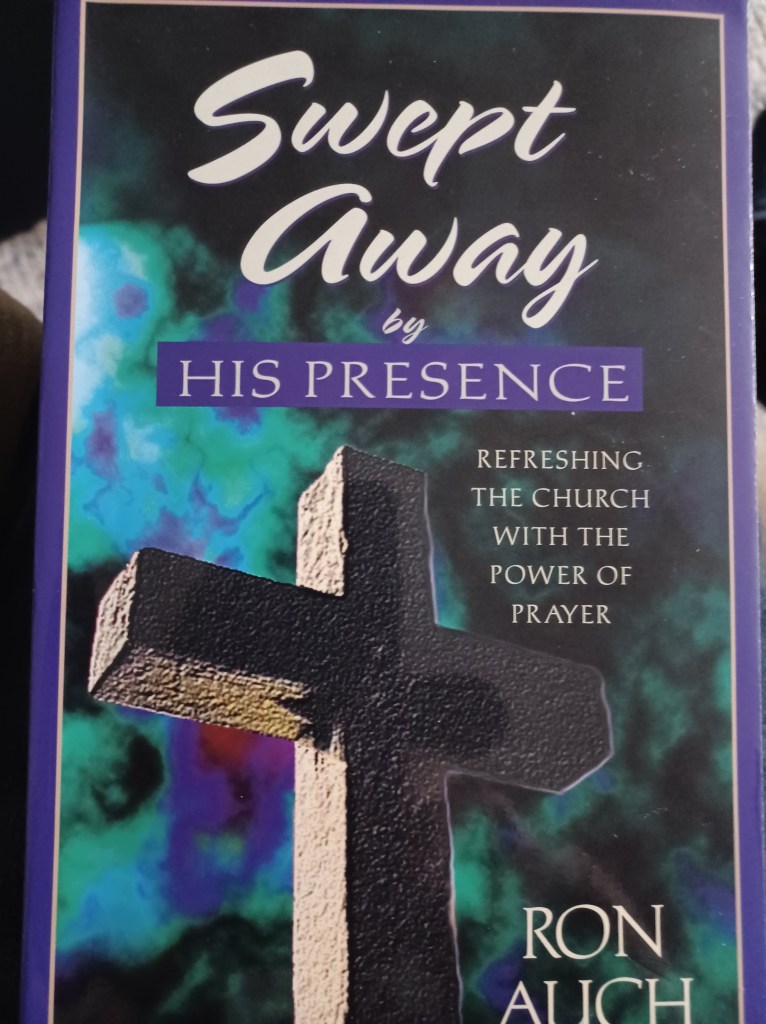
SWEPT AWAY BY HIS PRESENCE – by Ron Auch
The subtitle of the book is: Refreshing the Church with the Power of Prayer. Ron Auch is calling the church back to prayer. He writes from a Pentecostal background, reminding the reader of the early revivals such as the Asuza Street Revival. In chapter 3 Auch points out how the first generations who experience God have a much different faith experience than the second, and how the third generation often has lost any experience of God. He calls the present generation back to prayer and a real and alive relationship with God. And he says prayer is the way to get that real relationship again. While the book is a little older (1997), the call to prayer is needed just as much today as it was back then.
A Christian leader faces the same challenges that any other leader does. And a Christian leader can help himself to any of the tools other leaders use to help them lead well. But the Christian leader has one powerful tool that others do not. Prayer.
Like any tool, it may take some practice and some skill to access this tool’s full potential. Often when we think of prayer, we think of asking God to do something for us. We come to him with a request. But that is only one aspect of prayer.
Another way to use prayer is to learn to listen to God. We are so used to telling God our problems and asking him to do something about them, and that is often where a Christian leader stops. Yet if we learn to listen, God will do much more for us through prayer than just respond to our grocery list of requests.
Here are some of the ways that I have benefited from this great tool we have.
God encourages through prayer.
Every leader faces opposition from time to time in their leadership, and Christian leaders are not exempt. As a pastor, I have faced opposition many times, both from inside and outside the church I have been asked to lead. People have called me names, accused me of being controlling, demanded I be removed from my position, and more. People have not liked what I stood for and deliberately chosen to walk in a different direction. I have faced opposition from within myself. There are times I have been disappointed in what my leadership accomplished. I have been disappointed in goals not met. I have been discouraged and depressed.
These are not uncommon problems for leaders to face. There are times we need encouragement. We might find some of it in books or in encouraging words from other leaders or supporters of ours. But I have found that some of the most powerful encouragement has come directly from God.
God has encouraged me as I listened to him. One time he told me: “you are my beloved son in whom I am well pleased.” This was powerful for me as I had just come through one of the most difficult times in my ministry. Another time, God affirmed that I was on the right track. I was a little unsure of the direction to lead the church and in a conversation with Him, I heard (or felt) Him say, “You are on the right track. Just keep going.”
God encourages the Christian leader through listening prayer where we actually hear God or sense God speaking words of encouragement to us.
God directs through prayer.
Every leader needs to know where they are going. They need to know where they are trying to take their organization. They need to know the priorities of the day. Sometimes we get caught up in the urgent needs of the moment and begin to veer off track from our intended goals. I love the fact that I can talk with God about my day and ask Him for direction for the day. I am serving as a Transition Pastor right now and have a limited time to work with the church through the various exercises. There are times when I have had to readjust my schedule because it just was not working. As I talked with God about it, I was able to patiently let him give me the priorities of the week.
God instructs through prayer.
One of the roles of the Holy Spirit is to instruct and remind the believer of God’s truth. When we pray, we are able to hear God speaking to us through the Holy Spirit. There are times we will be reminded of certain scriptures that speak into a situation that we are facing. There will be times when we will be given an idea or a concept to put into practice that clearly did not come from our own wisdom but from God.
If we pray and read scripture together, God uses those scriptures we are reading to give us insight into how and what we should be learning and doing in our leadership.
There are many tools available to leaders today. One of the best and most powerful tools the Christian leader can access is prayer and hearing God speak directly into their leadership. Pray, not just with a list of requests for God, but with a listening attitude and God will direct your paths.
The moments of our life are filled with little decisions. A mother in Zambia stirs her nshima. A farmer in Peru harvests his coffee. A businessman in Japan exits an elevator. Life is going on in every corner of the world. Insignificant moments? Insignificant people?
A kind word encourages a friend. A “thank you” lifts the spirits of the barista who prepared your coffee. A word of encouragement helps a young person decide on a career. Small moments that make a difference.
A secretary phones in sick, and a temp gets a new job. A student calls for prayer and a movement takes shape A neighbor introduces himself to another neighbor – and introduces him to the Lord three years later.
A woman pours perfume on a man’s dirty feet and wipes them with her hair – and Jesus makes sure it is recorded in history. An impatient soldier shoves a spear into Jesus’ side to make sure he is dead – and fulfills prophecy. Small, seemingly insignificant moments, with significant effects.
John Maxwell is famous for his writing and speaking on leadership. I was amazed at his ability to find good quotes and the right facts – until I heard he has a crew of people who do much of that work for him. Those who have made significant contributions to the world require the support of people in the background. Unknown people are in the background of all who seem to have made significant contributions to the world.
A friend is recognized for his act of bravery by the Canadian government for helping a fellow passenger to safety when their small plane crashed. He’s seen as a hero now, but in the moment simply decided to act. And it turned out to be a significant decision. A choice made in the moment, but a lasting impact and recognition.
There are no insignificant moments. All the seemingly insignificant decisions of seemingly insignificant moments shape who you become. Everything we do, as insignificant as it may seem, has significance. Those small decisions that we make in a moment accumulate in your character. They shape you and determine who you become.
So whether you eat or drink or whatever you do, do it all for the glory of God.”
the Apostle Paul
“So whether you eat or drink or whatever you do, do it all for the glory of God” writes the Apostle Paul in 1 Corinthians 10: 31. Brush your teeth for the glory of God? Share your testimony for the glory of God? Every moment that feels insignificant can glorify God. God is at work using the moments, the words, and the actions, of each person. God uses the average, unimportant people to bring Him glory.
Every moment can make a difference. Every word can be powerful. Every person has value and purpose.
May you live a life of significance as you surrender your life to the pursuit of the glory of God. Invite him into every aspect of your life, every decision you make, and you will live a life of significance in His eyes.
May you be a leader who recognizes the value of the insignificant moments and insignificant people.
Music is a part of our lives. From the song playing on your radio alarm as you wake up, to the elevator music you hear on you way to work, to the dinner music at a dinner out with your special person, music is all around us. Lullabies put our children to sleep, national anthems announce the start of a hockey game, and Happy Birthday makes us smile around a candle-lit cake. Music is also a big part of the church.
Music triggers memories.
Some couples have a song. It could be the song that was playing on their first date or another significant moment. Songs can take us back to occasions or moments of significance to us. I remember singing How Great Thou Art with some friends underneath tall evergreens on the shore of Heart Lake in northern British Columbia. We sang of God’s work in creation as the rain poured down and the lightning flashed against the night sky, lighting up the mountains around us. Every time I hear that song, I remember that place and that special moment.
In church, some songs remind us of special moments we had with God. The Goodness of God, by Bethel Music has a special place in my heart because I first heard it while in a low point in my life and it did a lot to lift me up and reorient myself with a renewed trust in God.
Songs teach us.
The tunes that stick in our head through the week remind us of the sermon we heard last Sunday and the truths that the Holy Spirit revealed to us. Humming or whistling a tune reminds us of something even when the words aren’t sung.
Statements read or spoken are not as easily retained as when in a song or put to a tune. As we sing songs together on Sunday morning or on our own throughout the week, we begin to internalize the words, and ultimately learn from them. Some of the great hymns of old were powerful because of the biblical truths they teach.
On the other hand, some of them taught us things that were not true. Christmas carols for instance taught us that baby Jesus didn’t cry, which can’t be true if He was truly human. How else would he have communicated his needs as a baby? We Three Kings declares there were three wisemen or Magi when the Bible doesn’t say that. Songs make assumptions and take poetic license, which is fine until we assume the words are truth.
Songs teach us. We just need to be aware what we are learning as we sing. Do the lyrics declare biblical truths that we can stand behind, or do they teach something contrary to what we preach and practice?
Songs speak to our hearts
Songs, and the music we sing them to, have a way of grabbing ahold of our hearts. They become personal expressions declaring great truths we agree with, or prayers expressing our hearts in a way we couldn’t until we heard and sang this song. Songs are the expression of the writer, and when we find a song where the writer expresses exactly what we want to say, it can be a wonderful experience. It gives words to feelings we may not have been able to articulate.
I have had songs help me declare my faith in God in the middle of the storms of my life. When everything seemed to be going wrong around me, I could join in with the song and reaffirm my belief that God was and is still sovereign even in my tough times.
Songs can make us laugh and make us cry as they enable us to put words to our emotions.
Songs Invigorate Us
Armies often had battle songs. National anthems inspire athletes to do their best at the Olympics. And songs can help us to rise to the challenges that face us every day. They don’t just give us something to identify with but draw us to commit to action. Songs can invite us to declare our allegiance to our God and King again.
There is power in music and song. We need to recognize that power and use it in a way that will continue to remind each other to keep looking to Jesus and honor God with our lives. Let’s encourage and inspire each other as we sing.
I will be sharing a brief review of every book I read this year. Hope you enjoy and hope it encourages you to keep reading.
DISCIPLINES OF A GODLY MAN – R. Kent Hughes
Disciplines of a Godly Man is a call to men in the church and home to stand up and be whom God has called them to be. Kent Hughes challenges men to step up and discipline themselves with chapters dealing on personal soul issues, relationships, character, and ministry. The church is looking for good men to give themselves to the work of ministry. God is looking for good men to give themselves to leading in the home, the church, and in the culture. Hughes does a good job reminding us that this is not about legalism: doing something in order to gain God’s favor. In fact, this is the opposite. This is about living in such a way that we honor the One who already loves us and calls us to a disciplined life of faith in Him. This would be a great book to walk through with a Men’s Group.
Work is part of daily life for most people. We use our minds and our muscles to create and contribute to our world.
Work is an essential part of why we were created. In Genesis 2: 15 we read, “The Lord God took the man and put him in the garden of Eden to work it and keep it” (ESV). This happened before the Fall, where Adam and Eve sinned and received God’s judgement. And this is part of who we were created to be. When God finished creating the world, we are told he “rested from all his work that he had done in creation” (Genesis 2: 3). We are created in the image of God, so we are created – in part – to work. The ideal life is not one without work, but one in which we find joy in our work.
Work became harder after the Fall, after Adam and Eve sinned. Genesis 3: 17 – 19 tells us that work now became more difficult.
“…cursed is the ground because of you; in pain you shall eat of it all the days of your life; 18 thorns and thistles it shall bring forth for you; and you shall eat the plants of the field. 19 By the sweat of your face you shall eat bread…”
God also created us to rest. God created us for a regular rhythm of work and rest. He created for six days and then rested on the seventh. All throughout the Old Testament God continued to tell his people, to work for six days, then rest on the seventh.
Many of us work jobs that have shift work that doesn’t line up with a seven-day work week, but we can all make sure to rest when we have our days off. We fulfill our purpose as we keep a rhythm of work and rest.
The New Testament agrees with Genesis: we are created to work. Ephesians 2: 10 tells us, “For we are his workmanship, created in Christ Jesus for good works, which God prepared beforehand, that we should walk in them”. When we come to faith in Jesus, he works in us to do good works. There is no instruction about what these exact works are to look like or how we are to go about them. Instead, we are told in 1 Corinthians 10:31, “whether you eat or drink, or whatever you do, do all to the glory of God.” Whatever we do, whether we are working or taking a day off, whether we are spending time with friends or attending a church service, we are to do everything we do for the glory of God!
Like most of life, how we handle work requires balance. On one extreme is the lazy worker, the one who slacks off as soon as the boss walks away. This is the one who takes extra long breaks and helps himself to supplies from the shop for his own projects at home. This is the worker who does whatever he can to keep his contribution to the company to a minimum. If this is you, then you have some serious questions to ask yourself. How are you reflecting the creator in your work? How are you doing your work for the glory of God?
On the other extreme is the workaholic. This is the one who prides himself in how many hours he has put in this week. I have heard pastors boast about how many hours they work each week, as if this makes them extra special. Or maybe they feel this shows how much they are willing to sacrifice in order to serve the church. Sacrificing your energy, time with your spouse and your family, or even time with God is not a sacrifice that God is going to be impressed with. Boasting about how many years you have gone without a holiday does not make you a good worker in God’s eyes. Where is the balance of work and rest? Where is the understanding that work is one priority in your life, not the main one. How many, men especially, have poured their lives into their work and had no time and energy to pour into their kids at home? Sometimes we may find ourselves in a situation in which we need to work more hours than allows for a good balance, whether this is due to financial stress, busy events or seasons at work, or many other life circumstances. However, if you choose to work beyond what leads to a healthy life for you and your family, it is likely time to re-evaluate your priorities.
In the middle is the balance we are all trying to find. Putting in a good day’s work and having time to love and play with your family is ideal. Christians should always do good work. We should be able to echo the evaluation of God at the end of Creation: “And God saw everything that he had made, and behold, it was very good” (Genesis 1: 31). We should be proud of our efforts at work, and what our effort accomplishes. And we should be proud of the time we have to pour into our family and what those efforts accomplish.
I write with the Christian leader in mind. So, Christian leader, how are you doing with your work and rest, and work and family balance? And don’t get caught up in the mindset that we have to work hard for and at the church at the cost of time with family. The father who desires to have a reputation of someone always serving the church needs to balance their efforts at the church with their time with their family as well.
We are created to work, and to rest. May God guide you as you balance your work and the rest of your life.
Sometimes our dreams are dashed in front of us. We had all kinds of dreams, were convinced that we were doing exactly what God wanted in the place he wanted us, and life is not going as we had planned.
All of us face disappointment. All of us will have times of discouragement. But sometimes the load seems too much. We consider giving up and moving on to something else. We feel that those close to us don’t understand how big the load is that we carry. We feel very alone. We may feel God has given up on us.
I’m reminded of the story of Joseph in the Bible, which begins in Genesis 37 and goes on for a few chapters. Joseph had eleven brothers. They hated him because they saw that he was Daddy’s favorite. Joseph had a few dreams that made it look like the rest of the family, all the brothers and their Dad, would bow down before Joseph. Sharing those dreams didn’t help his brother’s hatred. A few of them arranged it to look as if wild animals killed him, and then sold him to some slave traders. Those slave traders brought Joseph to Egypt and sold him to one of the Pharoah’s top officials.
That would be a terrible experience for anyone. No one would be shocked if Joseph became angry. Instead of being a rebellious and belligerent young slave, Joseph served his master well. In fact, his effort was rewarded by the master making him his attendant in charge of the whole household. Jospeh overcomes being sold as a slave and manages to do good for his master. What an amazing example of overcoming disappointment. Instead of letting the disappointment of the situation he finds himself in, causing him to dwell on his own terrible misfortune, Joseph rises above that to continue to do his best as a person – and as a slave.
Then his master’s wife tries to seduce him, but he runs away in order not to sin in this way. The master believes his wife when she accuses Joseph, and he sends Joseph to prison. A second wave of disappointment must have hit Joseph. No one would have been surprised if he was angry at God or became a hardened criminal in prison. Instead, he overcomes that disappointment by doing good in prison. Like when he arrived at the official’s house, his abilities and attitude are soon recognized, and he is placed in charge over all the prisoners. Yes, God is with him, His blessing is evident, but Joseph overcomes what would have been a terribly disappointing situation and is rewarded. Again, instead of letting the situation push him into despair or anger at God, he continues to do his best in the situation he finds himself in.
After some time, Joseph becomes aware through a dream, that one of his fellow prisoners will be soon released and return to his position as Pharaoh’s cupbearer. Joseph asks the cupbearer to please remember him when he returns to Pharaoh’s palace. Joseph begs him to speak up on his behalf and get him out of prison. The cupbearer gets his position back but forgets about poor Joseph back in prison. As time goes on Joseph realizes the cupbearer didn’t speak up and he remains in prison, experiencing yet another disappointment.
Two years later Pharoah has a dream. Finally the cupbearer remembers Joseph, and how he was able to interpret dreams for him. He recommends that Pharoah speak with Joseph, and Joseph is brought in to explain Pharoah’s dream. When Joseph favourably explains the dream, Pharaoh ends up making Joseph his second in command!
Joseph survived a few waves of disappointment – terrible things to endure. He made it through and God placed him over all of Egypt, second only to Pharaoh.
Some time later, when famine hits the homeland, Joseph’s brothers came to Egypt looking for food. Since Joseph is in charge of the grain, they bow down before him – just like the dreams Joseph had as a youngster! And then Joseph makes an incredible statement in Genesis 50: 20: “You intended to harm me, but God intended it for good to accomplish what is now being done, the saving of many lives.”
Not only did Joseph survive all the terrible disappointments, he saw that God used what others did to him as a means to accomplish great good!
Some lessons to help us survive disappointments:
1. Trust that God is the same God in both moments of triumph and moments of despair. Joseph never blamed God for what was happening. He even ended up saying God was in all of the things he suffered.
2. Be faithful where you are, no matter how disappointing. Joseph did his best in every situation he found himself in. And God blessed him and rewarded him. Whether the disappointments result in goals left unreached or a position terminated when you still had dreams to pursue, be faithful to God wherever you find yourself next.
Be the person God wants you to be no matter what the circumstances are around you.
3. Find your sense of well-being in your relationship with God rather than in your circumstances. Whether Joseph was head slave in an important official’s house or a lowly prisoner, he did everything to the best of his abilities.
4. Trust that God will look after the future. Serve God faithfully right now, wherever you are, trusting that God knows all the next steps and future twists and turns, and that you are safe in His hands.
Disappointments will come. Sometimes they are small, often they are big. We can survive them if we continue to trust God and know we are safe with Him.
When your dreams are dashed and life is not meeting your expectations, continue to hold onto God in the middle of the frustration and pain.
People need hope. There are too many things going on in our world that cause people to fear and to worry.
We can all find things to complain about or worry about. I don’t think we need any training in this area. It seems to come so naturally to us. It is much harder to look for and find the good in life, in business, and in ministry.
My grandma was a good pessimist – if there is such a thing. Don’t get me wrong. I’m not putting her down, but she was incredibly creative in finding things to worry about. If you are going to be a leader that inspires hope you will need to be an optimist. You will need to be creative in seeing the good in things and in finding things to smile about.
Hope is an antidote to fear. Hope teaches that just maybe we can make a situation a little better. If we can instill a little hope in the people we work with, we will have done a great kindness to humanity. And we may very well find that our team wants to work all the harder for us because they enjoy the environment and are excited about the good they are able to be part of.
I believe in God. I believe that He is over all things, so I can trust him to work in situations I am in. I know that no matter how dark life may get, God, through His Spirit is walking with me. Even the worst situation can become more hopeful when we realize God is looking after us.
I’ve come to recognize the value of inspiring hope in the people around me, and I’d encourage you to do the same. It can be difficult to know where to start, so here are a few suggestions:
Focus on the positive things. You could use appreciative inquiry when planning ahead or looking to improve something. Appreciative inquiry is more interested in what is going well and building from that, than what is not going well and how to get rid of that. The focus is on what is positive.
Be kind. People receive enough negative messages without us joining in. Be kind to others. Say something nice about who they are or how they have impacted you. Say thank you and please. Be respectful of them as a person.
Seek creative solutions. Be more interested in dreaming wild dreams and allowing people to get carried away in their imaginations than stifling any conversation that goes a little off the beaten path.
Be a giver. Give more than you take. Be generous with your time and money. Seek to bless others rather than receive.
Be willing to learn from those who have figured out how to do something well. Instill hope by showing your team that others found solutions, and you can too.
Be humble. Don’t let your pride prevent others from blossoming into incredible people. Be okay with helping others become their best, even if that means that at some point the student surpasses the teacher. That’s actually one of the best compliments you could receive.
Share information freely. Sometimes hope is overcome by fear because people don’t see the whole picture. Communicate well so that people will know what they need to know.
Be a friend. Sometimes people just need someone to walk with them, or to listen, and try to understand.
Be a pray-er. Do not hesitate to go to God with the problems of the day. Ask God to help you. And pray that God will encourage others. Pray with people and for people. God can give hope no matter the circumstance.
Hope says there is a better tomorrow. Hope says I will have others to walk with me along the way. Hope says no matter the problem, we can find solutions.
Let’s be leaders that inspire hope in the people we work with.
I will be sharing a brief review of every book I read this year. Hope you enjoy and hope it encourages you to keep reading.
UNBURDENED – by Vance Pitman
This is among the TOP 3 books of the year so far! I know that I often describe the book I am reviewing as good, this one is great. Unburdened: Stop Living for Jesus so Jesus Can Live Through You is a much needed book for today’s Christian. We get so caught up in “doing what I need to do” to be a good Christian, that we slip into religion and loose the relationship with Jesus. Vance Pitman states in the Introduction: “The Christian life is not me living for Jesus but Jesus living His life in and through me.” Instead of having a list of do’s and don’ts to become a better Christian, work at building your relationship with Jesus. The more time you spend with Him, in tune with Him, listening to Him, and obeying Him, the more like Jesus you will become. Pitman describes our purpose as a Christian: God brought you to Himself so out of the outflow of your intimate relationship with Him – which is Christ in you, working through you – you could share in His mission locally and globally in fellowship with others.” The key in all of that is to pursue an intimate relationship with Jesus and the rest will flow out of you naturally. A great book that you will be challenged and encouraged by as a Christian.
I will be sharing a brief review of every book I read this year. Hope you enjoy and hope it encourages you to keep reading.
In Tangible, Chris Sicks introduces a concept that I have not come across before, an “apologetics of mercy”. The one who practices this is then a mercy apologist. He says if we were to help someone in need, like a single mother, for instance, then: “The merciful apologist steps into her life, addresses her physical burdens, soothes her emotional scars, and then presents Christ as the answer to her heart’s pain”. (p 26) He does an excellent job presenting the case that too often we Christians think they can win someone to Christ by giving them a great argument, by telling them about Jesus. The truth is, many people are not interested. But when you show people you love them and care for them in practical and real ways, they begin to wonder why. Now you can tell them its because of Jesus. When people experience God through your presence in their lives, God can love them through you. And often they will respond by surrendering to Jesus, because you spent time with them and loved them and just went out of your way to show them the love of Jesus. Sicks refers to this a “show and tell”. Don’t think telling people about Jesus alone, don’t think about showing people God’s love alone, but do both together and see what a difference that makes as people experience the God you are talking about through your relationship with them. Show and Tell.












 Elevate with Andy