Antidotes to Stress

More than three-quarters of adults report symptoms of stress, including headache, tiredness, or sleeping problems.

American Psychological Association, 2019

Everyone knows what stress is, and many people experience it often. We feel we are facing more than we can handle. The expectations on us are too much, or we are in uncomfortable situations without a way to gain control or get out of it. It affects our mind, our emotions, and our bodies. Some of our medical issues are even caused by stress.  And just because you attend church does not mean you immune to stress. Many of us even experience stress as we serve in the church.

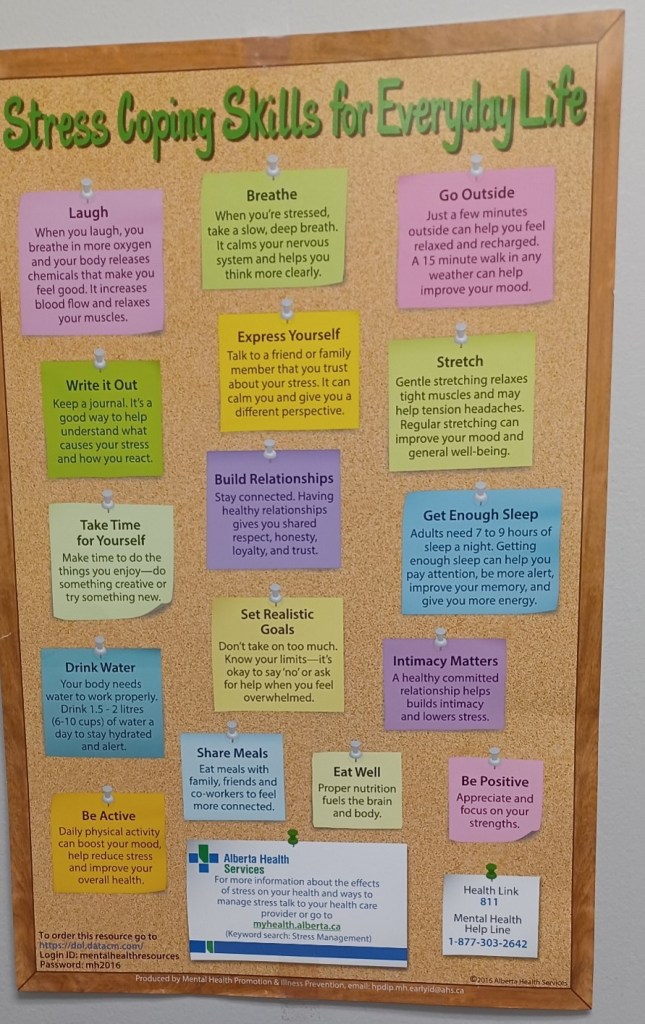
At a recent visit to the doctor I saw this poster on the wall: Stress Coping Skills for Everyday Life.

There are a number of great ideas to put into practice when we are experiencing stress. Some of them are physical exercises such as “go outside” or “stretch”. Others are mental exercises such as “be positive”. There are social exercises and suggestions for eating better and drinking enough water.

These might all be good ideas. They cover most aspects of a person’s life – social, physical, emotional, and mental. But I couldn’t help noticing that there was something missing. Where is the spiritual aspect?

As people who know God, we should recognize the value of going to God in our times of stress. In fact, if we have put our faith in Christ for salvation, then we have also received His Spirit that lives within us. He is God within us. He wants us to have life and have it to the full. (John 10:10)

Like the psalmist David, we can cry out to God in our times of need.

When my spirit grows faint within me,
    it is you who watch over my way.
(Psalm 142: 3)

 Lord, you are the God who saves me;
    day and night I cry out to you.
May my prayer come before you;
    turn your ear to my cry.

 I am overwhelmed with troubles
    and my life draws near to death.
(Psalm 88: 1-3)

Yes, there are many different things we can do to try to alleviate the feelings of stress, but why not call on God to help?

Call out to God for help. Pray. Spend time reading scripture. Allow God to speak. Meditate on passages of scripture or dwell on God’s attributes. Spend time in worship. Sing songs of praise. Listen to songs of praise. Ask God to calm your spirit and empower you by His Spirit to tackle the day with confidence.

When stressed, do what you can to trust God to walk you through it.

Keep looking up,

Andy Wiebe

Book Reviews: Andy’s 2023 Reading Experience

I will be sharing a brief review of every book I read this year. Hope you enjoy and hope it encourages you to keep reading.


LEADING WITH A LIMP – by Dan B. Allender, PhD.

Allender states this as his core assumption for the book: “To the degree you face and name and deal with your failures as a leader, to that same extent you will create an environment conducive to growing and retaining productive and committed colleagues.” If you try to hide your failures as a leader, you will need to be more controlling of others around you. He says that in God’s leadership model, “He calls us to brokenness, not performance; to relationships, not commotion; to grace, not success.” While leaders often feel compelled to show they know everything and are definitely the right people for the job, they would be better off admitting their weaknesses since  everybody else can see them anyway, and work more on a good relationship with people than just trying to get the most out of them for the task at hand. Allender offers this great quote as he talks about the difficulty of being a leader and casting vision. “One can speak of vision and mission, calling and opportunity until the cows come home, but when the day ends, most people want nothing more demanding than some television and a few uncomplicated laughs.” He speaks honestly of the hard work of being a leader while giving hope from God’s perspective. A great leadership book that makes one think.

Finish Well

The start of a new job if often full of excitement and energy and ideas.

However, near the end of the job, it can be quite different. Whether you decided to hand in your resignation letter or you come to the end of a contract like me, it can be hard to finish with the same excitement.

I am coming to the end of a contract with a church right now. And I am trying to figure out what has to be done in the last two months here. I want to finish well, and not just coast across the finish line. I have been asking myself, “What can I do in these last two months that will help set the church up for a great future?” With that question in mind, I have determined what needs to be in my plans for the next few weeks.

Regular Duties

While I know that I will be leaving this position soon, that is not an excuse to quit doing the regular duties that I have been assigned. For me, I have to continue to preach and be available for caring for people right to the end of my time in this position. It doesn’t matter how close to the end I am, I need to serve them with the same commitment I did earlier.

People

I want to make sure that any people responsibilities I have are fulfilled. This includes letting people know or reminding them that I will be leaving soon. This is especially important when it comes to people who will be taking on tasks that I have maintained. Working with them before I leave and giving them a few pointers of what worked well will set them up for success.

Projects

One of my projects right now is to help the church set up their Search Committee and create and share a job posting for a full time Lead Pastor. As I finish up my contract as a transition pastor, I am helping the Search Committee with the process of posting the position and starting the hiring process.

My situation is quite specific, but for those who are resigning or retiring you may similarly want to help your organization as they find someone to fill your role.

Team Duties

Often, we are part of a team or a group of people who share responsibilities. For example, I work with the Elders Board at my church. As I near the end of my contract, I will continue to lead the team well, helping them to flesh out the vision we worked on together. I will help them prepare for the arrival of a new pastor so that his start will be planned out and he will have the best chance of success going forward.

Take time to finish your job well. Leave in such a way so that people think of you fondly as they remember you later. Don’t burn bridges – you may end up working with these people again some day. I served one church as a Transition pastor that I had served over 20 years ago as their lead pastor. Finish well to keep doors open down the road.

And finish well as a person of good character. Continue to do what needs to be done even though you know you are leaving soon. Don’t just mail it in. Do what you are expected to do to fulfill your job right to the end.

It’s fun to start new positions, but make sure you leave well at the end too.

Keep looking up.

Andy Wiebe

3 Ideas to Renew Your Passion

A while back I realized that my passion for my job was fading. When I started the job, I was excited and could see new opportunities. I loved the vision and purpose of the group I was leading. I loved working with these people because of their heart for the church and their desire to grow in their relationship with Jesus.

There are times in my life as a pastor that I have had to renew and restore my passion for my role. I always want to give my best and be excited about what I am working on, but I realized that initial excitement had faded. So I decided I needed to work on renewing my passion for that role, and here is what I did.

Add Variety

One reason I tend to lose passion is because I get bored with routine. I long for some creativity and variety.

I add variety in my preaching. This is an area that I have control over, so may be one of the first places I can work at renewing my passion. For example, I might use a video or story to help people connect with the sermon. I might use an object lesson and provide those items to each person when they arrive at church. Beyond Sunday sermons, I might identify a project that I could initiate with others to help us work toward our vision.

Celebrate something.

Sometimes the boring monotony can be awakened to new passion when I take a moment to reflect on the exciting things happening. Good things are happening. God is at work. People are being changed. Programs are reaching people. People are responding to sermons and applying what they learn. When I get stuck in feelings of boredom, I can identify reasons to celebrate. I might celebrate by myself, or with my family, or my coworkers or church. It’s amazing what praising and thanking God can do in lift my spirits and reawakening that passion for my role.

Talk to God about it.

There are times I have taken a mini-retreat – maybe even just an afternoon away from my office – where I can stop everything and talk with God. I talk with Him about what is going on and how my passion is fading. I ask him to show me where I need to focus. I ask Him to give direction. Often this time with God reaffirms my calling, renews excitement in me about what God is doing and inviting me into. Sometimes I come away with new ideas, other times it is a re-enforcing of what I already knew I was to do. But the time with God reminds me of my role and what I need to be doing.

There is often an ebb and flow in the intensity of our passion for the work we are doing. Don’t let it fade too long. Choose to renew your passion again and again so that you will enjoy your role and will continue to contribute well to the vision you and your team or church are pursuing.

What are some ways you have renewed your passion? Let me know.

Keep looking up,

Andy

Make It Easy For People To Do What You Want

I was shocked when I attended church this Sunday. I get an occasional Sunday off so I get to take in a service at a church I am not leading. It was a great Sunday with good worship, and the commissioning of a new Lead Pastor. But one thing was missing: the offering. There was no offering received as part of the service. There may have been some information regarding giving on the slide announcements that were playing prior to the service, but I didn’t notice them. On the way out I did notice that there was a “giving station” on the wall. There may have been a few. I don’t know what you would do at the station but it must have been a way to give financially to the church.

Now, you may be wondering why I was shocked, and why I would make such a big deal about this. Here’s why.

First, I know that the church is struggling financially, and had to let a few staff members to in recent months because they couldn’t afford them.

Second, giving of our tithes and offerings to God and the work of his kingdom on earth is part of what following Jesus looks like. It is part of discipleship.

Third, if we want people to do something, we need to make it as easy as possible. Do you want to have your congregation learn how to give back to God, trusting Him to provide all their needs with the remaining money they still have? Then make it easy for them to do so.

We need to make it easy for people to do what we want them to do, whether we are leading an organization or leading a church. Whatever you want your team to do, make it clear and easy to do.

As we entered 2023, I encouraged our church to read the Bible, every day. In fact, I encouraged them to read the whole Bible this year. I printed four different Bible Reading Guides that followed different reading strategies from reading straight through the Bible from beginning to end or jumping around to different topics. I was hoping that at least one of these methods may appeal to people who had never read the whole Bible. Each Guide was a different color, and we included a lengthy description of each guide in the Sunday bulletin, with descriptions in the color of the Guide. I announced that these Guides were available, for four weeks in a row, continually reminding the congregation to choose their plan and begin reading. We placed the guides in a display at the information table everyone walks by every Sunday, making it easy to grab one on the way in to the service or on the way out. We did everything we could to make it as easy for people to choose a reading plan as possible.

As for the way we take up the offering, we do a few things to make it simple and clear how and why we do it. We have a clear step by step direction in the bulletin as to the various ways people can give, including online and in person in the service. We place offering envelopes on the chairs so when people come in for the service, not only is it easy to find an envelope to put their offering in, by prominently displaying these envelopes, it is a reminder that we value their financial gifts to the church. We always include a time in the service when we pass a basket and invite members to drop their financial gift in the basket as it goes by. Just before we pass the basket, we take a moment to talk about why we give and how we do it, thanking everyone for their faithful and willing giving. We pray, inviting God to bless the offering for His work. The whole process doesn’t take long, but it shows we value that part of discipleship and want to include it in our worship service.

As you consider an aspect of your organization or church where you want people to take a certain action, think about how to make it as simple as possible. Explain the purpose and instructions for the activity in multiple ways so it is accessible, and provide materials and time to complete the task. If you want people to fill in a certain form, begin by clearly explaining what is expected in an accessible medium. It may be a public announcement, an email, or text, or even a phone call. It may be a combination of these along with a clear statement explaining each step. Along with the direction, provide a designated time and deadline for completing the task. For example, if it is an evaluation of an event, give the participants time right after the event, or a few minutes the next office day after the event. Make sure that everyone has access to the correct form in a format that is as easy to access as possible – providing each person their own copy (and even a pen) is the most effective for ensuring they will complete it. Do whatever you can to make completing the desired task easy to do.

We all have expectations of our congregation or our team. Let’s do the work to make sure that it is as simple as possible for them to meet your expectations.

Keep looking up,

Andy Wiebe

Assumptions Lead to Problems

Last week I was preparing for Sunday’s service at church. We wanted to include communion as part of the service. I have only been at this church for a few weeks now, and I assumed things.

I assumed that their traditions around the celebration of communion would be similar to my experience. Here are my assumptions. I assumed that I could insert communion into the service where I felt it fit best. I was planning for a two-part sermon and decided communion would work really well as a practical expression of the first part. Next, I assumed that communion would be set up with cups of juice in trays and bread on plates. I assumed that would mean we needed a table at the front for the elements to sit until we were ready to move into the ceremony of communion. Then, I assumed that we would be serving everyone. That lead to a few more assumptions. I assumed we then needed to have 4 people prepared to pass the trays down the rows to cover the two sections of chairs we had set up, so I asked four of the elders if they could help serve. Along with the serving, I then assumed that since we were serving the bread and then the juice, we could use someone to play some music while everyone was being served, so I asked my wife to be prepared to play a few songs on the piano. Since I assumed we were serving everyone, I thought my sermon would be longer because we had to give time to serve everyone which would draw things out a bit.

My assumptions were not correct. First, in talking to my wife, she mentioned that she had seen a supply of cups and wafers that were one sealed unit. So then I assumed we will only be serving them once, so that shortens up the time a bit. Then, in conversation with one of the Elders, he mentioned that they had just been handing the elements to people as they entered the sanctuary.

So we will not be serving them at all, okay. They will already have the bread and juice with them for when they were needed. And that meant that we didn’t need anyone to actually serve the congregation.

Well, someone still had to hand them out as people came in for the service. Another assumption was that the piano could be used and I was informed it desperately needed tuning and was not ready to play. I had to tell my wife that her playing was not needed.

Assumptions.

We often make assumptions, especially when we are in a new situation. I am new to this church and had not bothered to ask anyone about how they practiced communion. I could have saved myself some trouble by just asking a few appropriate questions.

So, how can we deal with assumptions in new situations?

  • Realize we don’t know what we don’t know.

When we are in a new situation, we assume that we can approach it the same way we have approached similar situations in the past. We need to realize that every new situation requires new information for us to know how to proceed in a meaningful way.

  • Watch and listen

We can learn a lot in a new situation if we slow down and carefully observe what is going on. Before jumping into action, watch what others around you are doing, even how they are doing things. Listen to the conversation. What do they talk about? What can you learn from what they are saying that will help you know how to move ahead?

  • Ask questions

I am serving as a Transition Pastor. That means I go into a church for a period of a year or so before I move on to a new assignment. Every new church I serve is a new experience for me. Yes, I have years of experience being a pastor, but I have not been a pastor for this church at this time. Even in the last church I served, I had been a pastor there years ago, but people and practices had changed. I did not know how things were done now.

So, I ask a lot of questions. I want to know what their traditions are and how they would like to see things done. I try to figure out who they are talking about when they mention a name.

I try to get a sense of the inter-personal dynamics in the relationships of the people I am working with. I want to know the history so I can get a true sense of the present.

  • Admit you are a newbie

It’s okay to remind people that you are new here, acknowledge that this is a new situation and you may mess up. As I greet people on Sundays, I admit I am new there and don’t know if they are long-term members or guests. As we talk about programs or practices, I remind people I am new and don’t know all the history. I regularly ask people to give me some background and detail on programs or practices so I can get a sense of what they are talking about.

  • Ask for a guide

Sometimes it is helpful to ask for someone to be your guide. It’s good to find who is familiar with the situation so they can help you navigate around potential missteps. If you can find someone like this, make use of their knowledge.

Assumptions can lead to problems, but you may avoid those problems by trying some of the tips above.

I would love to hear how you have handled new situations. Leave a comment about how something went really well or really bad.

Keep looking up,

Andy Wiebe

Book Reviews: Andy’s 2022 Reading Experience

I will be sharing a brief review of every book I read this year. Hope you enjoy and hope it encourages you to keep reading.


LEADING IN A CULTURE OF CHANGE – by Michael Fullan

This book is an older book but the principles are still helpful today, and maybe even more needed than back in 2001. Change is happening quickly around us, and many are suggesting they have answers. Often those requiring change to happen, look for a charismatic strong leader or a program that has worked somewhere else. Michael Fullan suggests, I believe correctly, that we need to realize that no one program is the answer to every situation. He also says that the change a charismatic leader brings may only last as long as he is leader. So Fullan suggests that change needs to be worked at slowly, with many of the people impacted participating in the transformation. As well, instead of using a cookie cutter approach, look for what might be appropriate to use at certain locations and at certain time periods of the change. He concludes the book like this: “Ultimately, your leadership in a culture of change will be judged effective or ineffective not by who you are as a leader but by what leadership you produce in others.”

Book Reviews: Andy’s 2022 Reading Experience

I will be sharing a brief review of every book I read this year. Hope you enjoy and hope it encourages you to keep reading.


HOPE IN THE DARK – by Craig Groeschel

Hope in the Dark: Believing God is Good When Life is Not addresses those questions we have when life is not going as well as we think it should. Craig Groeschel asks many of the questions that we have all asked from time to time, questions like: “Where are you God?” and “Why aren’t you doing something?” He draws on the book of Habakkuk where the prophet asks some of the same questions. Let me give you one quote that I thought was very helpful. He writes, “Habakkuk urges us to draw on our long-term memories of God rather than being so shortsighted that we choose to keep replaying only our immediate, distressing circumstances.” That is so good! As we take our eyes off of our present situation we can remind ourselves of God’s goodness in the past and know that that same God is still walking with us in the difficulties we face. This is a very encouraging book for anyone asking the questions about where God is in our pain.

Do You Really See Your Team?

We are quick to make judgements about people. Our first impressions can be completely wrong but we hold onto them anyway. Other times, the we may have known someone for a long time but do not realize they are not the same person they were years ago. For someone in a leadership role, there is a particular danger of viewing people one way and not realizing who they truly are and how they can be of help in our organization.

King Solomon, in Ecclesiastes, describes some of the unfortunate ways that people see others.

13 Here is another bit of wisdom that has impressed me as I have watched the way our world works. 14 There was a small town with only a few people, and a great king came with his army and besieged it. 15 A poor, wise man knew how to save the town, and so it was rescued. But afterward no one thought to thank him. 16 So even though wisdom is better than strength, those who are wise will be despised if they are poor. What they say will not be appreciated for long. (Ecclesiastes 9: 13-16, NLT)

These people greatly benefited from the wisdom of a poor person. They appreciated the rescue but did not appreciate the person. We are like these townspeople: quick to write people off, even if they have valuable gifts and insights. We see them a certain way and do not allow that to change as we begin to get to know them and what they offer.

Because of this oversight, we – and by extension our teams and organizations – may lose out on valuable skills and insight just because we have identified a person in one way so we do not think they have anything to add.

King Solomon continues:

There is another evil I have seen under the sun. Kings and rulers make a grave mistake when they give great authority to foolish people and low positions to people of proven worth. I have even seen servants riding horseback like princes—and princes walking like servants! (Ecclesiastes 10: 5-7, NLT)

Our quick judgements can create further damage when we choose to promote or demote the wrong people. This can be due to existing relationships or the desire to honour certain people. The unfortunate result is that we listen to the advice of the wrong person when there is someone much wiser nearby.

Most of us work with teams and volunteers in some way at some point in our life. This is especially true in ministry, when programs and services rely on staff and volunteers.

Get to know these staff and volunteers. This could be through personality tests, or at a minimum, putting in the effort to get to know each person well enough to see how they can contribute best. Intentionally take time with this in order to avoid making quick assumptions or writing someone off because of one or two missteps. Often the best outcome happens when people are in roles that suit them best, and it often takes time to identify these roles and responsibilities.

As you work with your teams and notice people are in the wrong roles, be brave enough to reorganize and reassign individuals to roles where they will excel and your team will be better in the long run.

I love to get things done, but I have realized that there are times where I am better off taking time to get to know people first. As we get to know each other, I will learn where someone can serve and give their best, and we will be able to communicate better because I know them and they know me.

Good organizations will have a regular system of evaluating people. The leader does a formal review every six months or a year to continue to help the person get better. In the evaluation, the leader can also discern if this person is still a fit here or would fit better in a different role. A system of regular evaluation is good, but the personal relationships are even better. As you develop good relationships with your key people, they will be brave enough to approach you when they want to learn or grow in a certain area or if they would like to try a different role. If open communication is valued and practiced, you will be more likely to continually give the right responsibilities to the right people.

So much of what we do in life involves working with people. Let’s figure out how to help our teams be the best by putting the right people in the right seats where everyone can contribute their best.

Get to know your people first, then get the work done.

Keep looking up,

Andy Wiebe

9 Reasons To Not Quit Today

Have you heard about the “Great Resignation?” Many people are quitting their jobs. So many in the recent months that it has been given the name: the Great Resignation. While this trend mainly focuses on the private sector, it has been felt within the churches, too. There are many churches currently hiring pastors because pastors have quit and are not in a hurry to take on another pastoral position.

I would like to give you nine reasons not to quit today.

1. You have been called by God.

If you are a pastor, you have been called to this role. Do not let the frustrations of covid and the hard work of ministry make you leave your calling.

2. Your church needs you.

No matter how long you have walked with your congregation, you know them better than any other pastor. They know you better than any other pastor. They may be walking through similar frustrations in life and need someone like you to remind them that God is walking with them, just as he is with you.

3. Your community needs you.

I hope you have invested in your community to the point that people know you and you know the people. They need someone like you to introduce them to Jesus. They need you to lead your congregation to continue to pour God’s love into the community. The new pastor does not have the relationships you have already built in the community.

4. The grass is not greener elsewhere.

If you were to leave your church and go to another one, you will most likely encounter people with many of the same life issues and problems. People are the same everywhere.

5. There are people watching you.

If you are a leader, you are being watched by others. They are looking to you to see how you handle the frustrations of life. You can show them how to persevere through difficult times. You can show them how to find encouragement from others.

6. Your present pain may be future gain.

It is often in the painful moments of life that our faith in God deepens and our relationship with God matures. The hard times offer us forks in the road of life. Will you choose the path to a deeper relationship with God or the path that gives you an easier life?

7. A sabbatical may be the answer.

There are times when we do need a break, a time for rest and recovery. In the same way that our body needs rest after a hard day’s work, there are times we need to have a break from the hectic pace of life. Don’t quit, but ask for a sabbatical to rejuvenate for the next part of your journey with your church.

8. Take advantage of help that is available.

Too often leaders try to lead alone. Pastors, don’t be a Lone Ranger. If you are part of a denomination, there is likely support available. There may be other pastors who are willing to walk the journey with you. Maybe you could seek out some encouragers you trust. Find a counselor who can help you find tools to manage the emotions of your ministry.

9. Spend time with God.

Even if you can’t take a sabbatical, take some time every day to pour your heart out to God. Ask him for insight and wisdom to lead well. Read the Bible and hear from God. Read about other leaders in the Bible who struggled and kept on going. Spend time in the Psalms, and Laments, and ask God to help you join in with the writers who declare that they will trust in God no matter what.

Keep looking up, and keep on going,

Andy Wiebe

P.S. Watch for next week’s article on reasons TO quit.