Guard Your Reputation!

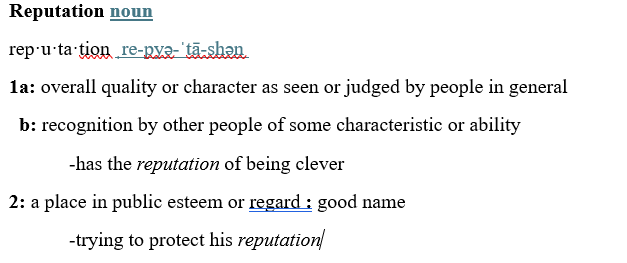
What people think about you because of what they have observed about you makes a difference as to whether people will want to spend time with you or even listen to what you say.

People are always observing you and your actions, and when they do, they instantly make assessments about who you are and what you are like. As people see you act you gain a reputation. It may be a good one, it may be a negative one. The only way you can gain a good reputation is by being careful about how you act and how you treat people.

Reputation is not about being a people pleaser. This is not about trying to gain the favour of all people by only doing what you think others expect. It is about knowing who you are and what you stand for, and then consistently living that out. But your reputation is also about more than yourself, especially if you are a follower of Christ.

In 1 Timothy 3:7, the apostle Paul describes the attributes of church leaders:  

He must also have a good reputation with outsiders, so that he will not fall into disgrace and into the devil’s trap.

One of the characteristics of a church leader is to have a good reputation “with outsiders.” This is not just about a good reputation with other believers in your church, but also with those who do not yet know Jesus. Thus characteristic does not just apply to church leaders; churches, too, must be filled with people who have good reputations because this is where leaders are developed.     

The word translated “reputation” in 1 Timothy 3:7 could also be translated as “testimony.” So the church leader, or Christians in general, should have a good testimony. This means that their life and words should match up. What they believe and stand for should be evident in how they live their lives and how they interact with believers and unbelievers.

Why? 1 Timothy 3:7 indicates that a good reputation may help a person avoid “falling into disgrace and into the devil’s trap”. A bad reputation may bring personal disgrace, – as well as bring disgrace on the church you are part of and on the Christ you say you believe in. An inconsistent walk could lead a church leader into the devil’s trap where they are no longer living a good testimony and reflecting well on Christ. The bad reputation is then earned by not consistently honoring Jesus with our life. The devil would like nothing better than to make Jesus Christ or his followers look bad.

Guard your reputation, not just so you look good, but to help make Jesus look good! Make sure your belief in Jesus matches the way you do life and conduct your business. You do not want your reputation to cause others to lose interest in Jesus. Live a consistently God-honoring life!

Keep looking up,

Andy Wiebe

The Fun of Getting to Know People

The church is people. Being a church leader and pastor means being a leader of people. Every leader needs to recognize the value of getting to know the people they lead in a personal way. I enjoy getting to know people because as you get to know people you find out what they are passionate about and how they contribute to their community. Many people have unique skills they are using to help others that you wouldn’t know unless you get to know them.

Personal Connections

Some of the fun of getting to know people is finding you share common friends or have similar origins. When I meet someone for the first time, if I learn that we know the same people or are familiar with the same places, it immediately gives us something to talk about even though we just met.

Unique Skills

Last night, over supper with friends, I learned that the one friend translates children’s songs from English or Spanish into Low German. There are not many Low German children’s songs so she finds good songs in other languages, translates them to Low German as best she can, records herself singing them, and uploads the recording and song for Low German speaking parents to use for their children. I think that is fantastic! I would never have known about her unique contribution to other parents if I had not had opportunity to be in a conversation with her.

Personal Pain

I recently had a conversation with a young couple who are hurting because of an illness in their family. They have had to go through many difficult adjustments as they deal with a family member who lost their memory and the ability to function on their own. As a pastor, hearing the pain in their voices as they shared the story gives me a fuller picture of the realities of their life and and how they are trying to manage life. This informed perspective will also help me be a bit more forgiving when he doesn’t make it to every board meeting because he has unexpected responsibilities to deal with at home. Gaining a fuller understanding of people on our team and people we serve reminds us to view people as humans with complicated lives.

Passions

As we get to know people, we get to know what makes them tick, and what they are passionate about. Some are passionate about people, others about projects. Many people have certain values that they regard with extra importance. For example, knowing which people are passionate about youth or the poor can guide you when recruiting volunteers for youth or the food bank ministries.

Potential Friends

Some people warn pastors not to become friends with people in their church. Others say pastors need to be friends with everyone. Pastors need friends too, and as they get to know people they discover new friends. Its natural that we become better friends with some people in the church than others, so don’t be afraid to get to know people as friends.

I encourage every pastor and church leader to go out of their way to get to know the people they lead. You will gain personally, as will your church, if you get to know them.

Keep looking up,

Andy Wiebe

Invite Books to Mentor You

Every leader benefits from reading regularly. Even those who do not enjoy reading can benefit from disciplining themselves to read. The authors we read become our mentors. We can benefit from being mentored by those whom we may never meet and who do not know us personally, but who pour into our lives through their written words. Many of us do not have access to pastoral mentors; these authors can become that for us.

As you read, you will find certain authors that you connect with or who seem to speak into your context in a way that you find helpful. There are certain authors I have read at different times depending on the situations I was working in or issues I was facing. Choosing a book allows you the opportunity to tailor your mentoring experience to your specific needs.

Let me share four authors and some of their books I have personally benefited from.

Nelson Searcy is the – founder and lead pastor of The Journey Church in New York and author of a many church leadership books. Many of Searcy’s books are about a specific system that he has developed in his church. I found many of the principles to be adaptable to my situation even in a smaller rural church.

A few of his books that I have benefited from are:

  • Fusion: Turning First-Time Guests into Fully – Engaged Members of Your Church
  • Activate: An Entirely New Approach to Small Groups
  • The Generosity Ladder: Your Next Step to Financial Peace
  • Maximize: How To Develop Extravagant Givers In Your Church

Andy Stanley is the – founder and lead pastor of North Point Community Church in Alpharetta, Georgia and author of many books, mostly about church leadership. I especially appreciated his teaching on preaching and vision setting.

A few of his books I have benefited from are:

  • Deep and Wide: Creating Churches Unchurched People Love to Attend
  • Communicating for a Change: Seven Keys to Irresistible Communication
  • Visioneering: God’s Blueprint for Developing and Maintaining Personal Vision
  • Seven Practices of Effective Ministry

Preston Sprinkle is an – author, speaker, and teacher. I have especially appreciated his books addressing gender and same sex attraction, as well as other issues of today.

Here are a few of his books that have helped me understand the discussion around these issues better:

  • Embodied: Transgender Identities, the Church, and What the Bible Has to Say
  • People to Be Loved: Why Homosexuality Is Not Just an Issue
  • Go: Returning Discipleship to the Front Lines of Faith
  • Fight: A Christian Case for Non-Violence

Thom Rainer –  is a writer, researcher, speaker, and founder of Church Answers, a website where many pastors connect and learn together about church ministry and the life of a pastor. His books are usually short but filled with practical advice about the church.

Here are a few of his books I have enjoyed:

  • Becoming a Welcoming Church
  • I Will: Nine Traits of the Outwardly Focused Christian
  • Who Moved My Pulpit?: Leading Change in the Church
  • Unchurched Next Door

I read a lot, but these are a couple of authors I have read often and enjoyed how they spoke into my life and ministry.

Invite leaders to mentor you as you read their books. Learn from their experience and expertise. Look for a couple of nuggets that apply directly to you as you read. And keep on learning.

Keep looking up,

Andy Wiebe

The Joy of Connecting with Teammates.

I had the privilege this past week of spending a day with others who have a similar role as I do. We don’t actually work together on the same projects or in the same church, but we are all part of the same denomination functioning in the role of transition pastors. There is a special joy in connecting with people who know your role and the situations you face because they face those situations, too. In the past, I was able to connect with fellow rural pastors and pastors in the same region. We may not all serve the same church, but we can connect and relate to shared experiences because of our similar roles.

It may feel like getting to know and spend time with these teammates takes too much time or effort that could be used for other priorities, but I have personally found value in connecting with others who understand my roles.

They understand the frustrations and joys.

    When I met with rural pastors as a rural pastor, I knew that they understood what small-town life was like. They understood the realities of serving a smaller church. When I meet with transition pastors, they know what it is like to face church conflict and to try to mediate it. Transition pastors know what it is like to help churches, to fall in love with them, and then have to move on to a new assignment in a year or two.

    When you are talking with others who know your role, you can share jokes and stories that they understand. They are “in the know” because they do the same things you do. Other transition pastors know the frustration of churches that do not want to change, even though they know they need to. They understand the joy of a board catching God’s vision together as they plan vision and strategy for the church.

    They can provide ideas and advice.

    When I meet with transition pastors, I know they use similar tools and processes as I do in helping churches transition. Transition pastors know what it is like to help churches build on the past to look to the future. One of the benefits of my recent meeting with other transition pastors is to learn about how they handle particular situations. Most of them have more experience in this role than I do so I love to soak up ideas as they talk about their ministry.

    They can pray for me with understanding and clarity.

    One of the joys of meeting with others in similar roles is that we can pray for each other with an understanding of the situations we face. Often we don’t even have to finish our story and the others are already smiling or nodding or even crying as they have gone through similar situations. They can pray for me, and I pray for them, with clarity because we have seen very similar situations where we have served.

    I encourage you to find others who are in a similar situation as you. You need to find “your people” so you can have people around to encourage you and help guide you as you need input and wisdom from them.

    Keep looking up,

    Andy Wiebe

    Reconciliation or a Bumpy Rug?

    The other day, I was speaking with someone who mentioned a “bumpy rug.” She was referring to the practice of ignoring problems and “sweeping them under the rug.” Another similar comment I heard recently was, “Let’s just get this behind us as soon as possible.” In both cases, people were dealing with sin in families and organizations. Both cases reflected a desire to move past the sin and the hurt it caused others as quickly as possible without a desire to actually address the sin and correct it.

    Very few people enjoy conflict. The average person will go out of their way to avoid it. It is not fun when others are mad at you, even if you are doing the right thing. Our desire to get along and please people means that we will try to move past problems without confronting the issue and dealing with it.

    We need to learn to work through the personal pain of a conflict to pursue correction, forgiveness, and reconciliation. We need to see the value of restored relationships both with God and with each other. We need to see the importance of repentance and forgiveness to help people truly get past a problem brought on by sin. We need to see the importance of pointing out sin that is affecting others in the family and in the church.

    We forget that Jesus gave clear direction on how to handle sin with a Christian brother or sister in Matthew 18: 15-17.

    “If your brother or sister sins, go and point out their fault, just between the two of you. If they listen to you, you have won them over. But if they will not listen, take one or two others along, so that ‘every matter may be established by the testimony of two or three witnesses.’ If they still refuse to listen, tell it to the church; and if they refuse to listen even to the church, treat them as you would a pagan or a tax collector.

    Jesus does not advise getting past sin quickly, and definitely does not suggest sweeping it under the rug. Jesus suggest confrontation. He gives some steps. First, go by yourself to the person you know has sinned and point out their sin. Do not tell others about it. Do not take a party with you. Go by yourself.

    The second and third steps are only taken if the first did not resolve the situation. So, second, if the sinner does not respond with repentance then take one or two others with you to confirm you are not just making a personal judgement. With two or three others, you can determine if the person really has sin they need to deal with.

    Third, if the first two steps do not resolve the issue, then tell it to the church. The hope is that the church will push for what is right and stand for truth and righteousness rather than sweep it under the rug. Too many churches prefer the bumpy rug to the pain of confronting and dealing with a sinning brother or sister.

    There is one last step. If the person does not listen and does not correct their ways, treat them as someone who is no longer part of the church. This is a very difficult step for any church to take, yet Jesus teaches this so we know there must be times when his teaching should be applied.

    We need to remove the persistent sinner from any leadership in the church yet continue to love them and pray for them and look for opportunities to draw them back to Jesus.

    Jesus did not write off tax collectors and pagans but invited them to follow him. He even called Matthew, the tax collector, to be one of his disciples. Jesus treated pagans and tax collectors as potential disciples, if only they would leave their sin behind. Even as we can’t allow the persistent sinner a place of leadership in the church, we continue to point them to Jesus, with the hope that they will repent and surrender their hearts to Jesus again.

    Let’s choose to pursue reconciliation, not allow more bumps under the rug!

    Keep looking up,

    Andy Wiebe

    Continually Collect More Tools of the Trade

    If you have ever worked on a car or built a deck, you know the value of a good tool. With the right tool the work becomes easier and you see better results. The same is true for a pastor. We benefit from having good tools to help us.

    Some of you may immediately think of tools like a good commentary or online study tools. These are great and we need those, but I’m thinking more along the lines of the ideas and questions we come across in our reading and study.

    Sermon Tools

    Over the years I have gathered many questions that I use regularly to help me better dig into the scripture I am preparing to preach. Referring to my pates of collected questions and processes has enhanced my sermon preparation. These are questions like:

    1. What does it say?
    2. What does it not say?
    3. Could it mean what it says?

    Sometimes I move through these three questions quickly, other times, if it is a difficult or controversial section of scripture, I tend to slow down and make sure these questions help clarify what God’s Word is truly saying.

    One question that I have found helpful to me, especially because I am usually preaching to a congregation of all ages is:

    4. “How will this sermon engage with a 12 – year – old boy?”

    I want to preach to everyone, but if I can get a pre-teen boy to be engaged, I will most likely I will engage with the rest of the congregation as well.

    Here are a sample of a few more questions:

    1. How does this speak to unbelievers?
    2. What is the audience’s thoughts, feelings, emotions, struggles, needs – relating to the big idea of this teaching segment or message?
    3. What are some practical steps the listener can take?

    One process I use is a diagram that helps me to move through a scripture passage in a way that moves my study from the text, to historical context, through the Biblical theology, to how it is fulfilled in Christ, and then to how we need to apply the scripture today. Following this process keeps me from taking a shortcut and miss an important step in clearly understanding what the scripture text is saying.

    Prayer Tools

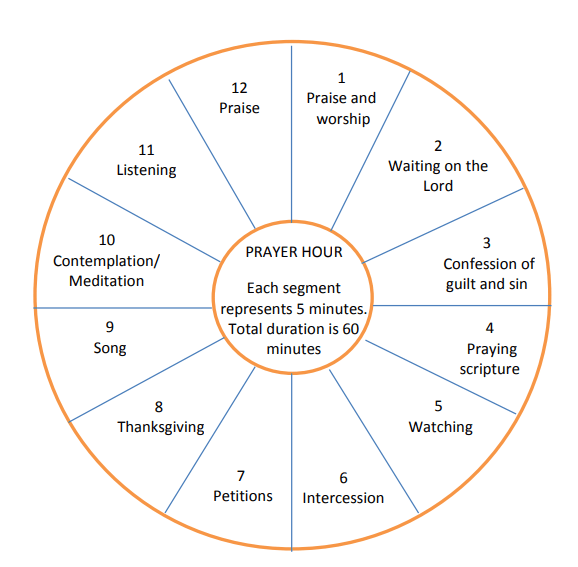
    I have come across some great ideas for prayer, whether personal or corporate. In his book, The Hour that Changes the World, Dick Eastman suggests praying for an hour i12 periods of 5 minutes. I try to use this prayer plan about twice a week. The forms of prayer are: 1. Praise and worship 2. Waiting on the Lord 3. Confession 4. Praying scripture 5. Watching 6. Intercession 7. Petitions 8. Thanksgiving 9. Song 10. Meditation 11. Listening 12. Praise

    I have used this one-hour prayer plan many times for myself as well as for a prayer group.

    Pastoral Tools

    One of the “tools” I need to remind myself of occasionally is to “move slowly through the crowd.” It is easy for me to have things on my mind and things to do, but there is benefit of moving slowly through the crowd prior to or after the Sunday morning service because it gives me opportunities to connect with people, or for them to stop me with a question or comment. It helps me to be more present in the moment and available to people.

    I don’t know what tools you have gathered over the years that have helped equip you to improve your ministry and leadership, but I hope you have many. I would love to hear from you about the tools that help you. Send me an email to share some of your tools with me.

    Keep looking up,

    Andy Wiebe

    5 Ways to Personally Leverage Slow Seasons

    Most churches experience seasons in their ministry. There are times that are slow, times that are steady, and times that are extremely busy. Summer is often a slow season for many churches. The church I’m serving right now has Vacation Bible School at the beginning of July, and then only a monthly prayer meeting and Sunday morning services for the rest of July and August. How can we use the slow times in a beneficial way?

    1.  Slow down yourself.

    Maybe you can adjust your vacation time to have shorter days in the office and spend extra time with your family. Maybe you can take an extra day off to enjoy a long weekend doing something fun with your kids. Or just take some time to focus on a personal hobby. Allow yourself time to slow down a bit. I’m not sure that taking vacation in the summer is the best plan. Sometimes we need to save that break for in the middle or just after a busy season. Enjoy the time at home with your family without a bunch of commitments for you or them, to distract you from each other.

    2. Take a personal retreat.

      Maybe you can go camping by yourself or go to a local retreat center for a day or two to spend time with God. Talk with God about what has been happening in the last year and ask God for direction for what is next. I have benefited from even a half day retreat out of the office to just spend time with God.

      You might want to ask God to help you plan your next preaching year. Pray through what God is asking you to preach on. Start by choosing which books of the Bible to preach on, or consider if there is a topic that your church needs to address scripturally. Do a rough summary of the texts that you identify and how many sermons you might need to fully preach through the topic or book so you can start plotting them on a calendar for the year ahead. These opportunities to plan a preaching year have been of great benefit to me when I have been in the middle of busy seasons. It has been very helpful to have a plan in place already.

      3. Read a book or two.

      I have been greatly encouraged through reading good books. You probably have a list of books, maybe even a pile of books, that you have been meaning to read. This is the time. Or maybe there is a topic you would like to know more about. Maybe there are certain trends or cultural issues that are affecting your church and ministry.

      Look for a book that addresses that issue. Ask around for recommendations from others for a book that speaks to your church’s needs. I recently enjoyed some great books by Preston Sprinkle on issues of sexuality and gender.

      4. Connect with friends.

      Summer may be a time to connect with leaders or members in your church, but it may also be a time to connect with friends who are not involved your ministry. It may be a pastor down the road, or a friend in another part of the country. Good friends can be very encouraging and may be worth a trip to meet up with. Do a road trip with your family that includes the opportunity to connect face to face with your friend.

      5. Enjoy nature.

      Our slow time for many is summer. Summer is a great time to enjoy God’s creation. Go for a walk with your spouse. Go camping if that is your thing. Take a day trip to nearby waterfalls or into the mountains. Enjoy a picnic by a lake. Maybe catch a fish and fry it up for supper. Allow yourself to breathe some fresh air and slow down in God’s creation.

      We all have busy times. Sometimes we feel like we are running to just keep up. So take the time to slow down during the slow times. Your health will benefit, and so will your relationship with your spouse, with your family, and with God.

      Keep looking up,

      Andy Wiebe

      Responding To An Audience That Doesn’t Like Your Sermon

      What do you do when you receive negative feedback on a sermon?

      First, do not feel personally attacked. It may be that the sermon was clear and accurate to scripture but the hearer didn’t like what God’s Word was saying. When I hear a negative reaction to a sermon – or to even decisions I make – I ask myself some questions to clarify the situation. Was I at fault? Or is the negative reaction in response to scripture says?

      Is it true and accurate to scripture?

      As preachers of God’s word, we need to be careful to say what scripture says. We need to be careful that we don’t misrepresent what God is says or misuse scripture to make it say what we want it to say. This means doing good research and study to ensure you are clear on what scripture says.

      Did I present it correctly?

      As we preach what scripture says, we also need to make sure we present this truth correctly. This could be ensuring we do not omit sections or aspects of scripture that we disagree with or do not like. We also need to remind ourselves that all of scripture speaks into the sermon of the day. Is there another side to the issue? Are there other scriptures that give a fuller view? Is there another scripture that needs to be referenced in order to give a complete picture of what is taught?

      Did I explain the situation it was addressing?

      There are times when it is helpful to give the background to the context of the scripture we are preaching on. It can help the listener first understand the message correctly, and secondly, figure out how to apply it to his or her own situations correctly. The historical background can give some meaning to why the author is addressing what he is addressing.

      Was I wrong?

      I ask myself this question sometimes because I want to make sure that I did not say something that was wrong or even hurtful. Yes, I need to present scripture accurately in a sermon, but I can choose what I say about it, or how I say it. If I did say something wrong, then I need to admit it. If I misrepresented God’s Word then I need to correct it.

      Is a follow-up or clarification needed?

      One sermon I preached brought a lot of response from the church members. Some who responded to me were thankful that I had said what I said. The sermon clarified something that they had been wondering about. The same sermon also brought responses from some who were pushing back against what I said. They did not like how I had interpreted what the verses said. Others were wondering how what I said fit with the rest of scripture. I began to realize, from both the negative and positive responses, that this was a topic that needed some more clarification. I decided to use the next Sunday to spend more time on the same scripture and the same topic, digging in a little deeper to explain how this fit with the rest of scripture and how I had come up with the interpretation and application of the verses that I did.

      I was serving this church as a Transition Pastor, so it was a great opportunity to remind the church that their next Lead Pastor may occasionally teach something they disagree with and understand scripture differently than what each member personally thought. I tried to use this situation to encourage the church that their new pastor would likely have different opinions on some things and that was okay.

      As preachers, we will occasionally say things that our audience doesn’t like. If their push back is against what God’s Word says, then it is an issue between them and God. If it is about something I said, then I need to make sure I was saying what was correct, and if not, apologize and correct myself.

      Preaching God’s Word is a privilege. We want to handle it correctly.

      Keep looking up,

      Andy Wiebe

      Preaching With Boldness

      All Scripture is God-breathed and is useful for teaching, rebuking, correcting and training in righteousness, so that the servant of God may be thoroughly equipped for every good work.

      2 Timothy 3: 16-17

      Recently, I began a sermon with this statement: “I am going to talk to you about something this morning, that is very hard for us.”

      I was preaching through 1 Peter. This morning we were looking at 1 Peter 2: 13 – 3: 7, which is all about submission. Not submission to God, but submitting to governing authorities, to masters, to husbands and wives. This is not a topic I would have chosen to preach about, except that it was in the middle of the book of the Bible that I was preaching through. Submitting to the government is not a popular topic among many church people, yet that was exactly what God’s Word was talking to us about in that scripture. Because it was God’s Word, and not my own ideas, I could preach it with confidence.

      If 2 Timothy 3: 16-17 above is right, then we know that there will be scriptures that rebuke and correct, not just encourage us or make us feel good. When the preacher makes sure to preach what God’s Word says, then the preacher can speak with confidence and boldness.

      I remember a person commenting after a sermon I preached that they thought I was brave to preach what I did. It actually surprised me a bit. I had preached on money, teaching what scripture said. I didn’t consider it brave. I was just preaching what God said, but this comment revealed the reality that there are certain scriptural truths that people do not want to hear. There will be people who are upset with you when you preach biblical sermons that challenge their personal beliefs, or even the beliefs and practices of their church.

      Scripture occasionally points out where we come up short and need to make corrections. As a preacher, I can preach boldly as long as I clearly say what scripture says. It is God’s Word. If the Bible says it, God says it. I should have no problem teaching it with confidence.

      At the same time, we need to preach with gentleness. When we teach about how God created people male and female, and only male and female with no other options, we can teach with gentleness in light of those who are personally struggling with this or have family who are.

      We can preach about money and giving to the church, but also recognize that some are struggling to make ends meet.

      We can preach on the importance of forgiveness even as we recognize that some people have been hurt deeply and personally in a way that is hard to move on from.

      God calls us preachers to preach the whole truth of His Word. We cannot pick and choose only the things that people want to hear. This is one of the benefits of preaching through a book of the Bible. We come across passages that we might not have chosen to preach about.

      If we are careful to preach what scripture says we can preach with confidence. We don’t need to be embarrassed to preach counter-cultural truths. We don’t need to be afraid that people won’t want to hear what the scripture says.

      If we are preaching something that scripture never said, then we better hesitate to say it. Yet we can preach with confidence when we know that we are saying what God said. Let’s continue to declare God’s truth with clarity and confidence.

      Keep looking up,

      Andy Wiebe

      A Good Team Produces Good Work

      Two are better than one,
          because they have a good return for their labor:
       If either of them falls down,
          one can help the other up.
      But pity anyone who falls
          and has no one to help them up.

      Ecclesiastes 4: 9-10

      As a pastor, much of my work is a solitary effort. I work on my sermon on my own. While I consult resources such as commentaries and word studies, I am responsible for creating the sermon myself. When I teach a Sunday School class, I generally work on it on my own. I am co-teaching a class on Acts right now. Though we spend some time discussing the scriptures together, we take turns preparing the lessons on our own. When I teach and lead, I build on all I have read and seminars I have attended, learning from the authors and presenters. Yet much of my job as a pastor I do on my own.

      This last week I was reminded of the value of working with a team. Our church is in the middle of a Three-Week Prayer Focus. We will conclude with a Solemn Assembly on a Saturday, a Prayer Vigil where people will sign up to pray for an hour or more through the night, and then a Celebration Service on the Sunday morning. This has become a much better event than I first envisioned because others have helped think through how to make it the best event it can be.

      When I presented the idea to the chairman of the church board, he instantly saw my vision and began to dream with me as to what we should plan and how to roll it out to the congregation. As we, together, dreamed about how the event might work for our church, we got more and more excited. We could see how to invite people to participate and even how to get them to step into some new experiences of prayer in the process. I had not thought of a prayer vigil through the night, but he suggested it.

      This chairman suggested we shoot a promo video with interviews of people from our congregation telling us what they thought of prayer. He knew of someone who could create the video. He asked someone to round up people to participate, and several people did, resulting in a very effective promotional video.

      He suggested that we make some promotional posters. Again, he knew of someone who would do a good job with this. Now we have some great posters for the event, and even a prayer guide for the event that people are now using to guide their prayer times. Other board members were willing to sign up to help coordinate and lead the prayer vigil. They have also volunteered to make announcements and lead group prayer times.

      If I had only depended on my own dreams and skills, we would still have had an event, but it would not have become the great experience it now is. I needed the Board Chair, the other board members, the promotional materials designer, and video producer to make the event that much better.

      We need others to team up with if we want to do a good job on many things. Inviting others into the process makes it better because we get to dream with others and bounce ideas off each other that make the result that much better. Working together ensures no one is left carrying the load, and everyone can use their skills and abilities to expand the capabilities of the leader. Sharing the work with others prevents your project from being a lonely experience; instead, the process becomes a shared collaboration with others who have the same convictions and ideas.

      I hope you have a good team around you. If not, then I pray that God will help you to find the right people to join your team.

      Keep looking up,

      Andy Wiebe