I will be sharing a brief review of every book I read this year. Hope you enjoy and hope it encourages you to keep reading.
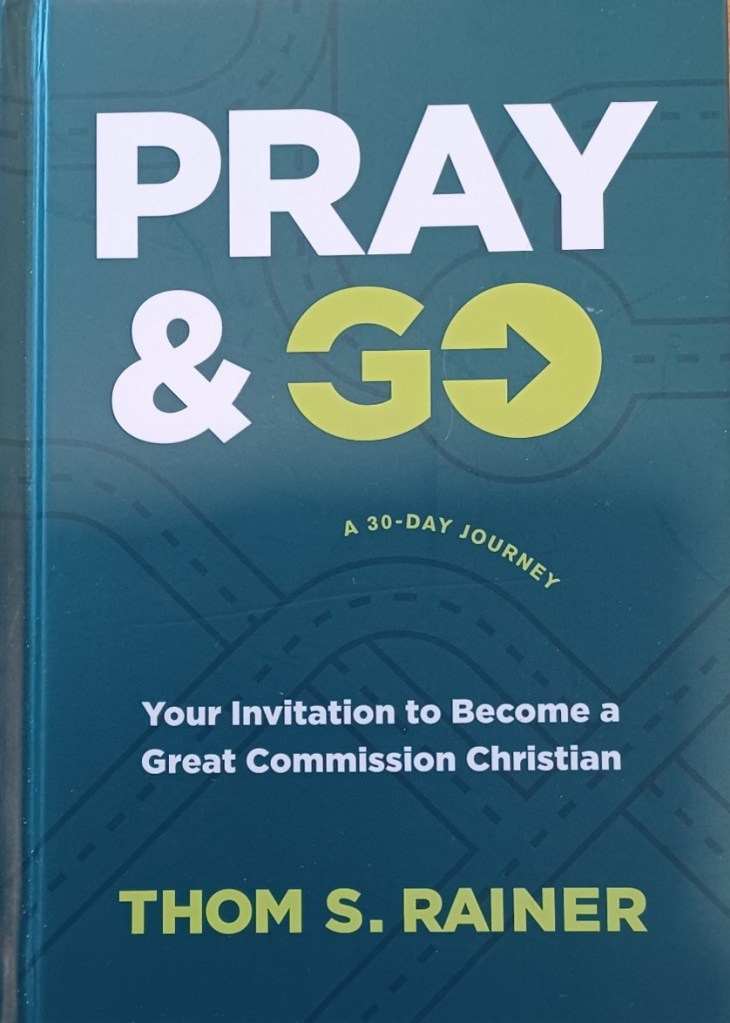
PRAY & GO: Your Invitation to Become a Great Commission Christian – by Thom S. Rainer.
Thom Rainer has written a great book that is used for Church Answer’s Hope Initiative, a 30-day journey that can be done as a group or individually. When you sign up for the Hope Initiative you also get other supporting resources and video encouragement in you 30-day journey. The intent of the book is to help you become more active in sharing your faith as you pursue the fulfillment of the Great Commission of introducing others to Jesus. A great book to help you grow as a disciple of Jesus.
Leadership within the church is similar to leadership anywhere, because it is leading people. Yet it is quite unique in that you are asked to lead people on a lifelong journey toward Christ. This is not about building a business, though some business ideas can work in a church as it grows. This is not about pushing your personal brand or a personal vision that your employees all work toward. Instead, church leadership is first about God, and secondly, about people. It is about God’s vision for the world and His specific vision for your church in the part of the world where you are located. God’s vision is about drawing all people to Himself. It is about helping others to come to know God and pursue holy living.
When you are first elected to your position on a leadership board at your church, you may wonder if you really belong there. 1 Timothy 3:1–7 and Titus 1:6–9 are two examples of scripture that identify the qualifications of an elder. Basically, these say that an elder must show evidence of a relationship with God through faith in Jesus and filling of the Holy Spirit, as well as evidence of being a leader already, specifically in your own home.
None of us is perfectly Holy. None of us is exactly like God or as good as God. We are humans, saved by grace, and pursuing a relationship with Jesus that helps us become more like Him every day. But none of us can say to those following us, those in the rest of the church: “If you do exactly what I do, or live exactly like me, then you will be good.” All of us have faults. All of us are attacked or influenced by Satan and his various means of tempting us. It is important that we realize we are not perfect. This will help us have more patience when working with others who are also not perfect.
There is a big difference between those who are walking toward Christ and those who are walking away from Christ. There are some people who will declare they are Christians and may have prayed a prayer at some point in their life, but who are regularly and continually walking away from Jesus. These are people who are living with a certain sin and have found a way to live with it and be okay with it. And they want others to agree that it isn’t really that bad. There are most likely some in your church, but hopefully not on your leadership board.
There are some Christians who are clearly walking toward Christ. They are trying to become more like Jesus every day. They spend time with him in prayer and talk with him and listen to him regularly. These are people who recognize how sinful they still are, but who keep getting back up after each stumble in sin, ready to pursue Christ again. These are the people who love Jesus and want others to come to love Him as well. Does this sound like you? Then I would think you may very well be a candidate for leadership in the church.
We must recognize we are not perfect, and yet we are pursuing Christ. What else might make someone a good candidate for leadership? This might sound wrong, but often good leaders are ones who have not sought it out. They haven’t been campaigning the nominating committee or tried to show they knew better than the existing leaders. These are the ones who recognize how far they come short from the holiness of God. These are the Christians who recognize they have so much to learn. But these humble and gracious individuals are great for the board because they will never lord it over anyone. Some boards love the power and take advantage of people because of their position. A leader who is hesitant and not clamoring for attention will probably be a much kinder leader.
A leader in the church should also believe that God has asked them to serve in this position. While not a personal attribute that qualifies a person, there should be no doubt in a church leader’s mind that they are there because God wants them there. This may be affirmed by God speaking in whatever way He speaks to that person: highlighting a verse in Scripture, or a voice, or an impression, or even just the belief that God is guiding the membership as they elected that person to this position.
Sure, it might be nice to have some leaders who have Bible education, or who have experience, or who have natural charisma that draws people to them, those are not necessarily what makes a leader in the church. First, Love God with your whole heart and serve him, second, love people with a humble heart, and third, trust that God has placed you where you are. While there could be many other qualities we may look for in a church leader, these are key.
Are you a church leader? Lead with humble service before God, with the best in mind for the rest of the church, and with a deep faith that God will enable you to do your best where He has placed you.
I have many unique and incredible experiences of church. I have been to churches meeting in large auditoriums, in school gymnasiums, in homes, and at a golf course. I have been to churches on three continents. I have been in churches that speak various languages. I grew up in a church where everyone felt comfortable speaking Low German. In one church most members were speaking Tagalog until the service began in English. I had the opportunity of preaching in a church in Choma, Zambia, where the pastor interpreted it into one of the local languages, Tonga. I have been in church services that started right on time and ended exactly one hour later. I have been in services where there was an approximate ending time but usually it went much longer. I have been in churches of thirty people and churches of hundreds of people.
I have been in churches where the staff led everything in the service and in churches where most of the service was led by volunteers. I have been in services where it felt like we were watching a performance, and I have been in services where the congregation was invited to participate in a number of ways.
So, what makes it church?
Let’s think of a few things that need to be present for it to be church, and before that, let’s define church. Church is the people of God meeting together. So let’s look at a few things that make something “church”.
Church is the people of God gathered.
When Paul wrote his different letters, he addressed them to the church in Corinth, or Ephesus, etc. He was addressing people. In Corinthians 1: 2 Paul writes, “I am writing to God’s church in Corinth, to you who have been called by God to be his own holy people.” Church is a gathering of people.
Church is the encouraging and motivating of God’s people.
Hebrews 10: 24 and 25 says, “Let us think of ways to motivate one another to acts of love and good works…encourage one another….” When the gathered disperse, they should feel encouraged and motivated to continue to grow in their love of God and their service to others. Something needs to happen when gathered so that the people going home are different than when they came in. They should have been challenged to change in some way.
In order for something to be church, the gathered must leave encouraged.
Church is the people of God praying to God.
In 1 Timothy 2: 8 Paul advises this young pastor, “In every place of worship, I want men to pray with holy hands lifted up to God….” One aspect of a church service, when God’s people gather, should be prayer. Somehow, as part of the time with each other, God’s people need to spend time talking with God.
In order for something to be church, the gathered must pray.
Church is the people of God gathered to listen to Scripture.
Here is some more advice from Paul to Pastor Timothy: “Until I get there, focus on reading the Scriptures to the church, encouraging the believers, and teaching them.” God’s Word should be read in church. While everyone should read at home on their own as well, there should be public reading of Scripture. That means, preaching through a popular book does not cut it.
In order for something to be church, the gathered must read Scripture.
Church is the people of God gathered to be taught.
In the advice to Timothy in the last point, Paul says to “teach them.” Someone, or more than one, needs to expound and apply Scripture to the regular daily lives of God’s people. Someone who has more training or more experience in a passage of Scripture can help others understand it and figure out how the rest of the Bible contributes to what is said in the verses read.
In order for something to be church, the gathered must be taught.
Church is the people of God gathered to celebrate communion.
In 1 Corinthians 11 Paul reminds the Corinthian church to respect the Lord’s Supper as a special event reminding us of Jesus’ death and resurrection: “For I pass on to you what I received from the Lord himself. On the night he was betrayed, the Lord Jesus took some bread…” (1 Corinthians 11: 23) He goes on to describe what happened during that meal Jesus had with his disciples, leaving us an example to follow. Many churches regularly celebrate communion, or whatever your church calls it. Some practice it every Sunday, others monthly.
In order for something to be church, communion will be celebrated regularly.
Is this church?
These are some of the elements that make church “church.” Basically, church is the gathered people of God, but the above elements are usually part of that gathering. Not every item above will be in every gathering of believers, and there may be others included. The point is, do we know what needs to included and what does not? Do we understand the incredible value of regularly meeting with others who are part of God’s family? Please leave a comment sharing what you would add or remove from the list. What do you believe needs to be present to be “church”?
I hope you have found a great local church to regularly gather with. If you have not found one, keep looking. You need to meet with others of God’s people.
I recently heard two statements by two different people that I believe are prophetic words for the church. In my experience, there have been shifts in how the church functions or what church leaders think is important in reaching people for Christ. When I was a young youth pastor, it seemed the emphasis was on finding ways to make church fun and cool. As I got a little older, books and seminars seemed to focus on the church being relevant and relatable to unbelievers. What is the next emphasis of the church as we reach out to people who have not yet met Jesus personally?
On January 24, 2022, I heard Adam Browett of Glad Tidings Church in Victoria, B.C., make a profound statement in his sermon: The church moving forward “looks more like a healing center than a rec center.” He pointed out that if we were to be following Jesus’ example, we would be surrounding ourselves with hurting people and healing their hurts.
Our world offers all kinds of entertainment. The church does not need to provide entertainment. The church needs to find ways of helping the hurting and lonely. Our church buildings should be places where people find healing. Those of us who have a relationship with Jesus, the Healer, should be people in whom others can find healing as we point them to Jesus.
Dr. Rob Reimer writes in Spiritual Authority, “I think more people are going to come to faith in Christ in this generation because they know they are broken and in need of a Healer than because they know they are sinners in need of a Savior.” Our emphasis when we share the gospel has so often been about showing people how sinful they were so they would recognize they need a Saviour. Instead, if we focus on brokenness and healing, people don’t need us to point out how hurt and lonely they are. And we have an answer to that hurt and loneliness. We have a Healer.
In his book, Reimer points out that almost every time Jesus mentioned the kingdom of God he also mentioned healing from diseases and casting out of demons and restoring what is good and right in people. The church has been too focused on the “getting out of here” aspect of the Kingdom of God, where our goal is to gain eternal life and then just wait for that to be fulfilled. The kingdom of God is where what is bad is made right. The kingdom of God must be evident in displays of God’s power, as can be seen in demons cast out and people healed and relationships restored.
Our world is full of conflict. Countries are at odds with each other. People are at mad at each other. Large demonstrations and protests are rising up out of people’s frustrations. Violence is not uncommon. Disputes and arguments dominate social media. People are mad at the government and frustrated with the pandemic and all its fallout. Marriages and families are struggling and breaking apart. Many people are struggling with depression. Suicide is a way out for many. People are hurting.
If we truly love our world, if we as Christians want to truly love the hurting as Jesus did, then we need to be people offering healing, and our churches need to be places of healing. We need to believe God can still do miracles and bring healing and restoration. We need to speak and act with His authority and power to bring healing to our world.
This will not be just up to the pastors or church leaders. This is the role of every believer. We have the Holy Spirit in us. We have his power at work in and through us. We need to learn how to bring his healing to the hurting people around us. This will take much prayer, some in depth reading, and practice, as well as a continual filling of the Holy Spirit.
This is the need of the church today, but it is really just going back to what Jesus did when he was on earth, and what the apostles did as they established churches, and what New Testament church leaders did in their communities. We need to come back to inviting God to display his power and to bring healing to our hurting world again.
Let’s pray that the church will become the healing center it is meant to be.