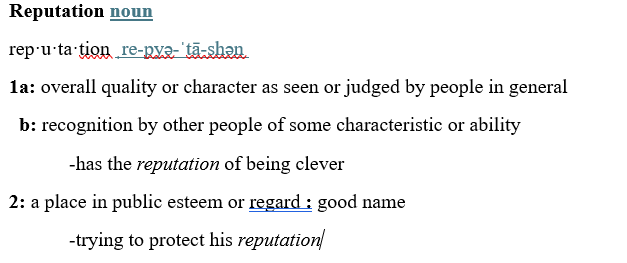
Guard Your Reputation!

What people think about you because of what they have observed about you makes a difference as to whether people will want to spend time with you or even listen to what you say.

People are always observing you and your actions, and when they do, they instantly make assessments about who you are and what you are like. As people see you act you gain a reputation. It may be a good one, it may be a negative one. The only way you can gain a good reputation is by being careful about how you act and how you treat people.

Reputation is not about being a people pleaser. This is not about trying to gain the favour of all people by only doing what you think others expect. It is about knowing who you are and what you stand for, and then consistently living that out. But your reputation is also about more than yourself, especially if you are a follower of Christ.

In 1 Timothy 3:7, the apostle Paul describes the attributes of church leaders:  

He must also have a good reputation with outsiders, so that he will not fall into disgrace and into the devil’s trap.

One of the characteristics of a church leader is to have a good reputation “with outsiders.” This is not just about a good reputation with other believers in your church, but also with those who do not yet know Jesus. Thus characteristic does not just apply to church leaders; churches, too, must be filled with people who have good reputations because this is where leaders are developed.     

The word translated “reputation” in 1 Timothy 3:7 could also be translated as “testimony.” So the church leader, or Christians in general, should have a good testimony. This means that their life and words should match up. What they believe and stand for should be evident in how they live their lives and how they interact with believers and unbelievers.

Why? 1 Timothy 3:7 indicates that a good reputation may help a person avoid “falling into disgrace and into the devil’s trap”. A bad reputation may bring personal disgrace, – as well as bring disgrace on the church you are part of and on the Christ you say you believe in. An inconsistent walk could lead a church leader into the devil’s trap where they are no longer living a good testimony and reflecting well on Christ. The bad reputation is then earned by not consistently honoring Jesus with our life. The devil would like nothing better than to make Jesus Christ or his followers look bad.

Guard your reputation, not just so you look good, but to help make Jesus look good! Make sure your belief in Jesus matches the way you do life and conduct your business. You do not want your reputation to cause others to lose interest in Jesus. Live a consistently God-honoring life!

Keep looking up,

Andy Wiebe

Ready to Preach, Pray, or Die

There’s an old saying describing how a pastor should be ready for anything at anytime. A pastor should always be ready to preach, pray, or die. I thought of this saying the other day because of a situation I found myself in.

A friend asked me to join him in praying for a friend of his. We were going to meet in my office at the church with the plan of entering into a time of spiritual warfare. His friend did not know Jesus and was facing some torment in his life. His prayers to the god of his religion had not accomplished anything. He was desperate and was now willing to have us pray to our God for him.

One of my first thoughts was, I’m glad I am ready for this. This is going to be a spiritually significant encounter, and I am glad there is no unconfessed sin in my life. I am right with God and feel empowered to be his servant in this situation. It reminded me of the saying to be ready to preach, pray, or die. I wanted nothing in the way if I was going to ask God to fight on behalf of this friend. I was ready.

 As I contemplated this, I realized how absurd this thought was. As followers of Jesus, we should always be ready to serve God in any capacity He invites us into; not just on the occasion when we “feel” ready. Not only pastors, but all Christians should strive to be right with God at all times, ready to serve Him in any way He asks. We should not be afraid to enter into spiritual warfare, as if we had reason to think that we had to do something to prepare first. If we are in right relationship with God, through faith in His Son Jesus, then we are always ready to serve God, no matter what He asks of us.

We should always live our lives free of sin. All sin should be confessed as early and as quickly as we recognize it. We should never carry sin in our life, waiting for a specific moment to deal with it. Deal with it immediately and makes sure you are right with God. Like David, in Psalm 51, desire to live a forgiven life where we are always ready to teach others. We should never harbor sin of any kind. We should always be clean and ready for service to our God.

We need to pray regularly. We need to be in daily communication with God. We need to read Scripture to learn and hear from God, but we also need to be talking with Him all the time. I paused for more prayer as I knew this encounter was coming up in a few hours, but I already had a prayed-up life as I have regular times of prayer with God.

We should continue to build up our faith. We need to remind ourselves regularly of the goodness and faithfulness of God. He provides all we need. He answers prayer. He is with us all the time in all things we face. As we continue to remind ourselves of the great God we serve, we are also equipping ourselves to serve Him when the serving may be difficult. I was not quite sure what to expect but I knew whatever the situation was going to be, God is bigger than anyone or anything else. I had faith in God to handle the situation.

I encourage you to live your life always read to “preach, pray, or die,” always ready to serve Him in whatever situation He may place in front of you.

Keep looking up,

Andy Wiebe

The Joy of Connecting with Teammates.

I had the privilege this past week of spending a day with others who have a similar role as I do. We don’t actually work together on the same projects or in the same church, but we are all part of the same denomination functioning in the role of transition pastors. There is a special joy in connecting with people who know your role and the situations you face because they face those situations, too. In the past, I was able to connect with fellow rural pastors and pastors in the same region. We may not all serve the same church, but we can connect and relate to shared experiences because of our similar roles.

It may feel like getting to know and spend time with these teammates takes too much time or effort that could be used for other priorities, but I have personally found value in connecting with others who understand my roles.

They understand the frustrations and joys.

    When I met with rural pastors as a rural pastor, I knew that they understood what small-town life was like. They understood the realities of serving a smaller church. When I meet with transition pastors, they know what it is like to face church conflict and to try to mediate it. Transition pastors know what it is like to help churches, to fall in love with them, and then have to move on to a new assignment in a year or two.

    When you are talking with others who know your role, you can share jokes and stories that they understand. They are “in the know” because they do the same things you do. Other transition pastors know the frustration of churches that do not want to change, even though they know they need to. They understand the joy of a board catching God’s vision together as they plan vision and strategy for the church.

    They can provide ideas and advice.

    When I meet with transition pastors, I know they use similar tools and processes as I do in helping churches transition. Transition pastors know what it is like to help churches build on the past to look to the future. One of the benefits of my recent meeting with other transition pastors is to learn about how they handle particular situations. Most of them have more experience in this role than I do so I love to soak up ideas as they talk about their ministry.

    They can pray for me with understanding and clarity.

    One of the joys of meeting with others in similar roles is that we can pray for each other with an understanding of the situations we face. Often we don’t even have to finish our story and the others are already smiling or nodding or even crying as they have gone through similar situations. They can pray for me, and I pray for them, with clarity because we have seen very similar situations where we have served.

    I encourage you to find others who are in a similar situation as you. You need to find “your people” so you can have people around to encourage you and help guide you as you need input and wisdom from them.

    Keep looking up,

    Andy Wiebe

    Getting it All Done!

    Life and ministry can be busy times. Maybe you have taken on too many commitments. Maybe someone else piled responsibilities on you that you can’t ignore. Maybe you thought you had time for everything until an unexpected demand popped up. This happened to me recently. I had accepted a number of responsibilities and thought I could manage them until I found a leak in my shower. Now I had the added work of dealing with house repairs that I am not skilled at and do not love doing. I was beginning to feel quite overwhelmed and wondered how I would get everything done.

    As my anxiety started to rise, I paused my day to spend some time with God. As I was praying, I began to get some clarity and peace, trusting God to help me get done what had to be done by the appropriate deadlines while also dealing with my house. Here are some of the steps I took to focus on one thing at a time:

    Pause the “doing” to be with God

      I took on the various responsibilities because I believed God was guiding me in accepting them. With that in mind, I handed it all over to Him and asked him to give me the time necessary to get it all done on time. I was reminded too, that God was not surprised by my house issues. So if God put these responsibilities in my lap, then he will give me the capacity to get them done.

      Remove anything from your to do list that is not important for now

      Sometimes we feel a duty to do something that we don’t really need to do. I had to reevaluate some of my goals and responsibilities and either eliminate some, or push them to next week.

      Plan my day and week.

      With God’s help, I began plotting all my responsibilities, along with their deadlines, onto my calendar. I tried to spread out the different requirements across the whole week. Then I considered all that I felt I had to accomplish for today. As I looked at the list, I started listing them in order of priority. If I could not complete all the tasks, at least the ones that had to get done today would get done.

      Focus on one thing at a time.

      When we get loaded down with responsibilities, we can get overwhelmed because we see it all in front of us. If we can break it down to what must be done this week, and this day, and this morning, we begin to narrow our focus. And if we tackle one thing at a time, giving it our full attention, we can begin to whittle away at the pile.

      It doesn’t matter how big the pile is, you can only deal with one thing at a time, so choose one thing and give it your best. You could even tell yourself you are focusing on this for a certain amount of time, and when that time is up, you will tackle something else before coming back to the first task.

      Celebrate your accomplishments

      I find it quite exhilarating to be able to check off the items on my calendar as I complete them. It feels good to see the momentum beginning to build toward completion of all the different tasks.

      Yes, life can be very busy at times, busier than we had planned, but God can help us grow in capacity so that we can get things done faster than we thought and can complete our list one task at a time. If God wants us to do it, he will help us to get it done.

      Keep looking up,

      Andy Wiebe

      Reconciliation or a Bumpy Rug?

      The other day, I was speaking with someone who mentioned a “bumpy rug.” She was referring to the practice of ignoring problems and “sweeping them under the rug.” Another similar comment I heard recently was, “Let’s just get this behind us as soon as possible.” In both cases, people were dealing with sin in families and organizations. Both cases reflected a desire to move past the sin and the hurt it caused others as quickly as possible without a desire to actually address the sin and correct it.

      Very few people enjoy conflict. The average person will go out of their way to avoid it. It is not fun when others are mad at you, even if you are doing the right thing. Our desire to get along and please people means that we will try to move past problems without confronting the issue and dealing with it.

      We need to learn to work through the personal pain of a conflict to pursue correction, forgiveness, and reconciliation. We need to see the value of restored relationships both with God and with each other. We need to see the importance of repentance and forgiveness to help people truly get past a problem brought on by sin. We need to see the importance of pointing out sin that is affecting others in the family and in the church.

      We forget that Jesus gave clear direction on how to handle sin with a Christian brother or sister in Matthew 18: 15-17.

      “If your brother or sister sins, go and point out their fault, just between the two of you. If they listen to you, you have won them over. But if they will not listen, take one or two others along, so that ‘every matter may be established by the testimony of two or three witnesses.’ If they still refuse to listen, tell it to the church; and if they refuse to listen even to the church, treat them as you would a pagan or a tax collector.

      Jesus does not advise getting past sin quickly, and definitely does not suggest sweeping it under the rug. Jesus suggest confrontation. He gives some steps. First, go by yourself to the person you know has sinned and point out their sin. Do not tell others about it. Do not take a party with you. Go by yourself.

      The second and third steps are only taken if the first did not resolve the situation. So, second, if the sinner does not respond with repentance then take one or two others with you to confirm you are not just making a personal judgement. With two or three others, you can determine if the person really has sin they need to deal with.

      Third, if the first two steps do not resolve the issue, then tell it to the church. The hope is that the church will push for what is right and stand for truth and righteousness rather than sweep it under the rug. Too many churches prefer the bumpy rug to the pain of confronting and dealing with a sinning brother or sister.

      There is one last step. If the person does not listen and does not correct their ways, treat them as someone who is no longer part of the church. This is a very difficult step for any church to take, yet Jesus teaches this so we know there must be times when his teaching should be applied.

      We need to remove the persistent sinner from any leadership in the church yet continue to love them and pray for them and look for opportunities to draw them back to Jesus.

      Jesus did not write off tax collectors and pagans but invited them to follow him. He even called Matthew, the tax collector, to be one of his disciples. Jesus treated pagans and tax collectors as potential disciples, if only they would leave their sin behind. Even as we can’t allow the persistent sinner a place of leadership in the church, we continue to point them to Jesus, with the hope that they will repent and surrender their hearts to Jesus again.

      Let’s choose to pursue reconciliation, not allow more bumps under the rug!

      Keep looking up,

      Andy Wiebe

      A Grateful Heart

      When parents are raising their children, they teach them how to be polite and how to live into the culture around them. One of the values parents often try to instill into their children is to say thanks. Parents often remind their children to, “Say thank you.” Or they ask the child, “What do you say?” They want the child to express their gratefulness when they receive something.

      Luke 17 tells us a story of ten men sick with leprosy who met Jesus. They stood at a distance, respectful of Jesus who did not have the disease, and called out for Jesus to have pity on them. Jesus tells them to go show themselves to the priest.  As they went to do so, they were cleansed. (The Old Testament Law said the priest was the only one who could declare a person clean after a sickness.)

      We might applaud the faith of these ten in going to do what Jesus said even though they were not cleansed yet. They were only healed as they headed to find the priest. But they were healed!

      Here comes the important part of the story. Yes, they were healed, but what did they do after that? We are told that one of the men who had just been healed, instead of continuing to the priest, turned around, came back, praised God with a loud voice, threw himself at Jesus’ feet, and thanked him. Ten were healed; one came to thank the healer.

       Jesus responded, “Were not all ten cleansed? Where are the other nine? Has no one returned to give praise to God except this foreigner?” Then he said to him, “Rise and go; your faith has made you well.” (Luke 17: 17-19)

      How many times have we completely forgotten to give thanks, enjoying God’s goodness to us as if we deserved it?

      We have a special day in our year that we stop to say “thanks.” Thanksgiving is coming up shortly. While it is good to have one day a year to give thanks, we need to cultivate a grateful heart and to develop an attitude of gratitude. As Paul encourages us in Ephesians 5:20, “always giving thanks to God the Father for everything.” Can we learn to give thanks regularly and not just on special occasions?

      God is good to us in many ways every day. We take so much for granted, that we need reminders to pause and give thanks. If one wants a grateful heart, it means being intentional in giving thanks. Include thanksgiving in your prayers. Give thanks with your family around the dinner table. Thank God for His goodness in your life. Thank God for the unusual things and the answers to prayer. But also thank God for the things we receive from Him every day. The air we breathe, the food we eat, water to drink. Thank Him for creation we can enjoy. Autumne in my part of the world is a beautiful experience as the leaves change color and start to drop from the trees. Notice God’s beauty around you and give thanks.

      Every time we give thanks, we remind ourselves that we depend on God for many things in our life. It is a reminder to us that we need God, and we benefit greatly from the good gifts He gives us!

      Thanksgiving is coming soon, but don’t wait for that special day to give thanks!

      Keep looking up,

      Andy Wiebe

      Unravelling the Tangled Mess

      When I was a kid, I loved flying my kite. I remember one windy summer day in the field just down from our house, releasing my kite into the sky. It was a thrill to feel the pull of the wind on the spool of string as the kite dove back and forth. I let out more string, and more string. The kite grew smaller as the string rolled off the spool until… oh no! The string was not tied to the spool in my hand! I had let the string reel out and suddenly the string was all gone – the kite was no longer tethered to the spool in my hand! I panicked! I scrambled after the kite, desperately trying to grab the string. After a few frantic attempts I managed to snag the string. In my panic I hauled the string in, not rolling it up neatly on its spool, but gathering it in a tangled pile at my feet until I had the kite back in my hands. I never managed to untangle that pile of string again.

      Sometimes, in an attempt to control our busy lives, it seems we end up with a tangled mess of roles and responsibilities at our feet. We do everything we are supposed to do or have signed up for, but we desperately try to untangle the mess and get a sense of control back. Each of us needs to manage various roles in work and life.

      Recently I felt like my life was resembling that pile of tangled string. I had some family issues that took precedence over all my other responsibilities. Everything else got put on the shelf for a week or so. I focused on the one thing that was most important in the moment. After that week, I recognized I had some untangling to do.

      I needed to figure out which strings to pull to start unravelling the mess. I had to take out a calendar and plot out my responsibilities to make sure I was working on the right things at the right time. We can’t work on everything at once. No matter how many responsibilities we think we can handle, we can only work on one at a time. I had to break down my responsibilities into manageable periods and schedule them on my calendar. I had to plot when I would focus on my transitional pastor responsibilities. I needed to chart when I would work on my transitional coaching duties. I needed to clearly schedule when to work on my doctorate work. I needed to schedule some family responsibilities. It took some work to sort it all out, but the end result was a plan that gave me peace. I could see my way through.

      Whatever is in your tangled mess of string, you can find your way through. Ask God to help you sort it out. And ask God to give you the time you need to accomplish what is on your plate. I know from experience, that God can enable you to work faster or to somehow stretch your time to do all He is asking of you. He will help you sort it out. Don’t panic or give up. Sort it out and begin working on one responsibility at a time.

      Carve out a time of retreat. Even a hour or so away from everything may give you the necessary time to evaluate your priorities and determine what you need to focus on and in what order. Then after the retreat you can advance with a plan.

      We all have numerous responsibilities. Sometimes they pile up and its hard to know where to start in addressing all the needs, but with God’s help you can do it.

      Keep looking up,

      Andy Wiebe

      Make Sure Your Heart is Right

      Proverbs 21:2

      A person may think their own ways are right,
          but the Lord weighs the heart.

      Proverbs 3:5-6

       Trust in the Lord with all your heart
          and lean not on your own understanding;
       in all your ways submit to him,
          and he will make your paths straight.

      If we were to take a look at the discipleship methods of our churches, we might tend to think that discipleship is about knowing enough information. We preach and teach on Sunday mornings, we have Bible studies mid-week, we encourage people to read the Bible at home. We want to make sure that people know the right stuff.

      It’s as if we think that if we give Christians enough information about God, about themselves in light of their relationship with God, and what God wants us to do in the world, then we will live out what God wants us to do. Unfortunately, that is not correct. Giving people more information, and helping them to think right is important, but is not the complete picture.

      Information by itself, if it does not connect with our inner being, may never affect us or change us in any way. In the verses above we see the emphasis on the heart. In these verses, “heart” refers to “the inner man, mind and will.” This moves beyond or rational thinking to our feeling. It moves beyond knowledge to our desires. Unless we care about something, it is simply information. Once we care about it, we want to act on it.

      When I tell someone there are over 30,000 orphans in 750 orphanages across Haiti, people receive the information. When that same person gets to know an orphan who was adopted, or visits an orphanage in Haiti, that information becomes personal. They become emotionally connected to the information. Then they may move beyond just storing information in their head to wanting to make a difference somehow.

      When I hear a sermon about the fact that God answers prayer, I receive it as information. I may even believe it. When I pray, and God answers in a specific way, then I know that God answers because I have experienced it. Now when I pray, I pray with a much deeper expectation because I don’t just have information.

      When I am taught that I need to read my Bible and pray every day, I might do it occasionally, but when I have come to know Jesus in a real way, then I want to read because I hear him speaking to me. I am not just reading information but having a conversation with Jesus.

      James K. A. Smith wrote You Are What You Love. He does a good job of pointing out that information alone won’t change us. We will still do what we love. We naturally act out of our personal desires, not just by being taught to think correctly.

      May our relationship with Jesus be much more than information about Him. May we love him and choose to obey Him out of a desire to please him.

      Keep looking up,

      H. Andy Wiebe

      Summer Road Signs Series – #5: No U Turn Signs

      There were a few times this summer where I was driving in unfamiliar territory and realized too late that I should have taken an earlier turn. I was headed the wrong direction and unsure how to safely turn around. Many intersections have “No U Turn” signs, sometimes with just the symbol, other times with the words “No U Turn” also posted. I would have loved to just turn around and go back to the starting point.

      In my experience working with churches in transition, I could have used No U Turn signs a few times. Some churches long for the “good old days.” There is a hope that if only they could get back to what they were like and the programs they ran some years ago, when the church was growing, then things would turn around in the church and it would start to grow again.

      In my experience working with churches in transition, I could have used No U Turn signs a few times. Some churches long for the “good old days.” There is a hope that if only they could get back to what they were like and the programs they ran some years ago, when the church was growing, then things would turn around in the church and it would start to grow again.

      The reality is a church cannot forget the last few years and the experiences they have gone through and just start over. Time moves on. Culture changes. The congregation changes, and so does the community around the church. Instead of looking backwards, the church must learn how to move forward with clarity and purpose.

      I love working on vision with churches. I love to help them see the reality of today and the possibilities of tomorrow. Instead of churches looking back to a certain period of history as the high point for the church, I want them to see that God has great things in store for them, so the best times are still ahead. It may take some work, and prayer, and trusting God, but looking back will not help. I tell churches that as we work on vision, I do not expect there to be radical change from what has happened in the past and what is going on in the church at the present. Instead, I believe God has the church on a trajectory that may need some adjusting here and there but the future will generally be consistent with their history.

      The same applies to our personal lives. Many of us can look back to certain periods of our life where we felt things were going really well. Looking back, those seemed like stress-free times, times of excitement and joy. As tempting as it may be to somehow replicate what we once had, life moves on. We have new experiences. We have new responsibilities and new relationships. As we grow our family and develop our careers, we can’t just drop all of that to return to a more carefree time. Instead, we need to find a way forward, to try new roads and look for what God is going to do in our lives in the future.

      U-turns are tempting because they seem like a quick and easy fix. Let’s just get back there and try again. This is usually not an option if we are leading a church or setting direction for our personal future. Time moves on like water under a bridge. Our past is not a static thing we can return to. We need to keep looking ahead.

      The reality of being human is that we cannot start over. Yes, we can come back to some original principles to live by. We can reorient ourselves to God and His Word. We can re-establish guidelines for our life that served us well in the past, but we cannot remove history and start over. Sometimes a map directory in a mall has a little icon stating “you are here” so you know where you are starting from. The reality is, we are where we are. Now we need to know how to move on from here. We cannot change the past, but we can make changes for our future.

      May God help us to learn from the past and keep moving ahead. U-turns to an earlier period in our life or in our church are not possible. Keep moving ahead.

      Keep looking up,

      Andy Wiebe

      Summer Road Signs Series – #2: Stop Signs

      We began the Summer Road Signs Series with speed signs. Now we’ll go to the opposite: stop signs. While moving forward and heading toward new adventures and new goals is exciting, there are times when we must stop. Eventually we have to take our foot off the gas, apply the brakes, and stop.

      Stop signs remind us of a few things. Sometimes we need to stop because we are coming to an intersection, and other traffic may be coming through. If we don’t stop, we may be hit by other traffic. There are times when we need to slow down and stop in life. We have all kinds of distractions and frustrations and even opportunities coming our way all the time.

      Sometimes we need to stop to just reset ourselves, to get our bearings. We need to remember to watch out for what is going on around us. Are there dangers we have been ignoring? Are there opportunities we have missed because we have been going forward with such passion and determination, we never recognized them? Slow seasons can give opportunity for us to stop and assess where we have been, where we are, and where we are going.

      For ourselves and our families, stopping to spend time reconnecting is valuable. Summer can be busy chauffeuring kids to camp or swimming lessons or tutoring. It can fill up with family gatherings and other expectations. But take time to spend with your family doing very little except being together. Instead of working on another project or chasing another busy thing, slow down and just listen to each other and talk about each other’s dreams and desires, hurts and frustrations. Pause to listen to each other.

      In our desire to move ahead, have we left people behind? Do we need to give time for our team to catch up with us? As pastors, we set vision and direction for our churches. Are we giving time for our teams and churches to capture that vision and move with us? As leaders, our jobs include thinking about our goals and our vision all the time, but the reality is that those lead have other things on their minds too. They are not necessarily prioritizing moving towards these goals at the pace we are. A stop sign may remind us to give time for those we lead to catch up.

      A stop sign could be at a T-intersection where we need to choose right or left. In our desire to move ahead, there are times we need to stop to figure out our next direction. What’s next? Just blindly choosing a direction in order to keep going may take us in the opposite direction of where we should be heading. Even if you are confronted with two equally good options, the stop will give space to allow you decide which one to take.

      A stop sign may also be a reminder to just pause. We all need, in biblical terms, an occasional sabbatical. When God created the world, the seventh day, the final day, was a day of rest. It was a time to recognize that the work that had been done was enough. It’s okay to stop. To rest from busyness and take a break. A sabbatical is a reminder that our worth is not found in what we produce or what we do. When the work stops, you are still loved by God and valued as a person, a child of His.

      There is also value in having other “sabbath” times. Taking a vacation can be a sabbath as we stop doing and pursing and producing and enjoy the people around us and take pleasure in the world God has created.

      Yes, it is fun to move ahead at full speed, but it is important to recognize the stop signs and take the important breaks that refresh and reorient us for the next part of our journey.

      Enjoy the stops signs!

      Keep looking up,

      Andy Wiebe

      P.S. Next week’s road signs: Watch for Wild Animals