Book Reviews: Andy’s 2023 Reading Experience

I will be sharing a brief review of every book I read this year. Hope you enjoy and hope it encourages you to keep reading.


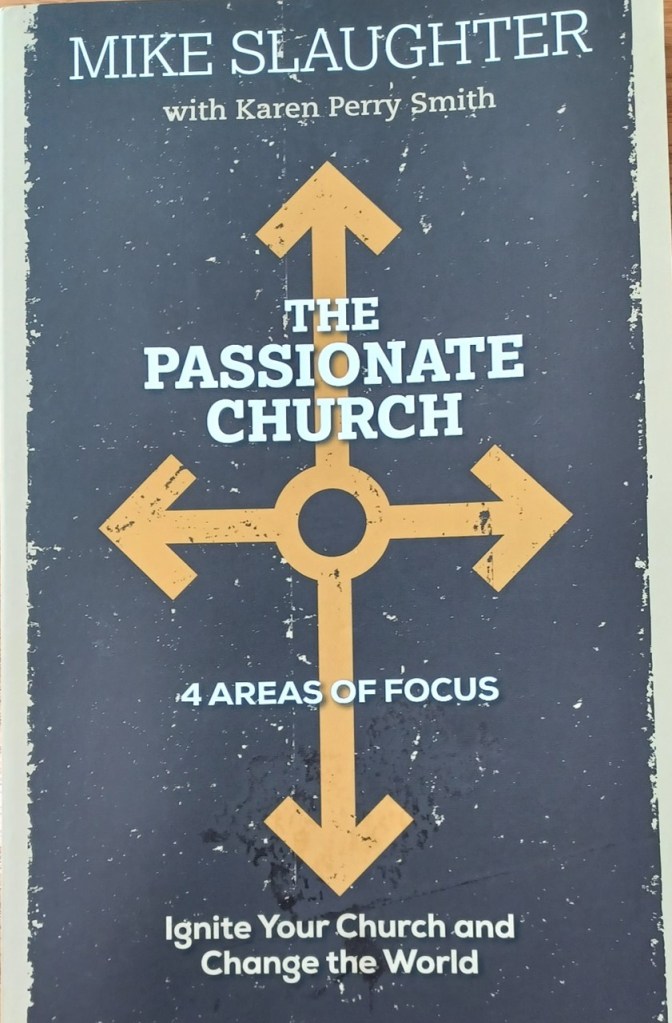
THE PASSIONATE CHURCH – by Mike Slaughter

Mike Slaughter draws on his United Methodist heritage and denominational connections to describe what a passionate church looks like. He addresses Four Areas of Focus as highlighted by the United Methodist Church: Developing Principled Christian Leaders, Engaging in Ministry for the Poor, Creating New and Renewed Congregations, and Improving Health. He does a great job of giving good examples for how each of these areas can become a real part of how a church does ministry. He uses examples from his own church in Ginghamsburg as well as from many others. What I love most about this book is the practicality of it. Passionate Church is a few years old now (2008), but the same questions can still be asked of our church and how we are living out our calling in our own communities.

Allowing The Bible To Guide Our Leadership

Many issues arise in our world today because of our search for the answer to the question: What is the truth? Theological issues may come about when we search for answers in teachings we have not heard before. Political issues can begin when we as Christians question what our place is in politics or responding to decisions our governments make. Moral and lifestyle issues are often found when the church is unsure how to respond to what is becoming acceptable in the world around us and even in the church that has historically not been accepted. What is the truth?

While there are many today who pretend we can have different truths to guide us, truth doesn’t work that way. If I am driving down the highway and decide that my truth is that I am in England so I will drive on the left-hand side of the yellow line, my truth will be quickly confronted by another truth when the traffic in that lane comes hurtling towards me. That is a silly simple example, but the fact is, what we believe about things makes a difference, and impacts our relationship with others. Truth, as God has laid it out, affects all of us.

As people of God, and as leaders of churches, we need to recognize that our answers need to be found in God’s Word. His Truth must be upheld in our churches. I do understand that sometimes we need to do some work to determine how God’s truth impacts the questions we face. But our answers should be informed by God’s Word – the Bible.

How might we find answers in the Bible?

Read the Bible.

The first priority to actually read the Bible. Read it regularly and search it for answers to your questions.

As you read, ask God, through the Holy Spirit, to give you correct understanding of what you are reading. We recognize that the Bible is more than a story book, though it contains many stories. Whether we are reading biblical stories, or a teaching section, or even some of the poetic books like Psalms and Proverbs, we want God to help us understand what the truth is and how it applies to my life and to the church where I serve as a leader.

Consult with others on difficult passages or topics.

We are blessed to have the results of many experts at our fingertips. We can find commentaries where others have worked through scripture and give their expert opinions. We can make use of tools that help with word studies and guide us through some of the definitions of the original language. We can read books by people who are struggling through some of the same questions we are. We cannot interpret scripture completely on our own, there is importance in reading scripture in community. Whether we agree or disagree, there is benefit in seeing how others have processed biblical truth in light of this topic. I’m presently reading a great book on how to respond biblically to those living a gay lifestyle. There are many other topics that others have been able to work through in more detail than we have so we can learn from them. Just make sure their teaching is arrived at by careful study of scripture.

And one of the simplest ways to consult others is to have conversations with others in your church as you work through scripture to find the answers you need. Find some other believers and read the Bible together. Work through scripture as a leadership team and ask God to guide you to the correct understanding and application.

Do what it says.

The hardest part of allowing the Bible to guide our leadership, is to then do something about what it says. If it means leadership needs to confront false teachers or people living contrary to truth in your church, then do it. If it means changing policies on how volunteers are screened, then change the policies. If it means teaching the church what it means to live out truth and love in light of Gods Word, then teach your church that.

If we are going to allow the Bible a prominent role in church leadership, then we need to make sure we read it regularly. We need to do the work of understanding it clearly, and then we need to follow through on what God is asking us to do as a result.

If we are Christian leaders, whether in the church or elsewhere, our leadership must be informed by the truth of God’s Word.

Keep looking up,

Andy Wiebe

Book Reviews: Andy’s 2023 Reading Experience

I will be sharing a brief review of every book I read this year. Hope you enjoy and hope it encourages you to keep reading.


UNSTUCK: A Nine-Step Journey to Change that Lasts – by Tim Lane

Tim Lane walks through a 9-step process to deal with lasting personal change. If there is an issue or a habit you are dealing with and would like to change, he believes his 9 steps will help you work your way through and overcome. He uses some examples from his own life and people he has helped to show how to work the process. If you are looking to make personal change, check out this book.

Book Reviews: Andy’s 2023 Reading Experience

I will be sharing a brief review of every book I read this year. Hope you enjoy and hope it encourages you to keep reading.


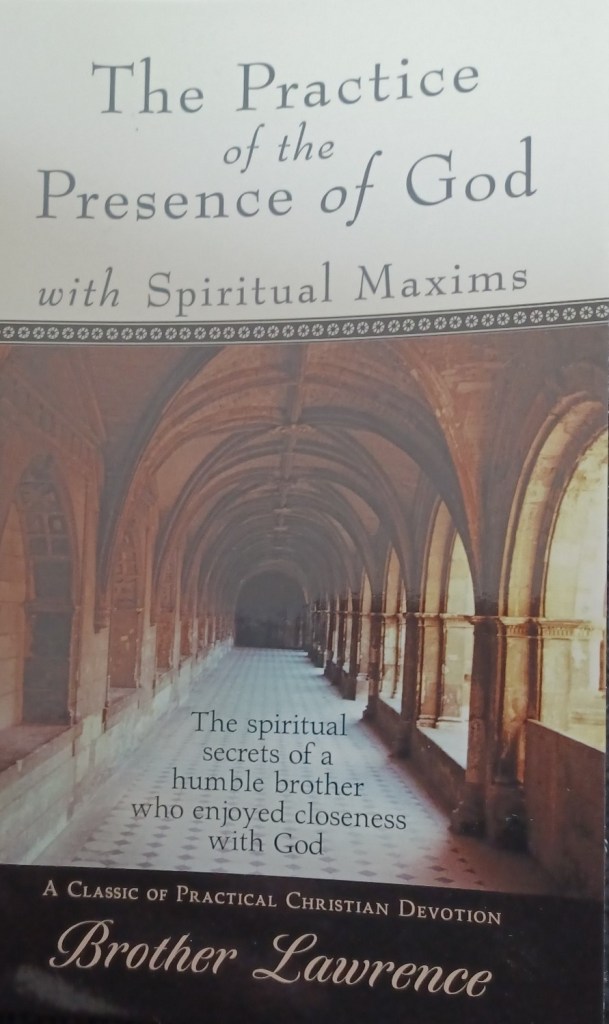
THE PRACTICE OF THE PRESENCE OF GOD – By Brother Lawrence

This book describes how Bother Lawrence practiced the presence of God in the mundane practices of life. It was in 1666 that he became a lay brother among the Carmelites at Paris. His main role was to work in the kitchen. He practiced the presence of God in his everyday activities, so much so that he felt that time for devotions distracted him from his time with God. He was continually aware of God’s presence, as if he had a continuous uninterrupted conversation with God. “I desire only Him, and to be wholly devoted to Him. He pointed out the need to be fully committed to God, “no soul which delights in earthly things, can find full joy in the Presence of God.” This is a little old book that packs a big punch if you want to draw near to God.

Reacting To An Offense

Has anyone at church ever offended you, or said something you didn’t agree with? Or has something happened publicly in the church that you were offended with? When a public offense occurs in the church, the first thought often is to write up a new policy. When we are part of a church, we are part of a group of people who will at times do something or say something that you don’t like. Each of us have different standards in our homes, and we likely have slightly different understandings of how to interpret and apply biblical truths.

When reacting to a situation in our church, we may act out of a desire to have policies and guidelines governing everything so that everyone does everything exactly the same. This is impossible to do. There will always be someone who does something you don’t like. So, how do we best respond to that perceived offense?

As I’ve worked with various churches and congregations, I’ve learned (and am continuing to learn) how to respond to situations where individuals are offended within the church. These may not necessarily be steps to follow in this order but are some helpful thoughts and questions I’ve learned to ask when working through the perceived offense.

  1. Is this an issue about me or about the other person?

Did the person actually do something wrong, or is the problem with me and the standards I am trying to push onto another person? Sometimes we just don’t like what another person does, but it doesn’t mean that what they’ve done is wrong.

  2. Is there a real issue to address?

If we believe there was truly an offense committed by the other person, what is the real issue? Did they do something that is spiritually wrong? It could be they did something that scripture can easily correct if they are shown the appropriate verses. Is this morally wrong? Did they do something that is generally believed to be wrong and offensive? What is the real issue that needs addressing? Why is what they did, wrong?

3. If an offense has occurred, what is the best response?

Jesus gives some practical advice in Matthew 18:15-17, about how to react when we see a fellow Christian sinning.

“If your brother or sister sins, go and point out their fault, just between the two of you. If they listen to you, you have won them over. But if they will not listen, take one or two others along, so that ‘every matter may be established by the testimony of two or three witnesses.’ If they still refuse to listen, tell it to the church; and if they refuse to listen even to the church, treat them as you would a pagan or a tax collector.

If you believe someone else has sinned, you have a responsibility to address that as a brother or sister in Christ. Pray about it and be careful as you address it.

What if it wasn’t a sin, but just something that the church generally has agreed is not acceptable? I would suggest being very careful when addressing any issue with people to be clear on what the issue is, to do it with kindness and love, not vindictively or angrily.

Also, make sure the appropriate person deals with the issue. Depending on the situation, it might be best for the person who noticed the issue to speak up, or it might be more appropriate for a different leader to step in.

4. Protect the dignity of the person who has caused the offense.

If something has happened that must be addressed, do it carefully.

Pray about it before doing anything, and then look for a way to approach the person with the concern that communicates as clearly as possible that this is a desire to help the other person and not to hurt or condemn them.

5. Is there an immediate response required?

If at all possible, take some time before responding. Take time to pray. Take time to clearly assess the issue. Take time to think through exactly what to say and how to best say it.

6. Is a new policy necessary?

Often an offense is a one-time occurrence. This does not need a new policy or more guidelines. On the rare occasion that an issue demands new policies and guidelines, determine these prayerfully and carefully, and with input from affected people.

The church is made up of many different individuals. We have all chosen to be part of this local church. As such, we need to see each other as brothers and sisters and do our absolute best to get along. We should be slow to speak and slow to get angry, while quick to encourage and love. If something has truly been done that is wrong, ask God to guide you as you address the issue. Remember, someone else may approach you too if they think you have done something wrong.

Keep looking up,

Andy Wiebe

Antidotes to Stress

More than three-quarters of adults report symptoms of stress, including headache, tiredness, or sleeping problems.

American Psychological Association, 2019

Everyone knows what stress is, and many people experience it often. We feel we are facing more than we can handle. The expectations on us are too much, or we are in uncomfortable situations without a way to gain control or get out of it. It affects our mind, our emotions, and our bodies. Some of our medical issues are even caused by stress.  And just because you attend church does not mean you immune to stress. Many of us even experience stress as we serve in the church.

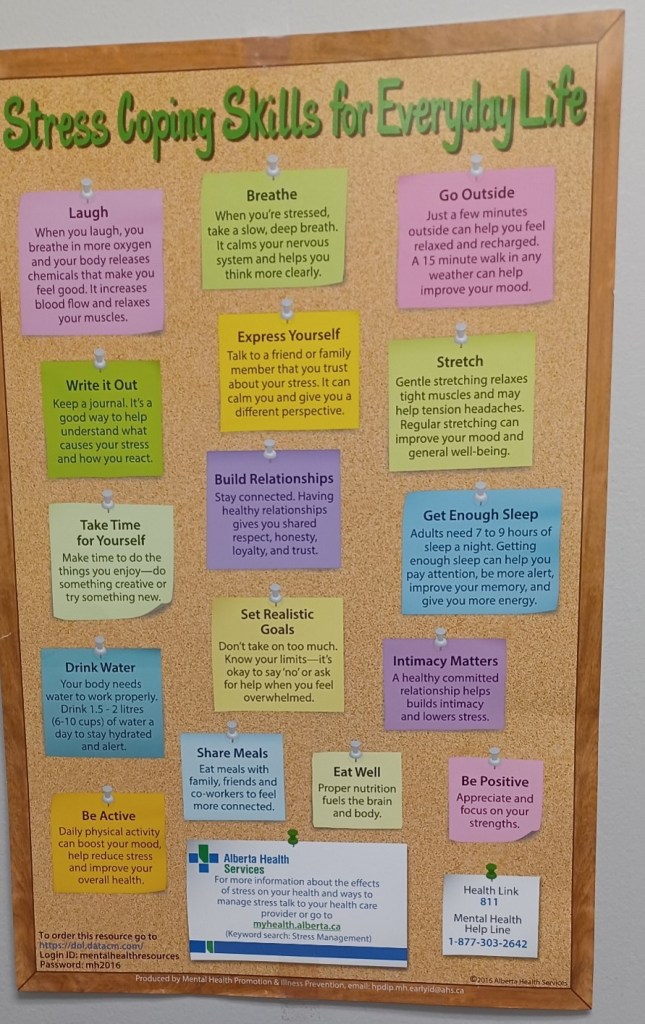
At a recent visit to the doctor I saw this poster on the wall: Stress Coping Skills for Everyday Life.

There are a number of great ideas to put into practice when we are experiencing stress. Some of them are physical exercises such as “go outside” or “stretch”. Others are mental exercises such as “be positive”. There are social exercises and suggestions for eating better and drinking enough water.

These might all be good ideas. They cover most aspects of a person’s life – social, physical, emotional, and mental. But I couldn’t help noticing that there was something missing. Where is the spiritual aspect?

As people who know God, we should recognize the value of going to God in our times of stress. In fact, if we have put our faith in Christ for salvation, then we have also received His Spirit that lives within us. He is God within us. He wants us to have life and have it to the full. (John 10:10)

Like the psalmist David, we can cry out to God in our times of need.

When my spirit grows faint within me,
    it is you who watch over my way.
(Psalm 142: 3)

 Lord, you are the God who saves me;
    day and night I cry out to you.
May my prayer come before you;
    turn your ear to my cry.

 I am overwhelmed with troubles
    and my life draws near to death.
(Psalm 88: 1-3)

Yes, there are many different things we can do to try to alleviate the feelings of stress, but why not call on God to help?

Call out to God for help. Pray. Spend time reading scripture. Allow God to speak. Meditate on passages of scripture or dwell on God’s attributes. Spend time in worship. Sing songs of praise. Listen to songs of praise. Ask God to calm your spirit and empower you by His Spirit to tackle the day with confidence.

When stressed, do what you can to trust God to walk you through it.

Keep looking up,

Andy Wiebe

Book Reviews: Andy’s 2023 Reading Experience

I will be sharing a brief review of every book I read this year. Hope you enjoy and hope it encourages you to keep reading.


7 FRIENDSHIPS EVERY MAN NEEDS – by Justin Erickson

Erickson suggests that every man needs these 7 friends in their life to live a full life. Here are his seven friends: a mentor to disciple you, a Peter to encourage you, a best friend to uphold you, a courageous brother to confront you, a faithful disciple to follow you, a lost seeker to hear you, and a gracious Savior to befriend you. He presents some well though out chapters on the value of each one, comparing them to the value of a pit crew to a Nascar driver. While I do agree that most of us men could use more friends, I think it is highly unlikely that any man will have seven solid friendships in their life at the same time. Some of those roles may be played by the same person, or at times we may have a friend in a certain role for a season, yet his premise holds true: Men need to find more good friends to walk through life with.

Boor Reviews: Andy’s 2023 Reading Experience

I will be sharing a brief review of every book I read this year. Hope you enjoy and hope it encourages you to keep reading.


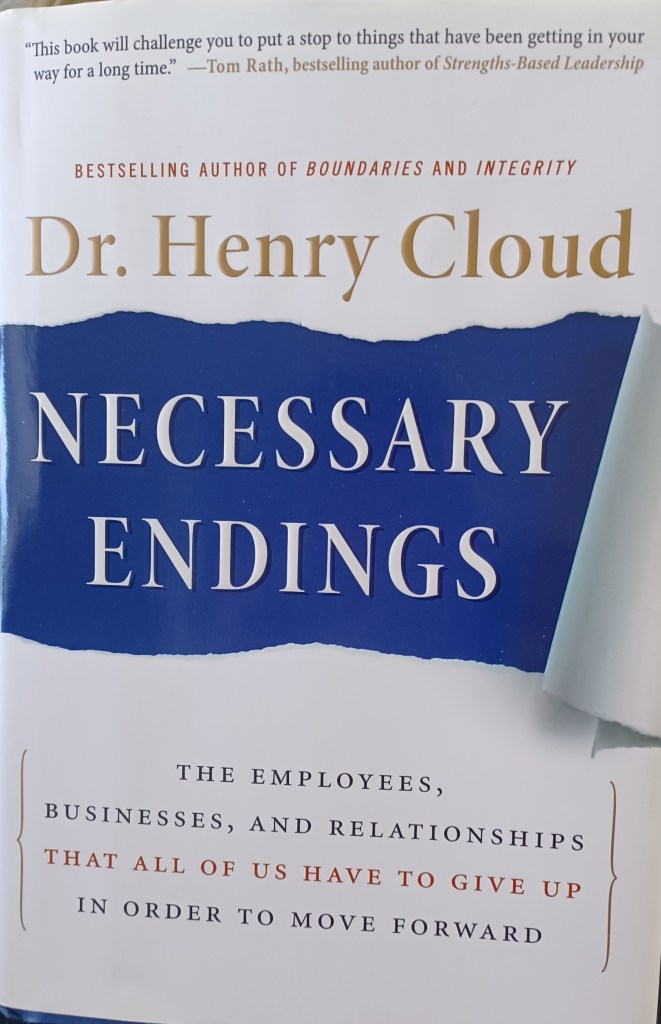
NECESSARY ENDINGS – by Dr. Henry Cloud

In Necessary Endings: The employees, businesses, and relationships that all of us have to give up in order to move forward, Dr. Henry Cloud explains why good endings are needed for good beginnings. He uses a number of great examples to show how appropriate endings at the right time can be very positive for you personally and for the organization you are part of or leading. Some endings are forced on us, and some are ones we choose, in either case we can determine how we will use that ending as an opportunity for something new. When you end something, you have room for that next thing that can be even better than what you just ended. A very helpful book!

Can God Really Be Heard?

As people who love God and want to serve Him, can we actually hear him? Can we have clear direction as we make decisions and lead a church?

God spoke with people in the stories of the Bible. In Genesis 3 the Bible describes a conversation between Adam and Eve and God. It tells us that God came and spent time with them in the Garden of Eden. Many times, prophets in the Bible spoke what they knew were the words of God. And others accepted their words as from God. People like Abraham and God had conversations about how many children he would have. God spoke to Moses from the burning bush. Sometimes God sent his angels as messengers, as seen when Gabriel visited Mary. God spoke through dreams and visions, as he did when warning the Magi not to return to King Herod after visiting Jesus. When people in the Bible heard God speak to them, they were confident that it was Him and clear about what He was saying to them.

God clearly spoke through His Son. John 1 tells us that Jesus was and is the Word from God. He is the expression of all God is. But Jesus also spoke with his disciples about many things. He taught with authority – so much so that people wondered where he got his authority. Jesus’ disciples had intimate conversations with Jesus dealing with everyday life like paying taxes, or dealing with the fact that he would have to die and rise again. He spoke to the two on the road to Emmaus, in Luke 24. Even though those who heard from Jesus were sometimes unsure what Jesus meant when he spoke, they clearly heard him, and had the privilege of asking questions to clarify what He meant.

God spoke in and still speaks through scripture. 1 Peter 1: 20-21 says, “Above all, you must realize that no prophecy in Scripture ever came from the prophet’s own understanding, or from human initiative. No, those prophets were moved by the Holy Spirit, and they spoke from God.” The scriptures are God’s words to us. 2 Timothy 3: 16-17 record Paul’s words to Timothy on the value and purpose of the Scriptures in people’s lives: all Scripture is inspired by God and is useful to teach us what is true and learn what is wrong in our lives. It corrects us when we are wrong and teaches us to do right. God uses it to prepare and equip his people to do every good work.” The scriptures are God’s words of guidance in our lives so we know how to live a life that honours Him. As God speaks in Scripture, we can clearly hear his direction for how to live our lives.

Sometimes God combines a few ways of speaking to give clear direction. A good example is the story of Philip leading the Ethiopian eunuch to Christ in Acts 8. First, an angel told Philip in verse 26, ‘” Go south down the desert road that runs from Jerusalem to Gaza.” So, he did. He started travelling down the road until he came upon this man sitting in his carriage. Verse 29 says, “The Holy Spirit said to Philip, “Go over and walk along beside the carriage.’” Philip did. He heard the man reading scripture so he asked, “Do you understand what you are reading?” The man did not and invited Philip into the carriage to sit with him and explain it. In the end, the man wanted to be baptized as he accepted he Good News of Jesus.

In this case, God spoke through an angel, through the Holy Spirit, through Philips willingness to enter into a conversation with the man, and through the scriptures – all to get the right person to talk with this man and explain salvation to him!

Philip clearly heard he was to go on that road, then clearly heard he was to go up to the chariot. But then, no one told him to enter into a conversation. He saw this as the next right thing to do. As the man asked questions, Philip explained scripture for him to understand and respond to.

I believe we serve the same God who will speak to us and direct us as we listen to him, though it doesn’t always seem as clear as we wish. God can and still occasionally speaks through angels. God can and does speak through the Holy Spirit. This may be an “out loud” voice or it may be strong sense that you need to do something. Sometimes we get this sense we are to call someone or visit someone and perhaps after responding, we see that God was setting that up. God can, and still does, speak through scripture. There are times when a certain verse jumps out at you as you are reading, and you know that was God’s encouragement for you. Sometimes, God will use a verse to clearly direct you.

God continues to speak in various ways. I have had God clearly direct me through seeing certain signs on trucks. He used these signs as a reminder of something I had written in my prayer journal, and he showed me the answer. I have had God speak through thoughts or feelings I was supposed to do something. I have heard God through the words others spoke. I have “heard” God speak through pictures he has given me in my mind. And many times God has spoken to me as I read the Bible, His Word to us.

God wants to speak to us. I am convinced of that. I also believe that God does not want us to be confused. We need to expect God to speak, and then respond as we believe we should. And if it is not clear, then ask him for clarity. Look to scripture to speak. Even ask God to speak through other wise people around you. Believe that God is interested in you and wants to speak. Keep listening.

And keep looking up,

Andy Wiebe

Book Reviews: Andy’s 2023 Reading Experience

I will be sharing a brief review of every book I read this year. Hope you enjoy and hope it encourages you to keep reading.


THE POSTMODERN PILGRIM’S PROGRESS by Kyle Mann and Joel Berry

Mann and Berry write a funny and entertaining allegory of the Christian life. It is a light read with a powerful reminder of how we get sidetracked with many varieties of ways we live our Christian lives. They do a good job reminding us of the main purpose of the Christian life, to keep on going forward in the journey toward a true relationship with the King!