I will be sharing a brief review of every book I read this year. Hope you enjoy and hope it encourages you to keep reading.
DISCIPLINES OF A GODLY MAN – R. Kent Hughes
Disciplines of a Godly Man is a call to men in the church and home to stand up and be whom God has called them to be. Kent Hughes challenges men to step up and discipline themselves with chapters dealing on personal soul issues, relationships, character, and ministry. The church is looking for good men to give themselves to the work of ministry. God is looking for good men to give themselves to leading in the home, the church, and in the culture. Hughes does a good job reminding us that this is not about legalism: doing something in order to gain God’s favor. In fact, this is the opposite. This is about living in such a way that we honor the One who already loves us and calls us to a disciplined life of faith in Him. This would be a great book to walk through with a Men’s Group.
Work is part of daily life for most people. We use our minds and our muscles to create and contribute to our world.
Work is an essential part of why we were created. In Genesis 2: 15 we read, “The Lord God took the man and put him in the garden of Eden to work it and keep it” (ESV). This happened before the Fall, where Adam and Eve sinned and received God’s judgement. And this is part of who we were created to be. When God finished creating the world, we are told he “rested from all his work that he had done in creation” (Genesis 2: 3). We are created in the image of God, so we are created – in part – to work. The ideal life is not one without work, but one in which we find joy in our work.
Work became harder after the Fall, after Adam and Eve sinned. Genesis 3: 17 – 19 tells us that work now became more difficult.
“…cursed is the ground because of you; in pain you shall eat of it all the days of your life; 18 thorns and thistles it shall bring forth for you; and you shall eat the plants of the field. 19 By the sweat of your face you shall eat bread…”
God also created us to rest. God created us for a regular rhythm of work and rest. He created for six days and then rested on the seventh. All throughout the Old Testament God continued to tell his people, to work for six days, then rest on the seventh.
Many of us work jobs that have shift work that doesn’t line up with a seven-day work week, but we can all make sure to rest when we have our days off. We fulfill our purpose as we keep a rhythm of work and rest.
The New Testament agrees with Genesis: we are created to work. Ephesians 2: 10 tells us, “For we are his workmanship, created in Christ Jesus for good works, which God prepared beforehand, that we should walk in them”. When we come to faith in Jesus, he works in us to do good works. There is no instruction about what these exact works are to look like or how we are to go about them. Instead, we are told in 1 Corinthians 10:31, “whether you eat or drink, or whatever you do, do all to the glory of God.” Whatever we do, whether we are working or taking a day off, whether we are spending time with friends or attending a church service, we are to do everything we do for the glory of God!
Like most of life, how we handle work requires balance. On one extreme is the lazy worker, the one who slacks off as soon as the boss walks away. This is the one who takes extra long breaks and helps himself to supplies from the shop for his own projects at home. This is the worker who does whatever he can to keep his contribution to the company to a minimum. If this is you, then you have some serious questions to ask yourself. How are you reflecting the creator in your work? How are you doing your work for the glory of God?
On the other extreme is the workaholic. This is the one who prides himself in how many hours he has put in this week. I have heard pastors boast about how many hours they work each week, as if this makes them extra special. Or maybe they feel this shows how much they are willing to sacrifice in order to serve the church. Sacrificing your energy, time with your spouse and your family, or even time with God is not a sacrifice that God is going to be impressed with. Boasting about how many years you have gone without a holiday does not make you a good worker in God’s eyes. Where is the balance of work and rest? Where is the understanding that work is one priority in your life, not the main one. How many, men especially, have poured their lives into their work and had no time and energy to pour into their kids at home? Sometimes we may find ourselves in a situation in which we need to work more hours than allows for a good balance, whether this is due to financial stress, busy events or seasons at work, or many other life circumstances. However, if you choose to work beyond what leads to a healthy life for you and your family, it is likely time to re-evaluate your priorities.
In the middle is the balance we are all trying to find. Putting in a good day’s work and having time to love and play with your family is ideal. Christians should always do good work. We should be able to echo the evaluation of God at the end of Creation: “And God saw everything that he had made, and behold, it was very good” (Genesis 1: 31). We should be proud of our efforts at work, and what our effort accomplishes. And we should be proud of the time we have to pour into our family and what those efforts accomplish.
I write with the Christian leader in mind. So, Christian leader, how are you doing with your work and rest, and work and family balance? And don’t get caught up in the mindset that we have to work hard for and at the church at the cost of time with family. The father who desires to have a reputation of someone always serving the church needs to balance their efforts at the church with their time with their family as well.
We are created to work, and to rest. May God guide you as you balance your work and the rest of your life.
I realized that I did not take a day off last week, and it showed. I was more tired by the end of the week than I usually am. I felt a push to get certain things done and decided to work on them on my day off. Most of us get a day or more off from work each week, and if you work shift work you may get a few days or weeks off after putting in several weeks in a row.
Time off should be a time to rest, refresh, and energize:
A Change of Routine
Some say that a change is as good as a rest. I’m not sure that is true, but a change of routine can be good for us. If we always go in to work, a day home can be a good change. If you work from home, not logging onto your computer for the day might be a good change or spending the day out of the house going shopping and running errands might be a welcome change. Your mind can take in a different set of stimuli than it has at work all week. It uses different parts of your brain to do these tasks than what you would do at work. You may use different muscles on a day off which can benefit your body.
A Rest
Rest is not easy to get in our busy lives, but a day off may allow you to sleep in a bit or grab a nap in the afternoon. You can demand less of your body, giving it a rest as well.
If you regularly spend your day on the computer, you can rest your eyes. I didn’t feel I needed rest on my last day off, so I worked instead. At the end of the week, I realized a restful day would have been of benefit in the long run. I may have had a little more energy to carry me through the next week.
Do Errands
All of us have things on our to-do-lists. Some of them have been there for a while. We may be able to be more focused at work if we know that we cleared some of those items off our list at home. If we have maintenance on our house or car that should have been done but has been put off, that can hang on us all week at work. Do the things you need to at home on your day off so you can focus on your work through the next week.
Catch up with Friends
Some of us have few friends. Is it because we never take time to connect with people outside of work. If your “work friends” are true friends, then hopefully you do some fun things together outside of work. Most of us will have other friendships that we maintain outside of work. Do something fun together. It could be a simple dinner out or a game night together. Find people who charge you up. We all know people who drain us. Those are not people you want to spend your time off with. You can’t afford to be drained from your time off and then head back to work exhausted. Get together with friends who pour into you and energize you.
Learn Something
I like to read. That is relaxing and energizing at the same time for me. I want to learn and be challenged. Learn something new. If you like working around the house, you could watch a YouTube video about how to place tile on your kitchen counter. Or you could sign up for a self-directed online course that you can work on a bit every time you have some time off. You could even watch baking shows, both for the entertainment, but also to learn another trick to try the next time you bake.
Do Something Meaningless
Some of us are so driven that we feel we can’t “waste” any time. Every day has to accomplish something.
Maybe you just need to watch a movie for fun or go feed ducks. Maybe you need to make a fire in the backyard and just watch the flames and enjoy a s’more or two. Read a fiction book to let your imagination run wild.
Do Something Meaningless
Some of us are so driven that we feel we can’t “waste” any time. Every day has to accomplish something. Maybe you just need to watch a movie for fun or go feed ducks. Maybe you need to make a fire in the backyard and just watch the flames and enjoy a s’more or two. Read a fiction book to let your imagination run wild.
Use your time off, whether it is a weekly day or a week each month, to rest, refresh, and re-energize yourself for the next stretch of work. Take time to slow down and enjoy life.
I will be sharing a brief review of every book I read this year. Hope you enjoy and hope it encourages you to keep reading.
MASTER LEADERS – by George Barna
If you want some leadership tips from a number of leaders in one book, this is it. Barna has interviewed thirty leaders and summarized their responses into sixteen keys to success. The leaders are from various backgrounds: Politics, business, sports, etc. The leaders share from their own experiences, including good examples of how they followed through or fell short of the leadership tips they are sharing. This is an excellent book for anyone wanting a good primer on leadership.
Sometimes our dreams are dashed in front of us. We had all kinds of dreams, were convinced that we were doing exactly what God wanted in the place he wanted us, and life is not going as we had planned.
All of us face disappointment. All of us will have times of discouragement. But sometimes the load seems too much. We consider giving up and moving on to something else. We feel that those close to us don’t understand how big the load is that we carry. We feel very alone. We may feel God has given up on us.
I’m reminded of the story of Joseph in the Bible, which begins in Genesis 37 and goes on for a few chapters. Joseph had eleven brothers. They hated him because they saw that he was Daddy’s favorite. Joseph had a few dreams that made it look like the rest of the family, all the brothers and their Dad, would bow down before Joseph. Sharing those dreams didn’t help his brother’s hatred. A few of them arranged it to look as if wild animals killed him, and then sold him to some slave traders. Those slave traders brought Joseph to Egypt and sold him to one of the Pharoah’s top officials.
That would be a terrible experience for anyone. No one would be shocked if Joseph became angry. Instead of being a rebellious and belligerent young slave, Joseph served his master well. In fact, his effort was rewarded by the master making him his attendant in charge of the whole household. Jospeh overcomes being sold as a slave and manages to do good for his master. What an amazing example of overcoming disappointment. Instead of letting the disappointment of the situation he finds himself in, causing him to dwell on his own terrible misfortune, Joseph rises above that to continue to do his best as a person – and as a slave.
Then his master’s wife tries to seduce him, but he runs away in order not to sin in this way. The master believes his wife when she accuses Joseph, and he sends Joseph to prison. A second wave of disappointment must have hit Joseph. No one would have been surprised if he was angry at God or became a hardened criminal in prison. Instead, he overcomes that disappointment by doing good in prison. Like when he arrived at the official’s house, his abilities and attitude are soon recognized, and he is placed in charge over all the prisoners. Yes, God is with him, His blessing is evident, but Joseph overcomes what would have been a terribly disappointing situation and is rewarded. Again, instead of letting the situation push him into despair or anger at God, he continues to do his best in the situation he finds himself in.
After some time, Joseph becomes aware through a dream, that one of his fellow prisoners will be soon released and return to his position as Pharaoh’s cupbearer. Joseph asks the cupbearer to please remember him when he returns to Pharaoh’s palace. Joseph begs him to speak up on his behalf and get him out of prison. The cupbearer gets his position back but forgets about poor Joseph back in prison. As time goes on Joseph realizes the cupbearer didn’t speak up and he remains in prison, experiencing yet another disappointment.
Two years later Pharoah has a dream. Finally the cupbearer remembers Joseph, and how he was able to interpret dreams for him. He recommends that Pharoah speak with Joseph, and Joseph is brought in to explain Pharoah’s dream. When Joseph favourably explains the dream, Pharaoh ends up making Joseph his second in command!
Joseph survived a few waves of disappointment – terrible things to endure. He made it through and God placed him over all of Egypt, second only to Pharaoh.
Some time later, when famine hits the homeland, Joseph’s brothers came to Egypt looking for food. Since Joseph is in charge of the grain, they bow down before him – just like the dreams Joseph had as a youngster! And then Joseph makes an incredible statement in Genesis 50: 20: “You intended to harm me, but God intended it for good to accomplish what is now being done, the saving of many lives.”
Not only did Joseph survive all the terrible disappointments, he saw that God used what others did to him as a means to accomplish great good!
Some lessons to help us survive disappointments:
1. Trust that God is the same God in both moments of triumph and moments of despair. Joseph never blamed God for what was happening. He even ended up saying God was in all of the things he suffered.
2. Be faithful where you are, no matter how disappointing. Joseph did his best in every situation he found himself in. And God blessed him and rewarded him. Whether the disappointments result in goals left unreached or a position terminated when you still had dreams to pursue, be faithful to God wherever you find yourself next.
Be the person God wants you to be no matter what the circumstances are around you.
3. Find your sense of well-being in your relationship with God rather than in your circumstances. Whether Joseph was head slave in an important official’s house or a lowly prisoner, he did everything to the best of his abilities.
4. Trust that God will look after the future. Serve God faithfully right now, wherever you are, trusting that God knows all the next steps and future twists and turns, and that you are safe in His hands.
Disappointments will come. Sometimes they are small, often they are big. We can survive them if we continue to trust God and know we are safe with Him.
When your dreams are dashed and life is not meeting your expectations, continue to hold onto God in the middle of the frustration and pain.
I will be sharing a brief review of every book I read this year. Hope you enjoy and hope it encourages you to keep reading.
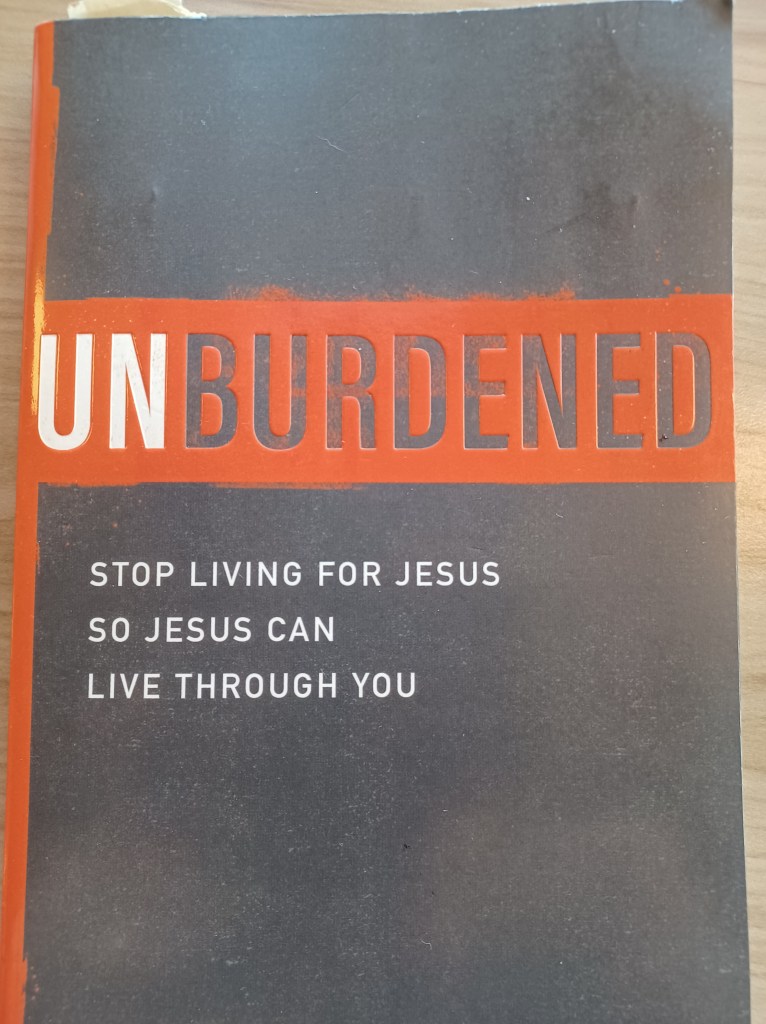
UNBURDENED – by Vance Pitman
This is among the TOP 3 books of the year so far! I know that I often describe the book I am reviewing as good, this one is great. Unburdened: Stop Living for Jesus so Jesus Can Live Through You is a much needed book for today’s Christian. We get so caught up in “doing what I need to do” to be a good Christian, that we slip into religion and loose the relationship with Jesus. Vance Pitman states in the Introduction: “The Christian life is not me living for Jesus but Jesus living His life in and through me.” Instead of having a list of do’s and don’ts to become a better Christian, work at building your relationship with Jesus. The more time you spend with Him, in tune with Him, listening to Him, and obeying Him, the more like Jesus you will become. Pitman describes our purpose as a Christian: God brought you to Himself so out of the outflow of your intimate relationship with Him – which is Christ in you, working through you – you could share in His mission locally and globally in fellowship with others.” The key in all of that is to pursue an intimate relationship with Jesus and the rest will flow out of you naturally. A great book that you will be challenged and encouraged by as a Christian.
Integrity is a characteristic that makes most lists describing good leaders. As you read the list of definitions of integrity below, evaluate yourself as to how you match up. If you want to become a better leader, with integrity, choose one to work on.
You are a person of integrity if:
You are the same person in every circumstance. While we may act differently when with friends or family or coworkers, we should display the same integrity in every case, no matter who you are talking to, or what context you are in, or how much you have had to drink or how tired you are. Consistency.
You are quick to acknowledge mistakes your mistakes, such as failed communication or broken promises.
You are who you say you are. Your actions match your words.
You are honest. Never surrendering to the draw of the white lie. Truth is a high value for you.
You are a person of few excuses. You never use “sorry” as an excuse or to get out of something. If you say “sorry”, you also look at how to correct the situation.
You are never satisfied with producing low quality work. You always do your best.
You make the tough calls. You know when to shut down a useless endeavor, when to address concerns of team members, and when to challenge someone to do better. You do not allow problems to simmer.
You do not throw others under the bus to save yourself. You take personal responsibility.
You are trustworthy. If you promote a new event or project, people trust that you will do the work necessary to make it the best it can be.
You want to be understood, not just heard. You learn how to communicate well.
You are quick to give credit where credit is due. You never claim credit for another’s ideas or work.
You respect people, whether a boss or employee, whether a team member or a client.
You are persistent, and follow through, not giving up easily. You look for ways to makes something work, rather than an excuse to give up.
You are ethical. You are more concerned about doing the right things than just doing things right. You do the right things even when no one is looking.
You have a high regard for the standards of your profession, calling, and position.
I hope you measure up to these 15 values, if not, you might choose one or two to start working on right now. Leaders, let’s be people of integrity.
I will be sharing a brief review of every book I read this year. Hope you enjoy and hope it encourages you to keep reading.
KEEP CHRISTIANITY WEIRD – by Michael Frost
Frost is encouraging the church to return to its counter-cultural beginnings. Instead of trying to blend in under the guise of being relevant, he encourages believers to be different. This is not about being strange to be noticed, but to do things differently than people expect. This is about actually caring for the needy, and being okay with doing things that the average person thinks is strange, if it means being more like Jesus. Frost writes, “Just as business and education is fostering greater creativity and innovation, the church is in a phase of rewarding compliance and conservatism and suppressing eccentricity.” (p. 16) We need to reward creativity, not “toeing the line”. We need out of the box thinkers and leaders.
Frost wants believers to come back to being different in a way that points people to Jesus and a proper understanding of God. “In a world of Moralistic Therapeutic Deism, keeping Christianity weird involves recovering our strange belief in a scary God who can’t ever be fully known, who doesn’t need us, whose face we can’t look upon, and whose name we can’t utter.” (p. 158)
This is a great book for anyone who wants their mediocre Christianity challenged!
I will be sharing a brief review of every book I read this year. Hope you enjoy and hope it encourages you to keep reading.
ALOOF: Figuring Out Life With A God Who Hides – by Tony Kriz
If you are looking for an easy read that packs a punch, this is for you! Tony Kriz walks through his life experience of pursuing a relationship with a God who is often in the shadows. He shares some great stories where God did something miraculous but also makes it clear that these are few and far in between. He does a great job of showing how God is continually there, even when we do not see Him or feel near to Him. Tony is very honest about his personally journey while asking great questions that make the reader think. And there is nothing wrong with thinking deeply about God! A great book for anyone who wants to go deeper with God!
One of the fundamental questions of life is this: Does my life have meaning?
Wrapped up in that question are others. Why am I here? Do I have a role to play? Where do I fit? Can I do something of meaning? What is my purpose?
There is a basic thirst in all humanity to find meaning in life. Everyone wants to find some meaning and value in what they do. And they look for answers in all kinds of places. Some try to fill that thirst with experiences and so they do all kinds of things hoping something will satisfy. They may choose to enhance or even remove the feeling of reality with drugs and drinking. Some chase achievements, some look to “just provide a good life for my family.” Others look to fame. Some look to “leave a legacy” so their name will remain alive long after they are gone. Everyone is searching for that satisfaction that will finally quench their thirst.
The search is on for that elixir that will truly satisfy. This search has carried people in many different directions. If you have attended college or university you will probably have come across some of the following people and their ideas.
Albert Camus wrote in his essay The Myth of Sisyphus “There is but one truly serious philosophical problem, and that is suicide. Judging whether life is or is not worth living amounts to answering the fundamental question of philosophy.” According to Camus, life is entirely without meaning.
Jean-Paul Sartre argued for dealing with the meaninglessness of life by creating our own meaning. We decide, not God, or any other person, what we find meaning in.
Augustine of Hippo and Blaise Pascal, though many years apart have both been connected to the idea of a “God-shaped hole” in mankind, or an “infinite abyss”, that Pascal wrote in Pensées, “this he tries in vain to fill with everything around him, seeking in things that are not there the help he cannot find in those that are...” Looking for something that doesn’t exist, outside of God.
Solomon, King of Israel, declared in his book, Ecclesiastes, “Everything is meaningless… completely meaningless! …I observed everything going on under the sun, and really, it is all meaningless—like chasing the wind.” (Ecclesiastes 1: 2, 14).
Solomon’s journey for meaning led him to seek pleasure and wisdom and hard work, and found none of these pursuits were fulfilling. In Ecclesiastes 3: 14 he says, “God has made everything beautiful for its own time. He has planted eternity in the human heart, but even so, people cannot see the whole scope of God’s work from beginning to end.” There is something in the human heart that longs for more. This is reminiscent of the “God shaped hole” or “infinite abyss” that is longing to be filled, to be satisfied. This thirst that is longing to be quenched.
Solomon journeys on, looking at the injustices of life, the futility of political endeavors and chasing after and gaining wealth. He points out that everyone dies. So what is the value of the time of our existence?
In chapter 11 Solomon encourages both the old and young to treasure their days, and reminds them that God is part of the answer to our thirst for meaning. Yet he still views life as meaningless.
When people live to be very old, let them rejoice in every day of life. But let them also remember there will be many dark days. Everything still to come is meaningless.
Young people, it’s wonderful to be young! Enjoy every minute of it. Do everything you want to do; take it all in. But remember that you must give an account to God for everything you do. So refuse to worry, and keep your body healthy. But remember that youth, with a whole life before you, is meaningless. (Ecclesiastes 11: 8-9)
In the end Solomon concludes “Fear God and obey his commands, for this is everyone’s duty. God will judge us for everything we do, including every secret thing, whether good or bad.” (Ecclesiastes 12: 13-14.)
His final conclusion is we need to recognize that God has the final say about our meaning and value. He is the final judge. Our job is to obey him and find meaning in that obedience to God. There is no meaning in all other pursuits, except in honoring God in those pursuits.
The thirst of humanity cannot be satisfied with any other pursuit than that which brings us into a relationship with the One who made us. God created us to have a relationship with Him. Any pursuit that looks for satisfaction outside of that relationship will never satisfy. To look for contentment outside of what we were created for will only bring more dissatisfaction and frustration.
To use a drill to pound a nail or a file to chop wood is ridiculous and frustrating. We need to come to God who created us for relationship with Him, and as we honor and worship him our craving will find relief.
Your thirst can only be quenched as you drink deeply from God who created you and loves you!











 Elevate with Andy