Ending Well

Every job you take on will eventually end. It may end when you retire after serving for 29 years like it did for the pastor of the church I am working with right now. The job may end when you are pushed out or let go. The job may end because you have a new opportunity waiting for you. Every job will eventually end, the question is: Will you end well?

When an ending happens on our own terms, like retirement or leaving to pursue another opportunity, our mindset is very different than when we are let go. Our attitude is also affected by how we feel about the people we are leaving behind. If we are not on good terms with most people on our team or in the church we serve, we may not mind leaving; if we are leaving good friends behind it may be bittersweet even if we are leaving on our own terms.

In either case, how do you end well?

Ending well has a lot to do with your attitude. You can choose to be grumpy and make your last days a grumpy experience for all, or you can determine to be cheerful, no matter the circumstances around your leaving.

I recently completed a contract with a church. As the last few weeks were winding down, I determined to make sure I stayed fully engaged right to the end. It was encouraging for people to see. One person even used the words, “We see you are fully engaged and not winding down.” I wanted to give my best. I deliberately planned a workshop for the second last weekend at the church, so I had something specific to work towards.

I encourage you to stay as engaged as possible even as you are nearing the final days. Don’t just coast the last bit but do what you can to encourage those you are leaving behind. No matter the reason for your departure, there will be some people who will greatly miss you. Encourage them as you finish up.

Do your best with every task you are responsible for. Look for ways to hand off any tasks others will be taking over. Make it a smooth transition for them. You don’t want people frustrated with you as you head for the door.

One of the reasons you want to end well is that everything you do is a demonstration of God’s character. You want to point people to Jesus, not leave them frustrated with you. You want to reflect well on the one you say you believe in and follow.

Another reason for ending well, is that everything you do contributes to your own reputation. Don’t burn bridges, you may need them again down the road. I was fired from one church. Over 20 years later they had me come back to be their transition pastor. The people in the church who still remembered me thought well of me and welcomed me back. Who knows what God will do in the years ahead, so end well so you are not destroying relationships that may be beneficial down the road.

End well, for the glory of God, for the good of the church, and for your own good. Protect relationships that you may need and want in the years to come.

Keep looking up,

Andy Wiebe

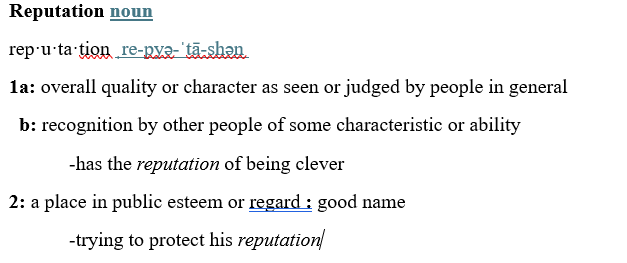
Guard Your Reputation!

What people think about you because of what they have observed about you makes a difference as to whether people will want to spend time with you or even listen to what you say.

People are always observing you and your actions, and when they do, they instantly make assessments about who you are and what you are like. As people see you act you gain a reputation. It may be a good one, it may be a negative one. The only way you can gain a good reputation is by being careful about how you act and how you treat people.

Reputation is not about being a people pleaser. This is not about trying to gain the favour of all people by only doing what you think others expect. It is about knowing who you are and what you stand for, and then consistently living that out. But your reputation is also about more than yourself, especially if you are a follower of Christ.

In 1 Timothy 3:7, the apostle Paul describes the attributes of church leaders:  

He must also have a good reputation with outsiders, so that he will not fall into disgrace and into the devil’s trap.

One of the characteristics of a church leader is to have a good reputation “with outsiders.” This is not just about a good reputation with other believers in your church, but also with those who do not yet know Jesus. Thus characteristic does not just apply to church leaders; churches, too, must be filled with people who have good reputations because this is where leaders are developed.     

The word translated “reputation” in 1 Timothy 3:7 could also be translated as “testimony.” So the church leader, or Christians in general, should have a good testimony. This means that their life and words should match up. What they believe and stand for should be evident in how they live their lives and how they interact with believers and unbelievers.

Why? 1 Timothy 3:7 indicates that a good reputation may help a person avoid “falling into disgrace and into the devil’s trap”. A bad reputation may bring personal disgrace, – as well as bring disgrace on the church you are part of and on the Christ you say you believe in. An inconsistent walk could lead a church leader into the devil’s trap where they are no longer living a good testimony and reflecting well on Christ. The bad reputation is then earned by not consistently honoring Jesus with our life. The devil would like nothing better than to make Jesus Christ or his followers look bad.

Guard your reputation, not just so you look good, but to help make Jesus look good! Make sure your belief in Jesus matches the way you do life and conduct your business. You do not want your reputation to cause others to lose interest in Jesus. Live a consistently God-honoring life!

Keep looking up,

Andy Wiebe

Ready to Preach, Pray, or Die

There’s an old saying describing how a pastor should be ready for anything at anytime. A pastor should always be ready to preach, pray, or die. I thought of this saying the other day because of a situation I found myself in.

A friend asked me to join him in praying for a friend of his. We were going to meet in my office at the church with the plan of entering into a time of spiritual warfare. His friend did not know Jesus and was facing some torment in his life. His prayers to the god of his religion had not accomplished anything. He was desperate and was now willing to have us pray to our God for him.

One of my first thoughts was, I’m glad I am ready for this. This is going to be a spiritually significant encounter, and I am glad there is no unconfessed sin in my life. I am right with God and feel empowered to be his servant in this situation. It reminded me of the saying to be ready to preach, pray, or die. I wanted nothing in the way if I was going to ask God to fight on behalf of this friend. I was ready.

 As I contemplated this, I realized how absurd this thought was. As followers of Jesus, we should always be ready to serve God in any capacity He invites us into; not just on the occasion when we “feel” ready. Not only pastors, but all Christians should strive to be right with God at all times, ready to serve Him in any way He asks. We should not be afraid to enter into spiritual warfare, as if we had reason to think that we had to do something to prepare first. If we are in right relationship with God, through faith in His Son Jesus, then we are always ready to serve God, no matter what He asks of us.

We should always live our lives free of sin. All sin should be confessed as early and as quickly as we recognize it. We should never carry sin in our life, waiting for a specific moment to deal with it. Deal with it immediately and makes sure you are right with God. Like David, in Psalm 51, desire to live a forgiven life where we are always ready to teach others. We should never harbor sin of any kind. We should always be clean and ready for service to our God.

We need to pray regularly. We need to be in daily communication with God. We need to read Scripture to learn and hear from God, but we also need to be talking with Him all the time. I paused for more prayer as I knew this encounter was coming up in a few hours, but I already had a prayed-up life as I have regular times of prayer with God.

We should continue to build up our faith. We need to remind ourselves regularly of the goodness and faithfulness of God. He provides all we need. He answers prayer. He is with us all the time in all things we face. As we continue to remind ourselves of the great God we serve, we are also equipping ourselves to serve Him when the serving may be difficult. I was not quite sure what to expect but I knew whatever the situation was going to be, God is bigger than anyone or anything else. I had faith in God to handle the situation.

I encourage you to live your life always read to “preach, pray, or die,” always ready to serve Him in whatever situation He may place in front of you.

Keep looking up,

Andy Wiebe

The Real Christmas Story

Luke 1:26-38

New International Version

The Birth of Jesus Foretold

26 In the sixth month of Elizabeth’s pregnancy, God sent the angel Gabriel to Nazareth, a town in Galilee, 27 to a virgin pledged to be married to a man named Joseph, a descendant of David. The virgin’s name was Mary. 28 The angel went to her and said, “Greetings, you who are highly favored! The Lord is with you.”

29 Mary was greatly troubled at his words and wondered what kind of greeting this might be. 30 But the angel said to her, “Do not be afraid, Mary; you have found favor with God. 31 You will conceive and give birth to a son, and you are to call him Jesus. 32 He will be great and will be called the Son of the Most High. The Lord God will give him the throne of his father David, 33 and he will reign over Jacob’s descendants forever; his kingdom will never end.”

34 “How will this be,” Mary asked the angel, “since I am a virgin?”

35 The angel answered, “The Holy Spirit will come on you, and the power of the Most High will overshadow you. So the holy one to be born will be called[a] the Son of God. 36 Even Elizabeth your relative is going to have a child in her old age, and she who was said to be unable to conceive is in her sixth month. 37 For no word from God will ever fail.”

38 “I am the Lord’s servant,” Mary answered. “May your word to me be fulfilled.” Then the angel left her.

Matthew 1:18-25

New International Version

Joseph Accepts Jesus as His Son

18 This is how the birth of Jesus the Messiah came about[a]: His mother Mary was pledged to be married to Joseph, but before they came together, she was found to be pregnant through the Holy Spirit. 19 Because Joseph her husband was faithful to the law, and yet[b] did not want to expose her to public disgrace, he had in mind to divorce her quietly.

20 But after he had considered this, an angel of the Lord appeared to him in a dream and said, “Joseph son of David, do not be afraid to take Mary home as your wife, because what is conceived in her is from the Holy Spirit. 21 She will give birth to a son, and you are to give him the name Jesus,[c] because he will save his people from their sins.”

22 All this took place to fulfill what the Lord had said through the prophet: 23 “The virgin will conceive and give birth to a son, and they will call him Immanuel”[d] (which means “God with us”).

24 When Joseph woke up, he did what the angel of the Lord had commanded him and took Mary home as his wife. 25 But he did not consummate their marriage until she gave birth to a son. And he gave him the name Jesus.

Luke 2:1-7

New International Version

The Birth of Jesus

In those days Caesar Augustus issued a decree that a census should be taken of the entire Roman world. (This was the first census that took place while[a] Quirinius was governor of Syria.) And everyone went to their own town to register.

So Joseph also went up from the town of Nazareth in Galilee to Judea, to Bethlehem the town of David, because he belonged to the house and line of David. He went there to register with Mary, who was pledged to be married to him and was expecting a child. While they were there, the time came for the baby to be born, and she gave birth to her firstborn, a son. She wrapped him in cloths and placed him in a manger, because there was no guest room available for them.

Grief and Hope

As I’m thinking about Christmas and the family celebrations, I am well aware that my mom will not be around this year. She passed away a few months ago. Going to see my Dad at Christmas time will not be the same. There will be an empty spot at the table and a big hole in our conversations where mom would have been.

Blue Christmas Services are special services held in December. Maybe you have had the privilege of taking in one of these services which are designed especially for those who have lost loved ones in the last year. The service includes carols and scriptures like other Christmas services, but it also takes time to acknowledge the pain that many in the service are facing. It is meant to be a time of healing and encouragement for those who are grieving and to give them encouragement as they enter their first Christmas without that loved one present.

The service is a time to remember the hope we have in Christ. All who have put their faith in Christ, if they are gone from here, are present with the Heavenly Father. We have a hope, a certain understanding that to die here is only the doorway into God’s presence.

Brothers and sisters, we do not want you to be uninformed about those who sleep in death, so that you do not grieve like the rest of mankind, who have no hope. For we believe that Jesus died and rose again, and so we believe that God will bring with Jesus those who have fallen asleep in him.

1 Thessalonians 4:13-14

As believers in Jesus, we believe that His death and resurrection was for us. We put our faith in Him and receive eternal life. We get a taste of this eternal life already, but don’t experience it’s fullness until we are with Jesus in God’s presence.

When believers die, they are immediately with God. They are immediately ushered into a place of “no more death or mourning or crying or pain” (Revelation 21:4). Not only are they experiencing the joy of being in God’s presence, but they are also immediately removed from all death or mourning or crying or pain. My mom was suffering a lot of pain regularly. She was taking many different medications. Life was difficult at times. But now she is no longer suffering any crying or pain. That is encouraging even as I grieve.

Knowing that she is with Jesus gives me hope. My grieving is not for her, but for my own loss. I am excited and glad for her, but there are times when I feel the loss. We grieve with hope. We feel the loss but are encouraged by the certainty of where we believe she is now.

Are you feeling the pain of missing a loved one this Christmas season? May it not be a grieving without hope. If they had put their faith in Christ, we know that they are with Jesus. And if you have done the same, you will join them eventually as well.

Yes, we grieve. We may go through the different stages of grieving numerous times as we continue to adapt to this person not being around anymore, and still rejoice that they are now in a place of no more crying and pain in the presence of the Heavenly Father. As believers in Jesus and the promises of a future with Him in heaven, we grieve with hope.

Keep looking up,

Andy Wiebe

Relax and Rest!

Rest doesn’t always come easily for driven people. Many pastors and church leaders are passionate about what they do. They are busy, sometimes with expectations put on them, but often because they see another thing that could be done to help move things forward. There is another person to visit, another meeting to prepare, or a new program to plan for. And Sunday is always coming. Every weekend needs another sermon, and service, and lesson prepared. Rest doesn’t always make it onto the “to do” list.

By the seventh day God had finished the work he had been doing; so on the seventh day he rested from all his work. Then God blessed the seventh day and made it holy, because on it he rested from all the work of creating that he had done.

Genesis 2: 2-3 (NIV)

We see four things God did as He concluded his creation. He finished, rested, blessed, and made holy the seventh day. God quit working. There was a certain point where God said, “That’s enough,” and he stopped working. Not only did he stop working, but he also rested. He took a break. He paused from the work and enjoyed a rest. And then he made the seventh day special by blessing it, and he “made it holy.” He set aside from all other days as a special day.

The people of Israel were told to celebrate the Sabbath every week. There were strict warnings from God to the Jewish people to keep this day as a day to stop working and rest and delight in Him and His creation.

Most Christians do not keep the Sabbath in the way that the Old Testament taught, and I don’t believe we need to; yet finding time to stop working and to rest and delight in God is still honoring to God and a huge benefit to all believers. For many, especially pastors, Sunday is not a Sabbath rest. This past Sunday was a good example. My wife and I left home in the morning at 8:30 am and did not return until 9:30 pm. We had a full Sunday. I had to set up and teach Sunday School. I then led a special Prayer Service. This was followed by visits to three different homes: lunch with one family, tea with another, and supper with a third. In that time, we debriefed the morning with an elder, anointed and prayed for a sick church member, and enjoyed playing games with some other friends. While not a Sabbath rest, as such, this was a great way to spend a Sunday, enjoying God and people.

Spending time with our church family, learning and worshipping together is part of Sabbath. Praying for people and anointing them with oil can be part of Sabbath. What many church leaders and pastors miss out on is the Sabbath rest aspect. For some, this works on a Sunday. For others, we need to set time aside at another time. My wife already asked me which day I was going to take off this week, but a Sabbath is more than just a day off. A meaningful Sabbath is a time to follow the example of God: to stop working, to rest, to delight in the day and in His Creation, and to contemplate the holiness of God. It may include feasting and church and family and friends.  It may include prayer and scripture reading. If you finish the day rested, with your joy refreshed, and feeling God’s pleasure, then you have “sabbathed” well.

I would encourage you to take time in your week to, not just take a day off, but to enjoy God and his creation and rest your body, mind, and soul.

Take time to relax and rest in the presence of God.

Keep looking up,

Andy Wiebe

The Joy of Connecting with Teammates.

I had the privilege this past week of spending a day with others who have a similar role as I do. We don’t actually work together on the same projects or in the same church, but we are all part of the same denomination functioning in the role of transition pastors. There is a special joy in connecting with people who know your role and the situations you face because they face those situations, too. In the past, I was able to connect with fellow rural pastors and pastors in the same region. We may not all serve the same church, but we can connect and relate to shared experiences because of our similar roles.

It may feel like getting to know and spend time with these teammates takes too much time or effort that could be used for other priorities, but I have personally found value in connecting with others who understand my roles.

They understand the frustrations and joys.

    When I met with rural pastors as a rural pastor, I knew that they understood what small-town life was like. They understood the realities of serving a smaller church. When I meet with transition pastors, they know what it is like to face church conflict and to try to mediate it. Transition pastors know what it is like to help churches, to fall in love with them, and then have to move on to a new assignment in a year or two.

    When you are talking with others who know your role, you can share jokes and stories that they understand. They are “in the know” because they do the same things you do. Other transition pastors know the frustration of churches that do not want to change, even though they know they need to. They understand the joy of a board catching God’s vision together as they plan vision and strategy for the church.

    They can provide ideas and advice.

    When I meet with transition pastors, I know they use similar tools and processes as I do in helping churches transition. Transition pastors know what it is like to help churches build on the past to look to the future. One of the benefits of my recent meeting with other transition pastors is to learn about how they handle particular situations. Most of them have more experience in this role than I do so I love to soak up ideas as they talk about their ministry.

    They can pray for me with understanding and clarity.

    One of the joys of meeting with others in similar roles is that we can pray for each other with an understanding of the situations we face. Often we don’t even have to finish our story and the others are already smiling or nodding or even crying as they have gone through similar situations. They can pray for me, and I pray for them, with clarity because we have seen very similar situations where we have served.

    I encourage you to find others who are in a similar situation as you. You need to find “your people” so you can have people around to encourage you and help guide you as you need input and wisdom from them.

    Keep looking up,

    Andy Wiebe

    Getting it All Done!

    Life and ministry can be busy times. Maybe you have taken on too many commitments. Maybe someone else piled responsibilities on you that you can’t ignore. Maybe you thought you had time for everything until an unexpected demand popped up. This happened to me recently. I had accepted a number of responsibilities and thought I could manage them until I found a leak in my shower. Now I had the added work of dealing with house repairs that I am not skilled at and do not love doing. I was beginning to feel quite overwhelmed and wondered how I would get everything done.

    As my anxiety started to rise, I paused my day to spend some time with God. As I was praying, I began to get some clarity and peace, trusting God to help me get done what had to be done by the appropriate deadlines while also dealing with my house. Here are some of the steps I took to focus on one thing at a time:

    Pause the “doing” to be with God

      I took on the various responsibilities because I believed God was guiding me in accepting them. With that in mind, I handed it all over to Him and asked him to give me the time necessary to get it all done on time. I was reminded too, that God was not surprised by my house issues. So if God put these responsibilities in my lap, then he will give me the capacity to get them done.

      Remove anything from your to do list that is not important for now

      Sometimes we feel a duty to do something that we don’t really need to do. I had to reevaluate some of my goals and responsibilities and either eliminate some, or push them to next week.

      Plan my day and week.

      With God’s help, I began plotting all my responsibilities, along with their deadlines, onto my calendar. I tried to spread out the different requirements across the whole week. Then I considered all that I felt I had to accomplish for today. As I looked at the list, I started listing them in order of priority. If I could not complete all the tasks, at least the ones that had to get done today would get done.

      Focus on one thing at a time.

      When we get loaded down with responsibilities, we can get overwhelmed because we see it all in front of us. If we can break it down to what must be done this week, and this day, and this morning, we begin to narrow our focus. And if we tackle one thing at a time, giving it our full attention, we can begin to whittle away at the pile.

      It doesn’t matter how big the pile is, you can only deal with one thing at a time, so choose one thing and give it your best. You could even tell yourself you are focusing on this for a certain amount of time, and when that time is up, you will tackle something else before coming back to the first task.

      Celebrate your accomplishments

      I find it quite exhilarating to be able to check off the items on my calendar as I complete them. It feels good to see the momentum beginning to build toward completion of all the different tasks.

      Yes, life can be very busy at times, busier than we had planned, but God can help us grow in capacity so that we can get things done faster than we thought and can complete our list one task at a time. If God wants us to do it, he will help us to get it done.

      Keep looking up,

      Andy Wiebe

      Reconciliation or a Bumpy Rug?

      The other day, I was speaking with someone who mentioned a “bumpy rug.” She was referring to the practice of ignoring problems and “sweeping them under the rug.” Another similar comment I heard recently was, “Let’s just get this behind us as soon as possible.” In both cases, people were dealing with sin in families and organizations. Both cases reflected a desire to move past the sin and the hurt it caused others as quickly as possible without a desire to actually address the sin and correct it.

      Very few people enjoy conflict. The average person will go out of their way to avoid it. It is not fun when others are mad at you, even if you are doing the right thing. Our desire to get along and please people means that we will try to move past problems without confronting the issue and dealing with it.

      We need to learn to work through the personal pain of a conflict to pursue correction, forgiveness, and reconciliation. We need to see the value of restored relationships both with God and with each other. We need to see the importance of repentance and forgiveness to help people truly get past a problem brought on by sin. We need to see the importance of pointing out sin that is affecting others in the family and in the church.

      We forget that Jesus gave clear direction on how to handle sin with a Christian brother or sister in Matthew 18: 15-17.

      “If your brother or sister sins, go and point out their fault, just between the two of you. If they listen to you, you have won them over. But if they will not listen, take one or two others along, so that ‘every matter may be established by the testimony of two or three witnesses.’ If they still refuse to listen, tell it to the church; and if they refuse to listen even to the church, treat them as you would a pagan or a tax collector.

      Jesus does not advise getting past sin quickly, and definitely does not suggest sweeping it under the rug. Jesus suggest confrontation. He gives some steps. First, go by yourself to the person you know has sinned and point out their sin. Do not tell others about it. Do not take a party with you. Go by yourself.

      The second and third steps are only taken if the first did not resolve the situation. So, second, if the sinner does not respond with repentance then take one or two others with you to confirm you are not just making a personal judgement. With two or three others, you can determine if the person really has sin they need to deal with.

      Third, if the first two steps do not resolve the issue, then tell it to the church. The hope is that the church will push for what is right and stand for truth and righteousness rather than sweep it under the rug. Too many churches prefer the bumpy rug to the pain of confronting and dealing with a sinning brother or sister.

      There is one last step. If the person does not listen and does not correct their ways, treat them as someone who is no longer part of the church. This is a very difficult step for any church to take, yet Jesus teaches this so we know there must be times when his teaching should be applied.

      We need to remove the persistent sinner from any leadership in the church yet continue to love them and pray for them and look for opportunities to draw them back to Jesus.

      Jesus did not write off tax collectors and pagans but invited them to follow him. He even called Matthew, the tax collector, to be one of his disciples. Jesus treated pagans and tax collectors as potential disciples, if only they would leave their sin behind. Even as we can’t allow the persistent sinner a place of leadership in the church, we continue to point them to Jesus, with the hope that they will repent and surrender their hearts to Jesus again.

      Let’s choose to pursue reconciliation, not allow more bumps under the rug!

      Keep looking up,

      Andy Wiebe

      A Grateful Heart

      When parents are raising their children, they teach them how to be polite and how to live into the culture around them. One of the values parents often try to instill into their children is to say thanks. Parents often remind their children to, “Say thank you.” Or they ask the child, “What do you say?” They want the child to express their gratefulness when they receive something.

      Luke 17 tells us a story of ten men sick with leprosy who met Jesus. They stood at a distance, respectful of Jesus who did not have the disease, and called out for Jesus to have pity on them. Jesus tells them to go show themselves to the priest.  As they went to do so, they were cleansed. (The Old Testament Law said the priest was the only one who could declare a person clean after a sickness.)

      We might applaud the faith of these ten in going to do what Jesus said even though they were not cleansed yet. They were only healed as they headed to find the priest. But they were healed!

      Here comes the important part of the story. Yes, they were healed, but what did they do after that? We are told that one of the men who had just been healed, instead of continuing to the priest, turned around, came back, praised God with a loud voice, threw himself at Jesus’ feet, and thanked him. Ten were healed; one came to thank the healer.

       Jesus responded, “Were not all ten cleansed? Where are the other nine? Has no one returned to give praise to God except this foreigner?” Then he said to him, “Rise and go; your faith has made you well.” (Luke 17: 17-19)

      How many times have we completely forgotten to give thanks, enjoying God’s goodness to us as if we deserved it?

      We have a special day in our year that we stop to say “thanks.” Thanksgiving is coming up shortly. While it is good to have one day a year to give thanks, we need to cultivate a grateful heart and to develop an attitude of gratitude. As Paul encourages us in Ephesians 5:20, “always giving thanks to God the Father for everything.” Can we learn to give thanks regularly and not just on special occasions?

      God is good to us in many ways every day. We take so much for granted, that we need reminders to pause and give thanks. If one wants a grateful heart, it means being intentional in giving thanks. Include thanksgiving in your prayers. Give thanks with your family around the dinner table. Thank God for His goodness in your life. Thank God for the unusual things and the answers to prayer. But also thank God for the things we receive from Him every day. The air we breathe, the food we eat, water to drink. Thank Him for creation we can enjoy. Autumne in my part of the world is a beautiful experience as the leaves change color and start to drop from the trees. Notice God’s beauty around you and give thanks.

      Every time we give thanks, we remind ourselves that we depend on God for many things in our life. It is a reminder to us that we need God, and we benefit greatly from the good gifts He gives us!

      Thanksgiving is coming soon, but don’t wait for that special day to give thanks!

      Keep looking up,

      Andy Wiebe