If I Believed In Luck

Good thing I don’t believe in luck. If I believed in luck, I would have no luck at all. Here’s some of my good luck bad luck story from my last few weeks.

Bad luck – I got caught behind a snowplow on the highway and the pickup behind me rammed into me.

Good luck – My wife and I, as well as the people in the other vehicle, were banged up a bit but okay.

Bad luck – It was the weekend and no rental cars available, not even any cars at the place my insurance sent me.

Good luck – another rental place did have a car.

Bad luck – the rental car had to be returned to where we picked it up. It was a 14 hour round trip to drop it off, and then how would I get home?

Good luck – we were allowed to return the rental car to another spot which was only about a 9 hour round trip. Saved a little time.

Bad luck – in order to come home, my wife had to rent a second car to drive down and pick me up.

Good luck – we found a car to replace the one that was totalled on the highway.

Bad luck – within two weeks it was in the shop, for about 2 weeks.

Good luck – they finally got it fixed and we could use it again.

Bad luck – in less than two weeks we hit a deer with the new car and back to the shop it went.

Yesterday was another bad luck good luck situation.

Bad luck – my prescription for my medication had run out. We don’t have a family doctor and go to a walk in which was totally booked by the time I got there.

Good luck – I was referred to another walk in that evening.

Bad luck – by the time I arrived all the spots were taken.

Good luck – they put me on a cancellation list in case there was room and they would call me back. And they did!

Extra good luck – I ended up seeing a doctor who specializes in helping people with chronic pain. Being I was the last patient of the day, she took extra time to walk through what my pain is and had some suggestions to help me. She was the first doctor in a long time who actually understood me and my symptoms and the medication I was taking. She is looking for how she can assist me further!

Okay. I have no place for luck. I don’t believe in luck. I believe in a God who loves his people and takes care of them. Yes, we live in a world where not everything goes our way. At times God allows certain things into our live that are not pleasant, even painful and discouraging. But I am convinced that God is walking with me. When it seems that good luck shows up, I believe it is God stepping in again and again doing those good and wonderful things for us!

This is important to understand in our personal lives and also in our church or business life. God is interested in everything we do. We can go to him with our needs and He will step in. He doesn’t always fix everything, but he definitely walks with us in it. And sometimes, as Psalm 94:12 says, “Blessed is the man you discipline, O Lord.” God uses the different situations we go through, not to punish us, but to help train us to become more like Him and more effective in what He wants us to do in life. Instead of seeing life as bad or good luck, ask God what he wants you to learn along the way.

If I believed in luck I would feel pretty discouraged by now.

Luck? No way! God stepping in? Definitely!

Keep looking up,

Andy Wiebe

Boor Reviews: Andy’s 2023 Reading Experience

I will be sharing a brief review of every book I read this year. Hope you enjoy and hope it encourages you to keep reading.


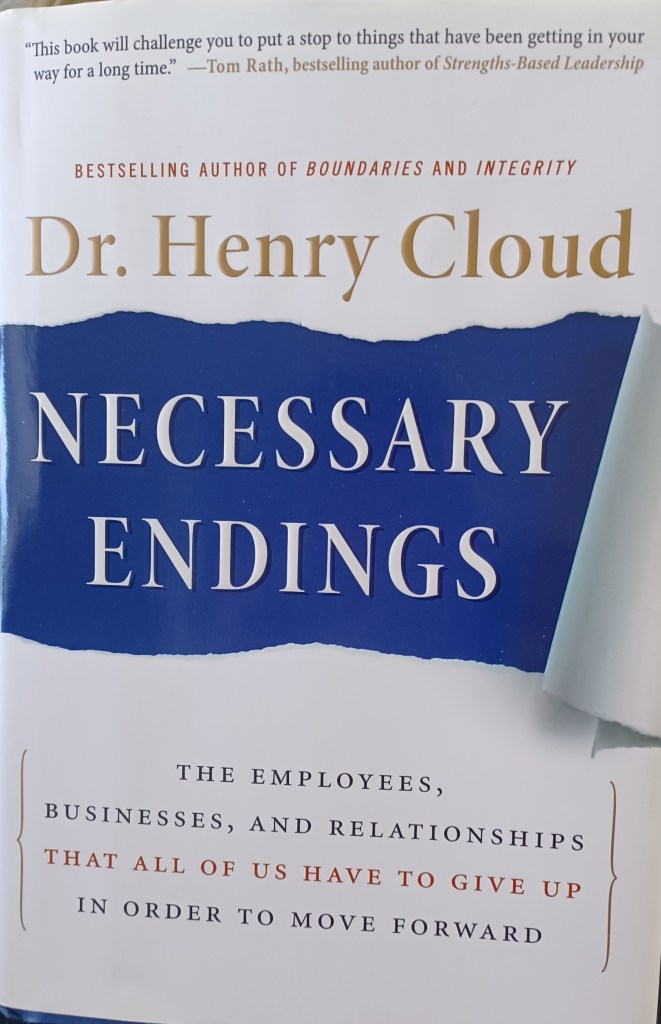
NECESSARY ENDINGS – by Dr. Henry Cloud

In Necessary Endings: The employees, businesses, and relationships that all of us have to give up in order to move forward, Dr. Henry Cloud explains why good endings are needed for good beginnings. He uses a number of great examples to show how appropriate endings at the right time can be very positive for you personally and for the organization you are part of or leading. Some endings are forced on us, and some are ones we choose, in either case we can determine how we will use that ending as an opportunity for something new. When you end something, you have room for that next thing that can be even better than what you just ended. A very helpful book!

Can God Really Be Heard?

As people who love God and want to serve Him, can we actually hear him? Can we have clear direction as we make decisions and lead a church?

God spoke with people in the stories of the Bible. In Genesis 3 the Bible describes a conversation between Adam and Eve and God. It tells us that God came and spent time with them in the Garden of Eden. Many times, prophets in the Bible spoke what they knew were the words of God. And others accepted their words as from God. People like Abraham and God had conversations about how many children he would have. God spoke to Moses from the burning bush. Sometimes God sent his angels as messengers, as seen when Gabriel visited Mary. God spoke through dreams and visions, as he did when warning the Magi not to return to King Herod after visiting Jesus. When people in the Bible heard God speak to them, they were confident that it was Him and clear about what He was saying to them.

God clearly spoke through His Son. John 1 tells us that Jesus was and is the Word from God. He is the expression of all God is. But Jesus also spoke with his disciples about many things. He taught with authority – so much so that people wondered where he got his authority. Jesus’ disciples had intimate conversations with Jesus dealing with everyday life like paying taxes, or dealing with the fact that he would have to die and rise again. He spoke to the two on the road to Emmaus, in Luke 24. Even though those who heard from Jesus were sometimes unsure what Jesus meant when he spoke, they clearly heard him, and had the privilege of asking questions to clarify what He meant.

God spoke in and still speaks through scripture. 1 Peter 1: 20-21 says, “Above all, you must realize that no prophecy in Scripture ever came from the prophet’s own understanding, or from human initiative. No, those prophets were moved by the Holy Spirit, and they spoke from God.” The scriptures are God’s words to us. 2 Timothy 3: 16-17 record Paul’s words to Timothy on the value and purpose of the Scriptures in people’s lives: all Scripture is inspired by God and is useful to teach us what is true and learn what is wrong in our lives. It corrects us when we are wrong and teaches us to do right. God uses it to prepare and equip his people to do every good work.” The scriptures are God’s words of guidance in our lives so we know how to live a life that honours Him. As God speaks in Scripture, we can clearly hear his direction for how to live our lives.

Sometimes God combines a few ways of speaking to give clear direction. A good example is the story of Philip leading the Ethiopian eunuch to Christ in Acts 8. First, an angel told Philip in verse 26, ‘” Go south down the desert road that runs from Jerusalem to Gaza.” So, he did. He started travelling down the road until he came upon this man sitting in his carriage. Verse 29 says, “The Holy Spirit said to Philip, “Go over and walk along beside the carriage.’” Philip did. He heard the man reading scripture so he asked, “Do you understand what you are reading?” The man did not and invited Philip into the carriage to sit with him and explain it. In the end, the man wanted to be baptized as he accepted he Good News of Jesus.

In this case, God spoke through an angel, through the Holy Spirit, through Philips willingness to enter into a conversation with the man, and through the scriptures – all to get the right person to talk with this man and explain salvation to him!

Philip clearly heard he was to go on that road, then clearly heard he was to go up to the chariot. But then, no one told him to enter into a conversation. He saw this as the next right thing to do. As the man asked questions, Philip explained scripture for him to understand and respond to.

I believe we serve the same God who will speak to us and direct us as we listen to him, though it doesn’t always seem as clear as we wish. God can and still occasionally speaks through angels. God can and does speak through the Holy Spirit. This may be an “out loud” voice or it may be strong sense that you need to do something. Sometimes we get this sense we are to call someone or visit someone and perhaps after responding, we see that God was setting that up. God can, and still does, speak through scripture. There are times when a certain verse jumps out at you as you are reading, and you know that was God’s encouragement for you. Sometimes, God will use a verse to clearly direct you.

God continues to speak in various ways. I have had God clearly direct me through seeing certain signs on trucks. He used these signs as a reminder of something I had written in my prayer journal, and he showed me the answer. I have had God speak through thoughts or feelings I was supposed to do something. I have heard God through the words others spoke. I have “heard” God speak through pictures he has given me in my mind. And many times God has spoken to me as I read the Bible, His Word to us.

God wants to speak to us. I am convinced of that. I also believe that God does not want us to be confused. We need to expect God to speak, and then respond as we believe we should. And if it is not clear, then ask him for clarity. Look to scripture to speak. Even ask God to speak through other wise people around you. Believe that God is interested in you and wants to speak. Keep listening.

And keep looking up,

Andy Wiebe

5 Steps to Maintaining Unity When Confronting Divisive Issues

We can all do a pretty good job of getting along when everything is going our way. We can enjoy time with people and think they are pretty good friends. Life is good when no one challenges me or my ideas. But what do we do when someone we thought we were on good terms with ends up on the opposite side of an issue?

The church I am presently serving is facing an issue that is fairly divisive. I won’t tell you what the issue is. You can insert your own issue as I address how we are attempting to maintain unity even as we deal with a divisive issue.

  1. Clarify the Issue

Whatever the issue is that you as a church or organization or team are facing, make sure that you clarify the issue. We thought we had been quite clear on the issue, but we realized that even after weeks of talking about it, people were confused. Do everything you can to make sure everyone knows exactly what you are talking about.

I remember a story of three men going into business together. They had rented a building and were setting up their restaurant. And then a problem arose. One of the men started talking about where he wanted the buffet area. A second interrupted him and told him clearly that a buffet was not part of the plan. They were going to have people come to the counter to order and pick up their meals. By now the third man was getting a little agitated. “I thought this was a fish and chips place!” We have to clarify the issue, and sometimes it means talking about it again and again to get down to what the real issue is so effective communication can take place.

2. Gather Supporting Information

For us, this was a decision that would affect some of our bylaws, so we had to make sure people understood what the bylaw was that was affected by the decision we were about to make. It was an issue that we believed had spiritual connotations, so we made sure to provide documents to our membership with scripture verses and explanations of how they spoke into the question at hand. We did some historical checking to see how this situation had been handled in the past. We even contacted our denominational office to get their input.

3. Prayer

We made sure to pray about this event. We encouraged people to pray on their own, we prayed about it in our services, and we prayed about it at leadership meetings. We prayed about it at discussion meetings we had regarding this question. We asked God to give us clarity and unity in the process.

4. Discussion Events

We hosted one formal evening of discussion on the topic. We recognized that there were people on either side of the question. Each side felt they had scriptural backing to why they believed what they believed. We determined not to enter into a debate. We did not want to set up a situation where we caused people to publicly take sides against each other. So we arranged for a time to carefully look at both sides of the issue. We invited people to speak up, but only in a positive way. No one was allowed to speak against an issue, they could only speak for their side. In this way, everyone was given opportunity to speak into the issue without it being against an individual.

As an aside, it was very encouraging to me as we ended that Discussion Evening, that many present stated their commitment to the unity of the church even if the vote did not go their way when decision time came. They were more concerned about protecting unity as one family or body, than about fighting for their point of view!

5. Make a Decision

At some point you have to decide how you will answer the question at hand. Like us, you may want to have a formal vote by the membership. You will need to decide at which level of authority in your church or organization that decision needs to be made. We encouraged our people to vote as their conscience directed after all the discussion and prayer we had. And then, whatever way the vote went, we trusted that God spoke into our situation and moved ahead according to the results of the vote.

Once a decision has been made, it is important to recognize that not everyone will agree with the decision as you move forward. Be alert to situations where people are having a hard time accepting the decision and take time to walk them as they process the results. You may need to meet with some individuals who are slow in processing the results so that you can help them move forward, encouraging them to trust God will continue to walk with us even as we trusted him to guide our decision process.

May God guide you with divisive issues you face. Too often, we become so closely tied to the issue that we would rather cause disunity than lose out on a vote. May God guide you and help you maintain unity as you too work through issues that could divide.

I would love to hear how you have worked through divisive issues and what worked for you. Let me know. Comment or email me.

Keep looking up,

Andy Wiebe

Book Reviews: Andy’s 2022 Reading Experience

I will be sharing a brief review of every book I read this year. Hope you enjoy and hope it encourages you to keep reading.


BEAUTIFUL OUTLAW – By John Eldredge

Beautiful Outlaw: Experiencing the Playful, Disruptive, Extravagant Personality of Jesus by John Eldredge is a book that will shock some people while encouraging others. He writes about Jesus, but not in the distant manner that we often think of him. Eldredge presents Jesus as a human in a way that few, if any, have before. It is a great reminder that Jesus was a human who walked this earth in a certain place in time within a specific community and with other human friends. Eldredge points out where Jesus responds with emotion like any other human person. He, in his words, is trying to “clear the religious fog” around who our Lord and Saviour Jesus was and is. Do you want to know Jesus better? This book will help you in that search. Your ideas may be challenged, but I do believe the person of Jesus will be revealed as a person you can actually communicate with and live your life with.

Book Reviews: Andy’s 2022 Reading Experience

I will be sharing a brief review of every book I read this year. Hope you enjoy and hope it encourages you to keep reading.


HINGE MOMENTS – by D. Michael Lindsay

Hinge Moments: Making the Most of Life’s Transitions is a powerful guide to anyone facing a transition, and in today’s world that is just about all of us. Transitions will happen, whether we choose them or not. Lindsay builds off interviews of hundreds of leaders looking at their transitions and lessons they learned in the process. He builds his book around a diagram of seven stages of transition. Discernment, Anticipation, Intersection, Landing, Integration, Inspiration, and Realization. He uses the example of a door to show how a “hinge moments” are the opportunities to open (or close) doors to various pathways of our lives. A helpful book for anyone facing or anticipating a transition in their life.

Book Reviews: Andy’s 2022 Reading Experience

I will be sharing a brief review of every book I read this year. Hope you enjoy and hope it encourages you to keep reading.


SWEPT AWAY BY HIS PRESENCE – by Ron Auch

The subtitle of the book is: Refreshing the Church with the Power of Prayer. Ron Auch is calling the church back to prayer. He writes from a Pentecostal background, reminding the reader of the early revivals such as the Asuza Street Revival. In chapter 3 Auch points out how the first generations who experience God have a much different faith experience than the second, and how the third generation often has lost any experience of God. He calls the present generation back to prayer and a real and alive relationship with God. And he says prayer is the way to get that real relationship again. While the book is a little older (1997), the call to prayer is needed just as much today as it was back then.

One Powerful Tool of a Leader

A Christian leader faces the same challenges that any other leader does. And a Christian leader can help himself to any of the tools other leaders use to help them lead well. But the Christian leader has one powerful tool that others do not. Prayer.

Like any tool, it may take some practice and some skill to access this tool’s full potential. Often when we think of prayer, we think of asking God to do something for us. We come to him with a request. But that is only one aspect of prayer.

Another way to use prayer is to learn to listen to God. We are so used to telling God our problems and asking him to do something about them, and that is often where a Christian leader stops. Yet if we learn to listen, God will do much more for us through prayer than just respond to our grocery list of requests.

Here are some of the ways that I have benefited from this great tool we have.

  • God encourages through prayer.

Every leader faces opposition from time to time in their leadership, and Christian leaders are not exempt. As a pastor, I have faced opposition many times, both from inside and outside the church I have been asked to lead. People have called me names, accused me of being controlling, demanded I be removed from my position, and more. People have not liked what I stood for and deliberately chosen to walk in a different direction. I have faced opposition from within myself. There are times I have been disappointed in what my leadership accomplished. I have been disappointed in goals not met. I have been discouraged and depressed.

These are not uncommon problems for leaders to face. There are times we need encouragement. We might find some of it in books or in encouraging words from other leaders or supporters of ours. But I have found that some of the most powerful encouragement has come directly from God.

God has encouraged me as I listened to him. One time he told me: “you are my beloved son in whom I am well pleased.” This was powerful for me as I had just come through one of the most difficult times in my ministry. Another time, God affirmed that I was on the right track. I was a little unsure of the direction to lead the church and in a conversation with Him, I heard (or felt) Him say, “You are on the right track. Just keep going.”

God encourages the Christian leader through listening prayer where we actually hear God or sense God speaking words of encouragement to us.

  • God directs through prayer.

Every leader needs to know where they are going. They need to know where they are trying to take their organization. They need to know the priorities of the day. Sometimes we get caught up in the urgent needs of the moment and begin to veer off track from our intended goals. I love the fact that I can talk with God about my day and ask Him for direction for the day. I am serving as a Transition Pastor right now and have a limited time to work with the church through the various exercises. There are times when I have had to readjust my schedule because it just was not working. As I talked with God about it, I was able to patiently let him give me the priorities of the week.

  • God instructs through prayer.

One of the roles of the Holy Spirit is to instruct and remind the believer of God’s truth. When we pray, we are able to hear God speaking to us through the Holy Spirit. There are times we will be reminded of certain scriptures that speak into a situation that we are facing. There will be times when we will be given an idea or a concept to put into practice that clearly did not come from our own wisdom but from God.

If we pray and read scripture together, God uses those scriptures we are reading to give us insight into how and what we should be learning and doing in our leadership.

There are many tools available to leaders today. One of the best and most powerful tools the Christian leader can access is prayer and hearing God speak directly into their leadership. Pray, not just with a list of requests for God, but with a listening attitude and God will direct your paths.

Keep looking up,

Andy Wiebe

Book Reviews: Andy’s 2022 Reading Experience

I will be sharing a brief review of every book I read this year. Hope you enjoy and hope it encourages you to keep reading.


IS GOD SPEAKING TO ME? – by Lysa Terkeurst

Is God Speaking to me is written by a woman (Lysa Terkeurst) to women, yet I found it very encouraging and a good little read for me too. This 57 page booklet is an excerpt from Lysa’s book, What Happens When Women Say Yes to God. Lysa writes, “I am amazed and saddened by the number of people missing out on the most exciting part of being a Christian – experiencing God.” This booklet is a great encouragement to listen and hear from God. Check it out.

Surviving Disappointment

Sometimes our dreams are dashed in front of us. We had all kinds of dreams, were convinced that we were doing exactly what God wanted in the place he wanted us, and life is not going as we had planned.

All of us face disappointment. All of us will have times of discouragement. But sometimes the load seems too much. We consider giving up and moving on to something else. We feel that those close to us don’t understand how big the load is that we carry. We feel very alone. We may feel God has given up on us.

I’m reminded of the story of Joseph in the Bible, which begins in Genesis 37 and goes on for a few chapters. Joseph had eleven brothers. They hated him because they saw that he was Daddy’s favorite. Joseph had a few dreams that made it look like the rest of the family, all the brothers and their Dad, would bow down before Joseph. Sharing those dreams didn’t help his brother’s hatred. A few of them arranged it to look as if wild animals killed him, and then sold him to some slave traders. Those slave traders brought Joseph to Egypt and sold him to one of the Pharoah’s top officials.

That would be a terrible experience for anyone. No one would be shocked if Joseph became angry. Instead of being a rebellious and belligerent young slave, Joseph served his master well. In fact, his effort was rewarded by the master making him his attendant in charge of the whole household. Jospeh overcomes being sold as a slave and manages to do good for his master. What an amazing example of overcoming disappointment. Instead of letting the disappointment of the situation he finds himself in, causing him to dwell on his own terrible misfortune, Joseph rises above that to continue to do his best as a person – and as a slave.

Then his master’s wife tries to seduce him, but he runs away in order not to sin in this way. The master believes his wife when she accuses Joseph, and he sends Joseph to prison. A second wave of disappointment must have hit Joseph. No one would have been surprised if he was angry at God or became a hardened criminal in prison. Instead, he overcomes that disappointment by doing good in prison. Like when he arrived at the official’s house, his abilities and attitude are soon recognized, and he is placed in charge over all the prisoners. Yes, God is with him, His blessing is evident, but Joseph overcomes what would have been a terribly disappointing situation and is rewarded. Again, instead of letting the situation push him into despair or anger at God, he continues to do his best in the situation he finds himself in.

After some time, Joseph becomes aware through a dream, that one of his fellow prisoners will be soon released and return to his position as Pharaoh’s cupbearer. Joseph asks the cupbearer to please remember him when he returns to Pharaoh’s palace. Joseph begs him to speak up on his behalf and get him out of prison. The cupbearer gets his position back but forgets about poor Joseph back in prison. As time goes on Joseph realizes the cupbearer didn’t speak up and he remains in prison, experiencing yet another disappointment.  

Two years later Pharoah has a dream. Finally the cupbearer remembers Joseph, and how he was able to interpret dreams for him. He recommends that Pharoah speak with Joseph, and Joseph is brought in to explain Pharoah’s dream. When Joseph favourably explains the dream, Pharaoh ends up making Joseph his second in command!

Joseph survived a few waves of disappointment – terrible things to endure. He made it through and God placed him over all of Egypt, second only to Pharaoh.

Some time later, when famine hits the homeland, Joseph’s brothers came to Egypt looking for food. Since Joseph is in charge of the grain, they bow down before him – just like the dreams Joseph had as a youngster! And then Joseph makes an incredible statement in Genesis 50: 20: “You intended to harm me, but God intended it for good to accomplish what is now being done, the saving of many lives.”

Not only did Joseph survive all the terrible disappointments, he saw that God used what others did to him as a means to accomplish great good!

Some lessons to help us survive disappointments:

1. Trust that God is the same God in both moments of triumph and moments of despair. Joseph never blamed God for what was happening. He even ended up saying God was in all of the things he suffered.

2. Be faithful where you are, no matter how disappointing. Joseph did his best in every situation he found himself in. And God blessed him and rewarded him. Whether the disappointments result in goals left unreached or a position terminated when you still had dreams to pursue, be faithful to God wherever you find yourself next.

Be the person God wants you to be no matter what the circumstances are around you.

3. Find your sense of well-being in your relationship with God rather than in your circumstances. Whether Joseph was head slave in an important official’s house or a lowly prisoner, he did everything to the best of his abilities.

4. Trust that God will look after the future. Serve God faithfully right now, wherever you are, trusting that God knows all the next steps and future twists and turns, and that you are safe in His hands.

Disappointments will come. Sometimes they are small, often they are big. We can survive them if we continue to trust God and know we are safe with Him.

When your dreams are dashed and life is not meeting your expectations, continue to hold onto God in the middle of the frustration and pain.

Keep looking up,

Andy Wiebe