Preaching to a Summer Crowd

Preaching to a summer crowd can be a different experience from preaching throughout the rest of the year. Often, the attendance is lower. Sometimes family, friends, and unexpected guests visit. Many regular attendees may be away camping or on vacation on several Sundays so that the crowd may vary each week.

Preaching is not just a monologue. Speakers tend to feed off the crowd, at least to some extent. If you notice one or two people dozing in the audience, your energy can drop; whereas if you see a few people smiling and nodding or fully engaged in what you are saying, your energy can increase. Preachers are also affected by the size of their audience; it’s just a fact. It’s not so much about how big the crowd is but how big it is in comparison to what you expect or what you are used to. If you are used to speaking to a congregation of 200 people, there is a natural let-down when you see there are only ninety people in the audience. If you are used to eighty people and there are only forty some on a given Sunday, you notice.

How can you preach with the same passion and joy throughout the summer?

Remember, God has a message for those present, no matter how many there are.

Pastor, you have prepared your sermon all week. You have been praying and listening to God as you have done your studying and writing. When you arrive on Sunday, you have the message ready that those in attendance need to hear. Yes, it would be nice if all the members of the church were present and heard this sermon you worked so hard on, but trust that the people who are to hear this message you prepared for this Sunday will be present.

Plan stand-alone sermons.

Many pastors like to preach a series from the Psalms during the summer because each Psalm is a separate unit and does not build on previous information the same way many of the other books of the Bible do. Summer may be a time to preach more topically. Choose some topics that speak to concerns in the church or the culture. Announce them ahead of time so that those who want to hear a certain sermon can plan their vacations and camping trips so that they can be present.

Experiment with something new in your preaching.

Summer may be the time for you to try something different. Things already feel different because many people are gone and the numbers are down, so people may be open to something different in the sermon as well. If you have never used an object lesson as part of your sermon, the summer may be the time to try it. A few weeks ago, I preached a sermon on Psalm 150 about how we are to praise God and to do it loudly. I handed out a variety of cheap noisemakers at the end of the sermon, inviting the congregation to use them as we would practice some loud praise. I invited them to shout out the names of God, so we could praise God for who He is. And then as I read the list of names, everyone made their loud noise. Pastor, maybe it’s time to bring out the kazoos.

Invite a member to share a testimony as part of the sermon.

Sometimes, when you are preparing a sermon, you will think of someone in the church who has a great story to tell that would reinforce the point you are making. Prepare the one sharing their story so they keep it to the point and share the part of their story that fits with the sermon you are preaching. Include a member or two in your sermon.

Remember that everyone who comes to church on that Sunday deserves the best you can offer as a preacher. Do not focus on who is absent, but determine to give your best for the ones who are present. Don’t be afraid to change things up a bit and experiment. And find joy in your preaching to the summer crowd.

Keep looking up,

Andy Wiebe

Sermons That Change Lives

A history teacher tells you what happened in the past. Or, they might inspire you to travel to historic sites. A first aid instructor will help you get a first aid certification. Or, they might inspire you to pursue a career as an EMT.

All instructors convey information…but some inspire. In the same way, sermons can convey information…but they should inspire the listener to action. Something should happen as a result of hearing the sermon.

As I was looking ahead to writing this blog, I heard some great material on a podcast I follow(Revitalize & Replant with Mark Clifton) where these two pastors were talking about how to write meaningful sermons. They referred to a model you may be familiar with. They said every sermon needs to answer the following 3 “what” questions: What? So What? and Now What?

The first question – “what?” asks what the scripture says. This is the research that forms the content of the sermon.

The next question asks, “so what?” This focuses on the importance of the scripture. Why is it something we are discussing? Why do we need to know this?

The third question is the one I want to focus on. Most preachers will do a pretty good job on the researching and writing of a sermon. Many identify the importance and value of the scripture. But many sermons fall short on the final question: “now what?”

“Now What?” is about the application of the sermon. Actually, it’s about even more than that. It is about inspiring the listener to want to do something as a result of the sermon they just heard. They cannot just go home with their family, eat their Sunday dinner, and go on with life.

A good preacher will not be satisfied until the sermon calls the listener to action.

Writing a good “now what” conclusion for a sermon requires an understanding of the scripture and what God is intending to communicate. The preacher takes it to heart and recognizes the action God is calling him to. He knows the content so well that the action required emerges from the text.

Further, the preacher needs to understand his local context, because God does not speak to people in a vacuum. We all live in a certain country or province or community. We all have certain political realities we live in. The preacher needs to know how to make the call to action one that fits his local church. This is one reason why it is important for the preacher to know the people who will be listening to the sermon. The application is then connected to the local setting.

I have discovered that giving a few ideas how to respond may help some people, while others will have already felt God speaking to them about a specific response.

Beyond just suggesting ways to respond, the preacher needs to find a way to inspire the congregation to respond. Just to be clear, it the Word of God by the power of the Spirit that changes lives, yet the pastor needs to prayerfully work in tandem with the Spirit to determine what the action should be and how to describe it in such a way that makes people want to respond.

In Acts 2 Peter preaches a powerful sermon. Look at the response of the people in verse 37:

 “When the people heard this, they were cut to the heart and said to Peter and the other apostles, ‘Brothers, what shall we do?’”

The people were not satisfied with information. They felt a response was required of them, but they were unsure what to do. Peter responds: “Repent and be baptized, every one of you, in the name of Jesus Christ for the forgiveness of your sins. And you will receive the gift of the Holy Spirit.”

As a preacher, you want people at the end of your sermon to be asking, “what shall we do?” So take the time to answer this question before you conclude. This should not just be tacked on at the end, but something that is given equal consideration as the body of the sermon because it is just as important.

If you want your sermons to change lives, you must help people see what is expected of them after hearing the sermon.

Keep looking up,

Andy Wiebe

Make Your Sermons More Engaging

I love preaching. I love opening a passage of scripture, expounding on it, and seeing eyes opened and hearts encouraged. The natural tendency is to make the sermon a monologue. Often this serves just fine, but I think it can be enhanced visually.

Personal Sermon Notes

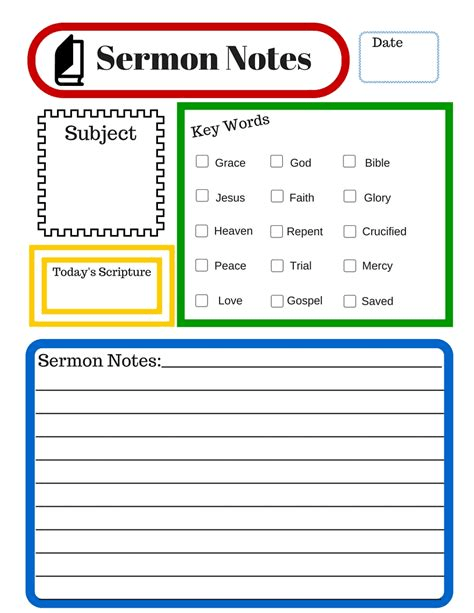
Sermon outlines or notes pages can be included in bulletins or handouts that each person receives as they arrive at church. Adding visual aids in these notes can provide an additional way the congregation follows along with the sermon.

Slides accompanying the sermon

In addition to outlines for each person, slides can be used to highlight a point you are making or a scripture you are referring to.

As a visual person, I appreciate seeing slides that go beyond the text that the pastor is saying, and include relevant images or other visual aids. For example, when quoting a person, include their photo. A sermon illustration could be accompanied by a picture of what is being referenced. If you are speaking on the Lord being our shepherd you could have a picture or brief video clip of a shepherd working with his sheep.

Props

While pictures are useful, the real thing can be even better. Some sermons make it easy to bring in a prop. An easy example could be pointing to a cross  already in your church when you are preaching about Christ’s death. Communion includes props which Jesus instituted: the bread and juice. A sermon from Matthew 7:3-5 about the person with a log in their eye pointing out a speck in another’s eye would be a great time to bring in a 2 X 4 and a little sliver and visually show people the absurdity of that action. A sermon on reaching the world for Christ might be a time to bring in a large world map or globe to point out some of the least reached areas of the world.

Models

This past Sunday I asked my wife, and she agreed, to be a model for me. I am preaching through Colossians, and we were in chapter 3 where Paul writes to the church in Colossae about how to dress as a believer. He specifically talks about “getting rid”, and “putting off”, and “stripping away” certain things. Then he twice says “clothe yourself with” something.

I had my wife put on an old T-shirt over her clothes. Then, after reading the scripture, invited people from the congregation to shout out all the things that were of the old life and were to be put off. As they listed the items from the scripture, I had preprinted words and phrases that I taped to this T-shirt. When they were all taped onto her T-shirt I reminded them that verse 5 talks about “putting to death” the things of the old life. So I picked up a pair of scissors and cut the shirt off of her and through it on the ground. That has now been put to death.

Then I had her put on a suit jacket of mine. Now we continued in the scripture and as they called out the things that we are to “clothe” ourselves with, I taped those words and phrases onto the suit jacket. Once she was wearing all the good things, I had her walk around as if she was a runway model, displaying all the things Paul was telling us to “put on”. I concluded by pointing out how Paul finishes that section by telling us to do all we do for the glory of God. The New Living Translation says we are to be good representatives of Christ in all we do. We are like a model, continually displaying what a Christian should be like. I pointed out that this was not “Dress to Impress”, but “Dress to Express”. We are to put on the things of Christ to show the world what Christ is like.

Look for ways to occasionally bring in a visual to aid your sermon. There will definitely be some who appreciate your efforts.

Keep looking up,

Andy Wiebe

Pursuing Excellence: Plan Your Sermons a Year Ahead

Life happens at a pretty steady pace. In fact, unless you plan ahead, you will be dragging behind regularly, just barely keeping up. It is valuable to set aside time at regularly to do the work of looking ahead. For preachers, there is always another sermon to prepare. Unless you plan ahead, it is difficult to spend adequate time thinking through how to preach a biblically accurate, relevant, and creative sermon. The more you plan ahead, the more time you have to think through and improve each sermon.

1.Natural Blocks of Time

I begin by determining the number of Sundays between natural breaks. For example, if I was going to preach on Christmas through Advent, and typically think of the church “year” from September to June, that means I only have September through November for a longer series. I could preach through a book of the Bible with that many weeks. Or, I might do a series for September and make a change at Thanksgiving. After determining how many Sundays for natural blocks of time, I start praying through and listing what I feel I need to preach on in the next 12 months.

2. Congregational Needs

There are times in a church where it seems the congregation needs a certain topic addressed. For example, I am presently leading a church transition ministry, meaning I come into a church that is newly without a pastor and is looking toward hiring the next one. Sometimes the transition is a painful one, where people have been hurt by the pastor or each other. Many transition pastors preach a series on the “one anothers” of the Bible. (“Love one another” or “forgive one another” and so on). The hope is to help people to restore their relationships and trust in each other.

As you pray and think through the needs of your congregation, God will guide you to which books of the Bible or topics to address. You could invite your leadership team into the process by asking them to suggest needs they see in the congregation. If you know that most people are going to take holidays over the summer, you might want to plan a summer series in which each sermon doesn’t build on previous sermons but can be fully understood on its own. If people miss a sermon, they are not falling behind.

If you have a number of new people, you may want to address some of your denominational and local church beliefs and priorities. Or if your church includes many new Christians, you might want to introduce them to Jesus through preaching through one of the gospels over the next year. You could intersperse it with thematic series at Christmas or leading up to Easter, or just preach right through the gospel.

If there are themes you feel need addressing but don’t fit in your preaching schedule, you could address some of those needs in a class or weekend seminar.

3. Main Idea of Each Sermon

Once you have decided which of the books of the Bible or themes you want to preach on, begin breaking them down to what scriptures will be preached which Sundays. Make sure each independent sermon builds on the theme you have decided on. After identifying the scripture for each Sunday, develop the basic sermon idea. This will not necessarily be the final decision, because at this point you are just doing a quick survey of the material. You may adjust the main idea later, but you want an outline of the focus for each sermon so you can begin to collect supporting materials, ideas, and stories for that focus over the next year leading up to each week’s sermon.

Develop the main ideas well enough so that you can give the music and creative service planning teams about six months’ notice for them to gather material for that Sunday that will fit with the sermon.

4. Monthly Glances Ahead

Each month, spend time looking at the next month’s sermons, reminding yourself of upcoming themes and topics. This helps you watch for how things like the news or world events are speaking into what you will be preaching about, as well as how that sermon will speak to local needs. Keep in touch with those who will be leading music or adding other creative ideas into the service so you are working together and building one cohesive service.

Prayerfully start to define the main focus of each sermon more specifically. Ask God to give you and your team creative ways of speaking truth and applying it to each one who will hear.

5. Weekly Specifics

As you work through the details of planning the sermon and accompanying service for the next Sunday, work closely with any volunteers who will be part of the service. Communicate your theme clearly and make sure you are on the same page with all who will contribute. Pray about the applications you will include in your sermon, and ask God to direct your final preparation so that lives will actually be transformed through what God has helped you prepare.

It is a privilege to weekly stand before a congregation who is waiting to hear from God. Put in the time necessary to be biblically accurate and creatively relevant to your congregation. God will reward your efforts as you continually listen to His guidance right from the time you determine what book of the Bible to preach on to the time you wrap up the conclusion of your sermon.

Keep looking up,

Andy