Discerning Truth

New ideas challenge our understanding. What do we do with new ideas? As a young man, I wanted things to be black and white. I wanted to know right and wrong. I accepted the teachings I received in my church and at home, as well as those I learned at Bible College. I held strong views about beliefs and practices of other churches based on what I had grown up with.

As I ventured into the world, I discovered speakers, authors, and churches who presented ideas I was not comfortable with because they were different than what I thought was right. There were times when the teachings I came across made sense. There were times I had to adjust my thinking because I was wrong, or at least not fully informed, about a certain belief.

How should we respond to new ideas? Let’s look at a couple of ways we often respond to new teachings.

It is new, so it is wrong.

There are some people who are convinced, as I was in my early years, that anything new and different must be wrong.  And if it is wrong, it must be avoided. These people will not accept anything new as true because it is not what they are used to or comfortable with. They will ban those books from their libraries and caution others not to listen to those speakers. In their desire to hold to the truth, they assume that they already have the truth and don’t need to be confused with new ideas. While well-meaning, this is a naïve attitude that prevents many good followers of Jesus from growing.

It is new and I don’t know if it is right or wrong.

Some Christians, when exposed to new ideas, aren’t sure if these are right or wrong, and either don’t want or don’t know how to determine if it is right, so they just choose to ignore the new idea. Maybe it’s too much work to figure out if it is true. Maybe they aren’t sure how to assess it’s validity. Maybe they are comfortable and don’t want anyone to rock the boat. Life is good, I know where I stand, I know what my church teaches, and my friends believe. I don’t need to check out anything else.

Again, this attitude keeps followers of Jesus from growing in their relationship with Jesus as they never struggle with new understandings of God or scripture. Spiritual growth assumes a deeper or further understanding of and obedience to God. This may include accepting something new.

It is new, but is it true?

Other followers of Jesus are aware that they do not have all the answers. They may have already experienced times where a new teaching has given them further clarity about who Jesus is or how He works in their lives. They are willing to do the work to find out if this new teaching is truth or not, and willing to accept and apply the new teaching if it is true.

Their attitude is “I don’t know if it is true, but I will check it out.”

And so they study scripture to see if what they have been hearing is consistent with scripture. They read other authors or listen to other teachers they trust to get advice from other believers. They take time to talk to God about what they have discovered, asking God to give them clarity about what they are hearing. They might consider how this teaching has been accepted by other churches or by some of the older writers.

These followers of Jesus do not just jump on the bandwagon because friends are or because a certain speaker endorses this teaching, but they take time to consider it carefully before accepting it.

I have benefited greatly from discovering teachings that were not part of my childhood or that of my church. I have learned to appreciate teachings on the gifts of the Spirit and learning to listen and hear from God. I have appreciated being challenged on my beliefs about the kingdom of God. I have come a long way from my theological roots, continuing to carefully learn and grow in understanding God and how He works in us. In my pursuit of a deeper intimacy with Jesus, I have had to grow in my understanding and learned to accept new truths along the way.

Discerning truth is not a quick and easy process, but it may be of great benefit to you and your relationship with God as you get to know more. Be willing to do the work of assessing the validity of new teachings you come across without discarding them too quickly.

Keep looking up,

Andy Wiebe

Allowing The Bible To Guide Our Leadership

Many issues arise in our world today because of our search for the answer to the question: What is the truth? Theological issues may come about when we search for answers in teachings we have not heard before. Political issues can begin when we as Christians question what our place is in politics or responding to decisions our governments make. Moral and lifestyle issues are often found when the church is unsure how to respond to what is becoming acceptable in the world around us and even in the church that has historically not been accepted. What is the truth?

While there are many today who pretend we can have different truths to guide us, truth doesn’t work that way. If I am driving down the highway and decide that my truth is that I am in England so I will drive on the left-hand side of the yellow line, my truth will be quickly confronted by another truth when the traffic in that lane comes hurtling towards me. That is a silly simple example, but the fact is, what we believe about things makes a difference, and impacts our relationship with others. Truth, as God has laid it out, affects all of us.

As people of God, and as leaders of churches, we need to recognize that our answers need to be found in God’s Word. His Truth must be upheld in our churches. I do understand that sometimes we need to do some work to determine how God’s truth impacts the questions we face. But our answers should be informed by God’s Word – the Bible.

How might we find answers in the Bible?

Read the Bible.

The first priority to actually read the Bible. Read it regularly and search it for answers to your questions.

As you read, ask God, through the Holy Spirit, to give you correct understanding of what you are reading. We recognize that the Bible is more than a story book, though it contains many stories. Whether we are reading biblical stories, or a teaching section, or even some of the poetic books like Psalms and Proverbs, we want God to help us understand what the truth is and how it applies to my life and to the church where I serve as a leader.

Consult with others on difficult passages or topics.

We are blessed to have the results of many experts at our fingertips. We can find commentaries where others have worked through scripture and give their expert opinions. We can make use of tools that help with word studies and guide us through some of the definitions of the original language. We can read books by people who are struggling through some of the same questions we are. We cannot interpret scripture completely on our own, there is importance in reading scripture in community. Whether we agree or disagree, there is benefit in seeing how others have processed biblical truth in light of this topic. I’m presently reading a great book on how to respond biblically to those living a gay lifestyle. There are many other topics that others have been able to work through in more detail than we have so we can learn from them. Just make sure their teaching is arrived at by careful study of scripture.

And one of the simplest ways to consult others is to have conversations with others in your church as you work through scripture to find the answers you need. Find some other believers and read the Bible together. Work through scripture as a leadership team and ask God to guide you to the correct understanding and application.

Do what it says.

The hardest part of allowing the Bible to guide our leadership, is to then do something about what it says. If it means leadership needs to confront false teachers or people living contrary to truth in your church, then do it. If it means changing policies on how volunteers are screened, then change the policies. If it means teaching the church what it means to live out truth and love in light of Gods Word, then teach your church that.

If we are going to allow the Bible a prominent role in church leadership, then we need to make sure we read it regularly. We need to do the work of understanding it clearly, and then we need to follow through on what God is asking us to do as a result.

If we are Christian leaders, whether in the church or elsewhere, our leadership must be informed by the truth of God’s Word.

Keep looking up,

Andy Wiebe

Book Reviews: Andy’s 2023 Reading Experience

I will be sharing a brief review of every book I read this year. Hope you enjoy and hope it encourages you to keep reading.


KINGDOM VALUES: Character > Chaos – by Tony Evans

This book has two parts. Part one: The Foundation of Biblical Character focuses on Truth. He addresses what Truth actually is, why there is an absence of it, and how to return to it. And then he has a great chapter on “Merging Love with Truth”. Evans says, “Our job as representatives of the King of Kings and the Lord of Lords in the church and outwardly to the world is to inform culture about what heaven thinks on every subject.” He points out that we are to be showing the world around us what it means to live out the truth of God, and do this with love.

Part Two: The Components of Biblical Character is a great journey through the Beatitudes of the Sermon on the Mount. He shows how a correct relationship with God will enable us to be better at living out truth.

Book Reviews: Andy’s 2022 Reading Experience

I will be sharing a brief review of every book I read this year. Hope you enjoy and hope it encourages you to keep reading.

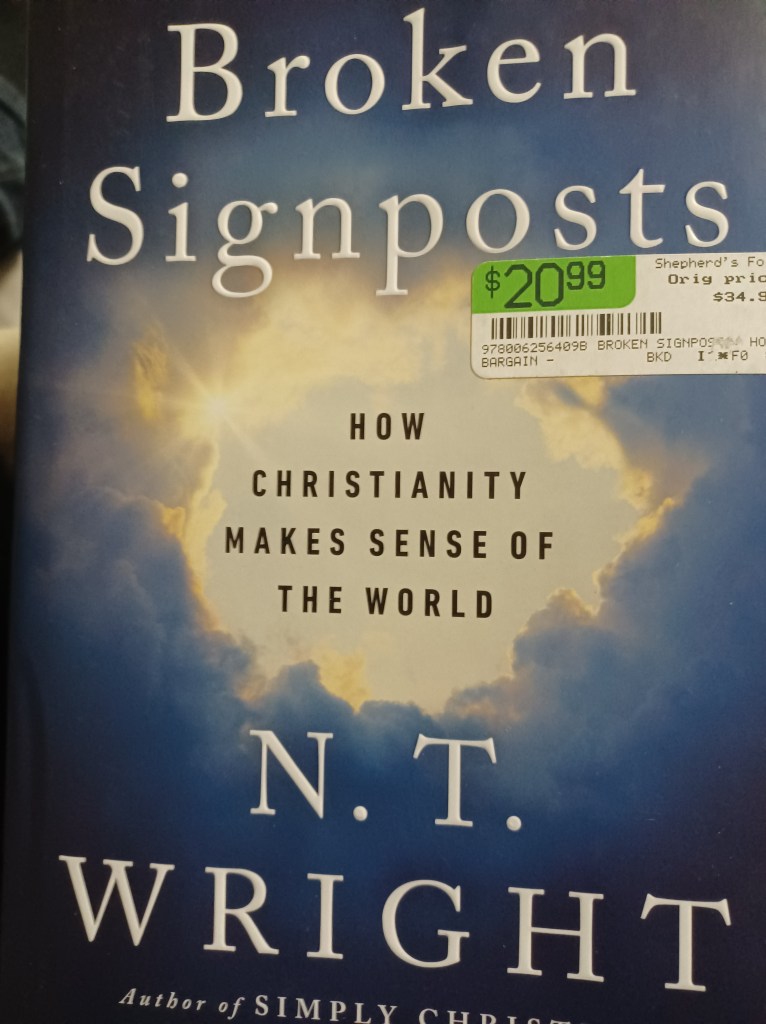
BROKEN SIGNPOSTS – by N. T. Wright

N. T. Wright always makes you think. In this book, he works through themes found in the Gospel of John. He focuses in on seven themes: Justice, Love, Spirituality, Beauty, Freedom, Truth, and Power. He shows how each was to be a signpost pointing to what the effect of Christ’s coming in this world should be. He concludes, “By the power of the Spirit of Jesus the Messiah, crucified and risen from the dead, they can become genuine signposts, mended signals, missional marker posts.” He is portraying what effect Christianity should have in this world.