Ending Well

Every job you take on will eventually end. It may end when you retire after serving for 29 years like it did for the pastor of the church I am working with right now. The job may end when you are pushed out or let go. The job may end because you have a new opportunity waiting for you. Every job will eventually end, the question is: Will you end well?

When an ending happens on our own terms, like retirement or leaving to pursue another opportunity, our mindset is very different than when we are let go. Our attitude is also affected by how we feel about the people we are leaving behind. If we are not on good terms with most people on our team or in the church we serve, we may not mind leaving; if we are leaving good friends behind it may be bittersweet even if we are leaving on our own terms.

In either case, how do you end well?

Ending well has a lot to do with your attitude. You can choose to be grumpy and make your last days a grumpy experience for all, or you can determine to be cheerful, no matter the circumstances around your leaving.

I recently completed a contract with a church. As the last few weeks were winding down, I determined to make sure I stayed fully engaged right to the end. It was encouraging for people to see. One person even used the words, “We see you are fully engaged and not winding down.” I wanted to give my best. I deliberately planned a workshop for the second last weekend at the church, so I had something specific to work towards.

I encourage you to stay as engaged as possible even as you are nearing the final days. Don’t just coast the last bit but do what you can to encourage those you are leaving behind. No matter the reason for your departure, there will be some people who will greatly miss you. Encourage them as you finish up.

Do your best with every task you are responsible for. Look for ways to hand off any tasks others will be taking over. Make it a smooth transition for them. You don’t want people frustrated with you as you head for the door.

One of the reasons you want to end well is that everything you do is a demonstration of God’s character. You want to point people to Jesus, not leave them frustrated with you. You want to reflect well on the one you say you believe in and follow.

Another reason for ending well, is that everything you do contributes to your own reputation. Don’t burn bridges, you may need them again down the road. I was fired from one church. Over 20 years later they had me come back to be their transition pastor. The people in the church who still remembered me thought well of me and welcomed me back. Who knows what God will do in the years ahead, so end well so you are not destroying relationships that may be beneficial down the road.

End well, for the glory of God, for the good of the church, and for your own good. Protect relationships that you may need and want in the years to come.

Keep looking up,

Andy Wiebe

Fruitful Leadership #4: Patience

This is the fourth blog in a series about leading with the fruit of the Spirit. The fourth fruit listed in Galatians 5: 22 is patience. A few versions use “forbearance” or “longsuffering,” but patience is the word we would most likely use today.

There is an old joke about praying to God, “God, give me patience, and give it to me now.” Patience takes time. Patience is needed when there is an ongoing situation that requires waiting or enduring. No one needs patience for something that happens in the moment.

Patience is the ability to wait, or to continue doing something despite difficulties, or to suffer without complaining or becoming annoyed (Cambridge Dictionary).

So first, to demonstrate a character of patience, we need to learn to wait. As Christians, there are many times where, by faith, we wait for God to act. This is often the case when we have a need we have prayed about for a long period of time, and we trust in God and know that He will act in His timing and according to His will. So we wait. I had to do this for a couple of years. I had concluded my time at a church and was waiting for the next pastoral position to open up for me. And it was not happening. As I sent out resumes and prayed and waited – sometimes very impatiently – I sensed God was telling me to wait because He was setting up a new opportunity for me. Some days I felt very patient, others I did not. It took about three years for me to finally see this new opportunity that God was preparing for me. In the waiting, I kept doing what I could to be faithful and wait. Waiting takes patience. Patience means waiting.

An example of patience is found in the story of Abraham and Sarah. God had promised them a son, yet they had no children. No son was born. They waited for years and years. Abraham was 100 years old when Sarah finally gave birth to the son God had promised. Patience takes time.

Patience is also visible in a person when they are continuing to persevere despite difficulties. There are times when we, as Christian leaders, believe God is calling us to move the church or organization in a certain direction and not everyone agrees. Patience may mean continuing to push ahead slowly and steadily even though there is opposition. A Christian leader may see the need to be patient as they look to pursue a vision God has given them, yet they do not see it becoming a reality yet. Patience is pushing ahead even when facing opposition.

There are times when Christian leaders see the frustrating situations around them and would much rather complain and show their annoyance, yet as we allow the Spirit to encourage us, we can respond in a joyful and peaceful manner. Combining joy and peace with the act of patience will make the waiting experience more enjoyable.

Patience is called a fruit of the Spirit. This means we will produce this fruit more naturally if we continue to depend on the Holy Spirit than if we think it depends on our determination alone. We can bring all our concerns to God in prayer, and then depend on Him to give us patience when we would rather give up or respond with criticism and frustration.

May God give you patience as you continue to trust in Him.

Keep looking up,

Andy Wiebe

Fruitful Leadership #3: Peace

Peace is not a common commodity in our world today. There are conflicts between countries, in business, in families, and in our workplaces.

When I think of a picture of peace, I remember the lake at the camp I spent a number of summers at. It was a fairly large lake, so it was a rare morning where the lake was completely calm. Yet once in awhile, the winds died down completely and turned the surface of the lake into a sheet of glace. Not a ripple to ruin the effect.

It’s a rare day when the wind isn’t blowing in our lives. It’s not easy to experience complete peace.

As a Christian leader who wants to allow the Holy Spirit to work in and through us, we do want to bear the fruit of the Spirit as described in Galatians 5: 22 . We want peace.

Yes, we want peace in our workplace. I’m primarily thinking of peace as the absence of conflict in the workplace. We want peace on our teams as they work together. We recognize the need to not let conflict simmer but to address it and work through it before it boils over.

Peace takes constant monitoring of the situations we are in. It takes discernment to know when something is eating away at peace and needs to be resolved. But if you are a leader who desires a peaceful workplace you will need to ensure you are at peace inside first.

Peace begins inside you – if you don’t have peace, you will have a hard time being peaceful in your relationships. Peace begins with a relationship with the Prince of Peace. We want Jesus to continue to help shape us to become like Himself. And we invite the Holy Spirit to work in our lives to make us more Christ-like. We need to pray that God will help us forgive others and not continue to carry personal hurts. We need God to fill us with His peace. Knowing that we are right with our creator, the God of the Universe, is a great place to start with peace.

To live out peace as a leader, we need to be at peace with our relationships at home. If we are in conflict in one area of our life, it is bound to create cracks in our peace with others. We cannot separate our private life from our public life. Keep short accounts at home before you even step into your leadership role. Peace is evident in harmonious relationships.

It is in the heat of the moment that what is inside comes out. When that mistake is made, or someone falls short of your expectations – what is your first response? If it is anger and shouting and judgement – you may need to work on peace in yourself first. Peace begins in us.

Peace has to be worked for. There are times when our Canadian troops have been sent into countries where there has been conflict, and they are called Peacekeepers. Jesus asks us to be peacemakers and says, “Blessed are the peacemakers, for they will be called children of God.” (Matthew 5:9) As Christian leaders, we need to be people of peace. This spiritual fruit should be produced continually in our lives in our relationships and in our leadership.

Peace may cost us something. There may be times where we need to apologize and make things right. There may be times where we will need to address issues with those on our team that won’t make us popular. Peace means addressing the issues that are causing conflict. Those in conflict may not always want to resolve that conflict. As leaders, we can ask God to give us great wisdom in how we lead through conflict and bring peace.

But let’s remember, peace, as a spiritual fruit, can only be produced in our lives as we continually are at peace with our God. If this is fruit of the Spirit, then we need to surrender to the Spirit’s work in our lives. And then we will bear the fruit of peace.

May you experience peace and excel at peacemaking!

Keep looking up,

Andy Wiebe

Book Reviews: Andy’s 2023 Reading Experience

I will be sharing a brief review of every book I read this year. Hope you enjoy and hope it encourages you to keep reading.


EMBODIED: Transgender Identities, the Church and what the Bible has to say – by Preston Sprinkle

Sprinkle asks the question: If someone experiences incongruence between their biological self and their internal sense of self, which one determines who they are – and why?

He then walks through a thoughtful and biblical journey of defining the transgender issue, understanding what the real issues are, and looking at how the bible speaks to this struggle many people face. He finishes by addressing some of the realities of how to love transgender people in a way that is kind and reflects Jesus. A great book for one of today’s tough struggles.

Antidotes to Stress

More than three-quarters of adults report symptoms of stress, including headache, tiredness, or sleeping problems.

American Psychological Association, 2019

Everyone knows what stress is, and many people experience it often. We feel we are facing more than we can handle. The expectations on us are too much, or we are in uncomfortable situations without a way to gain control or get out of it. It affects our mind, our emotions, and our bodies. Some of our medical issues are even caused by stress.  And just because you attend church does not mean you immune to stress. Many of us even experience stress as we serve in the church.

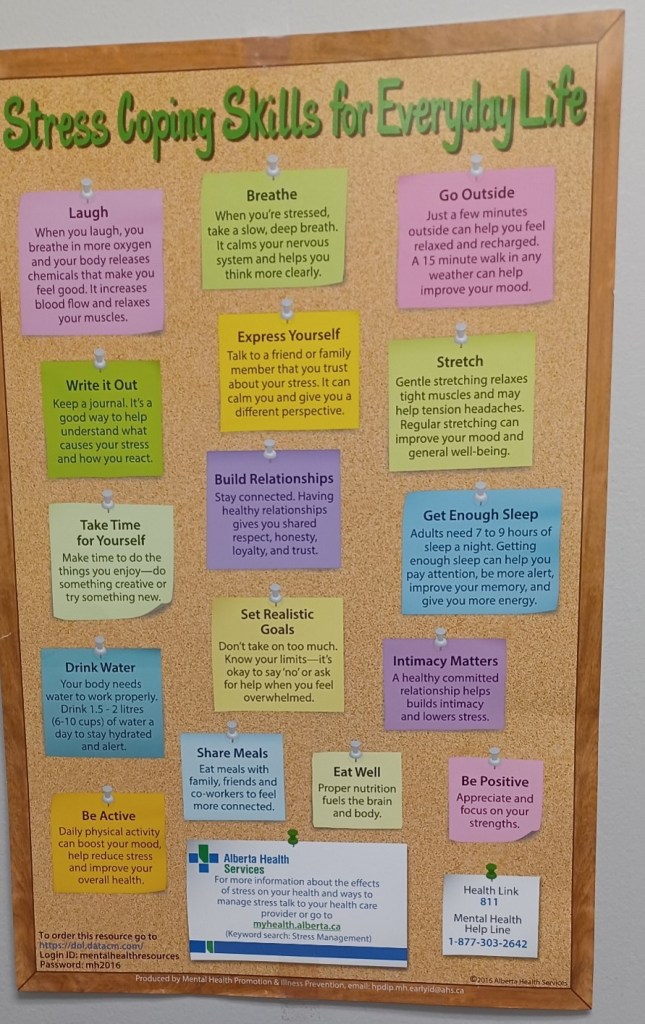
At a recent visit to the doctor I saw this poster on the wall: Stress Coping Skills for Everyday Life.

There are a number of great ideas to put into practice when we are experiencing stress. Some of them are physical exercises such as “go outside” or “stretch”. Others are mental exercises such as “be positive”. There are social exercises and suggestions for eating better and drinking enough water.

These might all be good ideas. They cover most aspects of a person’s life – social, physical, emotional, and mental. But I couldn’t help noticing that there was something missing. Where is the spiritual aspect?

As people who know God, we should recognize the value of going to God in our times of stress. In fact, if we have put our faith in Christ for salvation, then we have also received His Spirit that lives within us. He is God within us. He wants us to have life and have it to the full. (John 10:10)

Like the psalmist David, we can cry out to God in our times of need.

When my spirit grows faint within me,
    it is you who watch over my way.
(Psalm 142: 3)

 Lord, you are the God who saves me;
    day and night I cry out to you.
May my prayer come before you;
    turn your ear to my cry.

 I am overwhelmed with troubles
    and my life draws near to death.
(Psalm 88: 1-3)

Yes, there are many different things we can do to try to alleviate the feelings of stress, but why not call on God to help?

Call out to God for help. Pray. Spend time reading scripture. Allow God to speak. Meditate on passages of scripture or dwell on God’s attributes. Spend time in worship. Sing songs of praise. Listen to songs of praise. Ask God to calm your spirit and empower you by His Spirit to tackle the day with confidence.

When stressed, do what you can to trust God to walk you through it.

Keep looking up,

Andy Wiebe

Book Reviews: Andy’s 2023 Reading Experience

I will be sharing a brief review of every book I read this year. Hope you enjoy and hope it encourages you to keep reading.


LEADING WITH A LIMP – by Dan B. Allender, PhD.

Allender states this as his core assumption for the book: “To the degree you face and name and deal with your failures as a leader, to that same extent you will create an environment conducive to growing and retaining productive and committed colleagues.” If you try to hide your failures as a leader, you will need to be more controlling of others around you. He says that in God’s leadership model, “He calls us to brokenness, not performance; to relationships, not commotion; to grace, not success.” While leaders often feel compelled to show they know everything and are definitely the right people for the job, they would be better off admitting their weaknesses since  everybody else can see them anyway, and work more on a good relationship with people than just trying to get the most out of them for the task at hand. Allender offers this great quote as he talks about the difficulty of being a leader and casting vision. “One can speak of vision and mission, calling and opportunity until the cows come home, but when the day ends, most people want nothing more demanding than some television and a few uncomplicated laughs.” He speaks honestly of the hard work of being a leader while giving hope from God’s perspective. A great leadership book that makes one think.

If I Believed In Luck

Good thing I don’t believe in luck. If I believed in luck, I would have no luck at all. Here’s some of my good luck bad luck story from my last few weeks.

Bad luck – I got caught behind a snowplow on the highway and the pickup behind me rammed into me.

Good luck – My wife and I, as well as the people in the other vehicle, were banged up a bit but okay.

Bad luck – It was the weekend and no rental cars available, not even any cars at the place my insurance sent me.

Good luck – another rental place did have a car.

Bad luck – the rental car had to be returned to where we picked it up. It was a 14 hour round trip to drop it off, and then how would I get home?

Good luck – we were allowed to return the rental car to another spot which was only about a 9 hour round trip. Saved a little time.

Bad luck – in order to come home, my wife had to rent a second car to drive down and pick me up.

Good luck – we found a car to replace the one that was totalled on the highway.

Bad luck – within two weeks it was in the shop, for about 2 weeks.

Good luck – they finally got it fixed and we could use it again.

Bad luck – in less than two weeks we hit a deer with the new car and back to the shop it went.

Yesterday was another bad luck good luck situation.

Bad luck – my prescription for my medication had run out. We don’t have a family doctor and go to a walk in which was totally booked by the time I got there.

Good luck – I was referred to another walk in that evening.

Bad luck – by the time I arrived all the spots were taken.

Good luck – they put me on a cancellation list in case there was room and they would call me back. And they did!

Extra good luck – I ended up seeing a doctor who specializes in helping people with chronic pain. Being I was the last patient of the day, she took extra time to walk through what my pain is and had some suggestions to help me. She was the first doctor in a long time who actually understood me and my symptoms and the medication I was taking. She is looking for how she can assist me further!

Okay. I have no place for luck. I don’t believe in luck. I believe in a God who loves his people and takes care of them. Yes, we live in a world where not everything goes our way. At times God allows certain things into our live that are not pleasant, even painful and discouraging. But I am convinced that God is walking with me. When it seems that good luck shows up, I believe it is God stepping in again and again doing those good and wonderful things for us!

This is important to understand in our personal lives and also in our church or business life. God is interested in everything we do. We can go to him with our needs and He will step in. He doesn’t always fix everything, but he definitely walks with us in it. And sometimes, as Psalm 94:12 says, “Blessed is the man you discipline, O Lord.” God uses the different situations we go through, not to punish us, but to help train us to become more like Him and more effective in what He wants us to do in life. Instead of seeing life as bad or good luck, ask God what he wants you to learn along the way.

If I believed in luck I would feel pretty discouraged by now.

Luck? No way! God stepping in? Definitely!

Keep looking up,

Andy Wiebe