I will be sharing a brief review of every book I read this year. Hope you enjoy and hope it encourages you to keep reading.
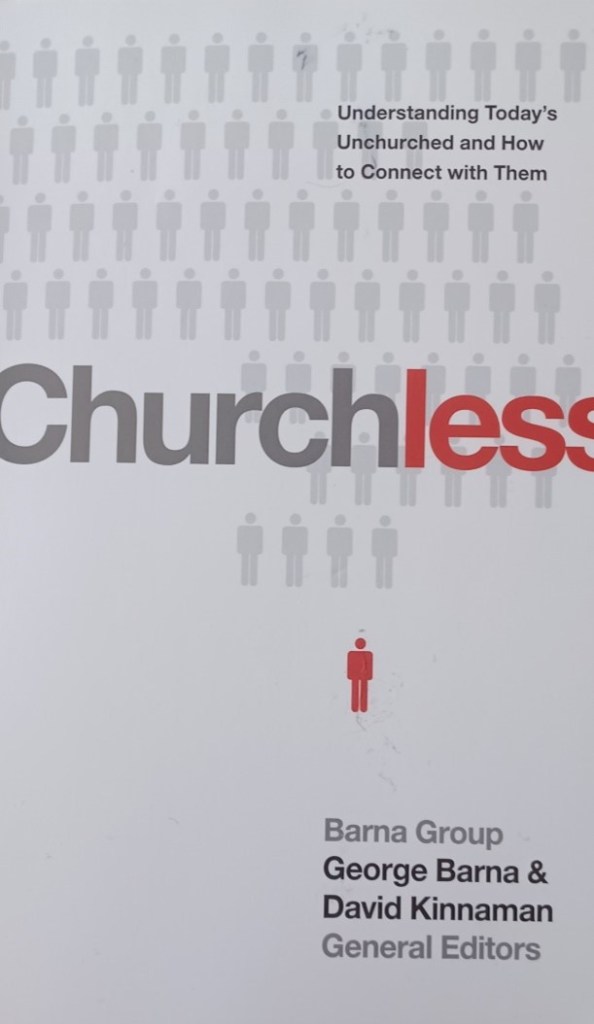
CHURCHLESS – by George Barna & David Kinnaman
Churchless: Understanding Today’s Unchurched and How to Connect with Them – by George Barna & David Kinnaman.
If you are familiar with the Barna Group, you know that they do ongoing research focused on the church and aspects of the church. This book is all about what the unchurched in our world are like and what they think of the church. It may not surprise you that most don’t think about the church hardly at all, and when they do, it is either with a negative or neutral view for the most part. At the same time, there are still people out there who would attend church with you if you only invited them. They will be more interested in the church if the church is known for its care for the community and meeting real needs. A good sermon or music will not draw most of them in. If they want entertainment, they can find better stuff in the world. A good place to start in connecting with the unchurched is to develop friendships as many people are lonely. It’s a great book if you want some real statistics. If you want the most up-to-date stats go to Barna.com.
Discipline is something you develop in yourself by deliberate and consistent decisions. It is not something a person automatically has but is a characteristic that must be learned and developed. Discipline is what helps maintain what is good in life and build on it to improve even more. It is developed by regularly choosing to make the necessary decisions and take the correct actions. A disciplined person may live by a rule or system of rules governing their conduct or activity. As you live by these good choices, you become a disciplined person.
A disciplined leader gets more done.
Many people put in the expected hours at work. Some get much more done in those hours than others. One reason is that the disciplined person knows how to keep breaks short and focus back on the task at hand.
A disciplined person starts on time, but also ends on time. Whether it is the start of your day or running a meeting, a disciplined person is prepared, ready to start when it is time, and focused enough to accomplish what is needed in the necessary time.
A disciplined leader develops good habits.
Self-discipline is the ability to control your behavior in a way that leads you to be more productive or have better habits. Systems or rituals can help you organize the activities you regularly do into an orderly fashion that eliminates time spent deciding what to do next or how to do it. These rituals can be as simple as cleaning off your desk before going home at night so it is not cluttered when you return in the morning. A ritual could include taking 10 minutes to plan the next day so you are ready when you arrive in the office the next day.
Systems are the habits that are packaged together, like a series of procedures. An example may be a system for tracking meeting decisions and action items. This might include transferring all dates discussed in the meeting onto their calendar, and adding your responsibilities to your to-do list, and adding time to work on these items to your daily schedule. In this way, within minutes of your meeting, you have all the pertinent information on the right calendars and to -do lists.
A disciplined leader excels at self-management.
A disciplined person is a self-starter. They don’t need someone else to regularly check in to remind them of the next job to do. They know how to determine what needs to be done and what can wait. They know where to go to get answers or expertise they don’t have. A disciplined person sets their own direction for the day rather than waiting for the supervisor to give them their jobs. A disciplined leader manages their time in such a way that everything gets done and they still have time to dream and plan for the future.
A disciplined leader keeps going when things get tough.
Being a leader is not always easy. Pushback can come from many angles, including some of your own staff or even those you serve. Financial issues can become a big concern when money isn’t coming in as expected. A time crunch can also be tough, when the amount that needs to be done seems to be greater than the time available. Things can get tough too, when a leader feel like they are leading beyond their limits. In all the different ways that things can get tough, the disciplined leader will never give up. They will push through. They may arrange for deadline extensions or make some financial adjustments. They may get outside help, whether personal coaching, or more staff, to push ahead when they feel they are in new territory and unsure how to proceed.
Discipline is a valuable characteristic of anybody, but especially a leader. This characteristic will help a leader get through many situations when an undisciplined person may give up or just panic and do a poor job. Work at becoming a disciplined leader, one good decision, one good habit, after another. If you want to lead well, develop the character of discipline.
If you are looking to become more disciplined, checkout next week’s post on how to develop discipline as a leader.
I will be sharing a brief review of every book I read this year. Hope you enjoy and hope it encourages you to keep reading.
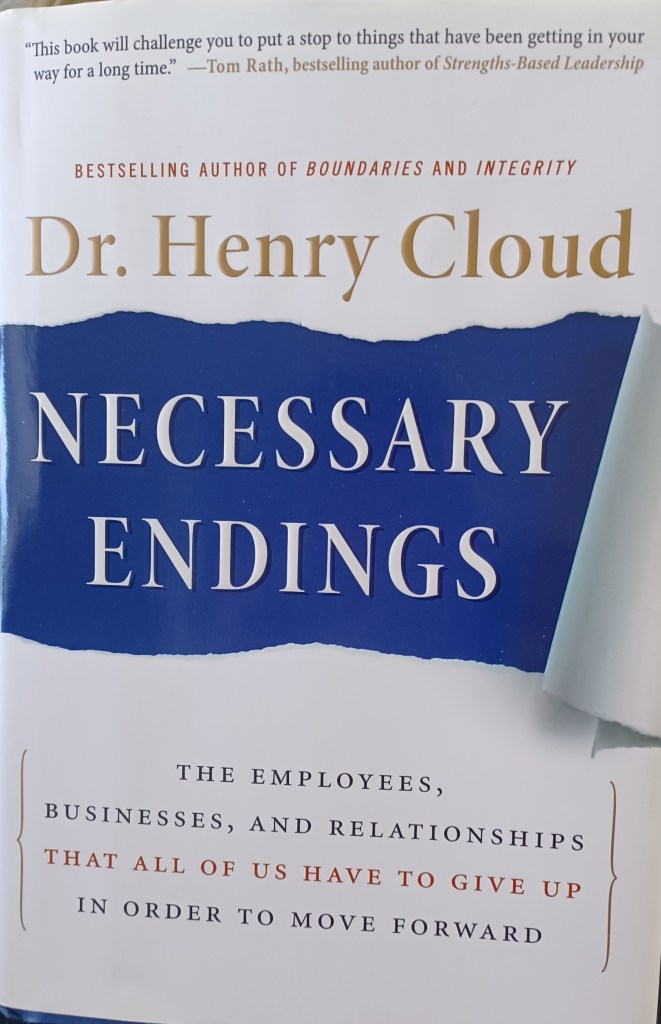
NECESSARY ENDINGS – by Dr. Henry Cloud
In Necessary Endings: The employees, businesses, and relationships that all of us have to give up in order to move forward, Dr. Henry Cloud explains why good endings are needed for good beginnings. He uses a number of great examples to show how appropriate endings at the right time can be very positive for you personally and for the organization you are part of or leading. Some endings are forced on us, and some are ones we choose, in either case we can determine how we will use that ending as an opportunity for something new. When you end something, you have room for that next thing that can be even better than what you just ended. A very helpful book!
As people who love God and want to serve Him, can we actually hear him? Can we have clear direction as we make decisions and lead a church?
God spoke with people in the stories of the Bible. In Genesis 3 the Bible describes a conversation between Adam and Eve and God. It tells us that God came and spent time with them in the Garden of Eden. Many times, prophets in the Bible spoke what they knew were the words of God. And others accepted their words as from God. People like Abraham and God had conversations about how many children he would have. God spoke to Moses from the burning bush. Sometimes God sent his angels as messengers, as seen when Gabriel visited Mary. God spoke through dreams and visions, as he did when warning the Magi not to return to King Herod after visiting Jesus. When people in the Bible heard God speak to them, they were confident that it was Him and clear about what He was saying to them.
God clearly spoke through His Son. John 1 tells us that Jesus was and is the Word from God. He is the expression of all God is. But Jesus also spoke with his disciples about many things. He taught with authority – so much so that people wondered where he got his authority. Jesus’ disciples had intimate conversations with Jesus dealing with everyday life like paying taxes, or dealing with the fact that he would have to die and rise again. He spoke to the two on the road to Emmaus, in Luke 24. Even though those who heard from Jesus were sometimes unsure what Jesus meant when he spoke, they clearly heard him, and had the privilege of asking questions to clarify what He meant.
God spoke in and still speaks through scripture. 1 Peter 1: 20-21 says, “Above all, you must realize that no prophecy in Scripture ever came from the prophet’s own understanding, or from human initiative. No, those prophets were moved by the Holy Spirit, and they spoke from God.” The scriptures are God’s words to us. 2 Timothy 3: 16-17 record Paul’s words to Timothy on the value and purpose of the Scriptures in people’s lives: all Scripture is inspired by God and is useful to teach us what is true and learn what is wrong in our lives. It corrects us when we are wrong and teaches us to do right. God uses it to prepare and equip his people to do every good work.” The scriptures are God’s words of guidance in our lives so we know how to live a life that honours Him. As God speaks in Scripture, we can clearly hear his direction for how to live our lives.
Sometimes God combines a few ways of speaking to give clear direction. A good example is the story of Philip leading the Ethiopian eunuch to Christ in Acts 8. First, an angel told Philip in verse 26, ‘” Go south down the desert road that runs from Jerusalem to Gaza.” So, he did. He started travelling down the road until he came upon this man sitting in his carriage. Verse 29 says, “The Holy Spirit said to Philip, “Go over and walk along beside the carriage.’” Philip did. He heard the man reading scripture so he asked, “Do you understand what you are reading?” The man did not and invited Philip into the carriage to sit with him and explain it. In the end, the man wanted to be baptized as he accepted he Good News of Jesus.
In this case, God spoke through an angel, through the Holy Spirit, through Philips willingness to enter into a conversation with the man, and through the scriptures – all to get the right person to talk with this man and explain salvation to him!
Philip clearly heard he was to go on that road, then clearly heard he was to go up to the chariot. But then, no one told him to enter into a conversation. He saw this as the next right thing to do. As the man asked questions, Philip explained scripture for him to understand and respond to.
I believe we serve the same God who will speak to us and direct us as we listen to him, though it doesn’t always seem as clear as we wish. God can and still occasionally speaks through angels. God can and does speak through the Holy Spirit. This may be an “out loud” voice or it may be strong sense that you need to do something. Sometimes we get this sense we are to call someone or visit someone and perhaps after responding, we see that God was setting that up. God can, and still does, speak through scripture. There are times when a certain verse jumps out at you as you are reading, and you know that was God’s encouragement for you. Sometimes, God will use a verse to clearly direct you.
God continues to speak in various ways. I have had God clearly direct me through seeing certain signs on trucks. He used these signs as a reminder of something I had written in my prayer journal, and he showed me the answer. I have had God speak through thoughts or feelings I was supposed to do something. I have heard God through the words others spoke. I have “heard” God speak through pictures he has given me in my mind. And many times God has spoken to me as I read the Bible, His Word to us.
God wants to speak to us. I am convinced of that. I also believe that God does not want us to be confused. We need to expect God to speak, and then respond as we believe we should. And if it is not clear, then ask him for clarity. Look to scripture to speak. Even ask God to speak through other wise people around you. Believe that God is interested in you and wants to speak. Keep listening.
I will be sharing a brief review of every book I read this year. Hope you enjoy and hope it encourages you to keep reading.
SHARING THE GOSPEL WITH EASE: How the love of Christ can flow naturally from your life – by Thom Rainer
In Sharing the Gospel with Ease, Thom Rainer explains how sharing the gospel should be a natural experience for a follower of Christ. He reminds us of our calling in the Great Commission from Matthew 28 and our encouragement and empowerment in Acts 1. Thom points out that many of us use excuses for not sharing the gospel. We complain about having no time. But the average Christian is also apathetic about the gospel. We say that we realize unbelievers will miss out on heaven and end up in hell, but we don’t seem to care enough to do it. Thom Rainer encourages us to allow it to be a natural part of our life. And to pray that God would guide us and open doors for us to share. A good little book.
I will be sharing a brief review of every book I read this year. Hope you enjoy and hope it encourages you to keep reading.
THE POSTMODERN PILGRIM’S PROGRESS by Kyle Mann and Joel Berry
Mann and Berry write a funny and entertaining allegory of the Christian life. It is a light read with a powerful reminder of how we get sidetracked with many varieties of ways we live our Christian lives. They do a good job reminding us of the main purpose of the Christian life, to keep on going forward in the journey toward a true relationship with the King!
I will be sharing a brief review of every book I read this year. Hope you enjoy and hope it encourages you to keep reading.
LIVE LIKE JESUS: Discover the power and impact of your true identity – by Putty Putman
Live Like Jesus: Discover the power & impact of your true identity, by Putty Putman
This is one of the best books I have read on the reality of our life in Christ. Putman asks questions and looks for answers that many Christians are afraid to ask. He does a good job asking questions that make a person think, and thus find answers that the average person is not looking for. If you want to be challenged in your walk with Jesus, this is the book you need to read.
I will be sharing a brief review of every book I read this year. Hope you enjoy and hope it encourages you to keep reading.
STARTING AGAIN WHEN YOU FEEL LIKE GIVING UP – by John F. Westfall
In Starting Again When You Feel Like Giving Up, John F. Westfall addresses the issue of feeling life has gone in such a terrible direction that it is sometimes hard to get back up. Life can be disappointing and disheartening when things go wrong and our goals are not achieved. I appreciate how, as he encourages the ones trying to get up, he addresses risk. Here are a healthy risks he thinks are worth taking. He expounds on the following:
Risk getting turned down.
Risk failing.
Risk being misunderstood.
Risk saying, “I love you”.
Risk being yourself.
Risk not being good enough.
Risk being good enough.
Risk getting hurt.
This might be just the book if you are struggling and trying to get back up again.
Many of you would have great suggestions for books on leadership from your own reading and study. And the list would be quite varied as there are all kinds of books on leadership from many different aspects. I love to check out the latest leadership books, but I want to remind you of some ancient leadership lessons from an old book.
If you were to read the Bible with an ear for leadership concepts you would find many aspects to put into practice and learn from. While it is not a leadership book, the stories of different leaders in history can speak powerfully into our present leadership situations.
Nehemiah has been an example as he had a clear vision for how to repair the wall around Jerusalem, how he was able to recruit and delegate, and persevere through opposition. Ezra is an example of a leader as he rebuilt the temple in Jerusalem. These are some good examples for us.
Leaders, I would encourage you to read the Bible and look to the Bible to speak into and shape your leadership. Some of it is personal. We have examples of the faith of Abraham over a long period of time, continuing to trust God to be faithful to his promises. Had God given you a vision? Trust God to do his work through you to accomplish that vision. Continue to push ahead faithfully.
Joseph is an example of someone who persisted faithfully no matter the circumstances around him. All leaders face difficult situations from time to time, but we can continue to faithfully serve God even in those difficult times.
I like the desperation of Moses, begging God to go with him and the people. Moses said to God, “if you don’t personally go with us, don’t make us leave this place.” (Exodus 33:15) We need to have that kind of desperation for God to go with us too. As children of God, we know that we can accomplish little of value unless He goes with us. Christian leaders need to have that desperation of Moses that God go ahead and with you in all your endeavors.
We can learn from some of the negative examples as well. We can learn the devastation of listening to the crowd, as Aaron did, when he allowed the people to make a golden calf because Moses was gone to long. We can learn from the bad example of Eli who did not correct his sons when they disobeyed God. We can learn the importance of leading and not letting the crowd mislead us. We can learn the importance of following through and even discipling those under us when they do wrong.
We can learn from the example of the twelve spies the Israelites sent into the land God had promised them. They came back with stories, but there were two very different stories. Ten of them saw danger everywhere. They even exaggerated their stories – talking of giants who made us look like grasshoppers. But there were two others, Joshua and Caleb, who spoke of the wonderful fruit of the land and that it was flowing with “milk and honey”. It is a great place, and we can trust God to go ahead of us and give us the land. We can learn how the different views and the different stories we tell influence the people we lead in powerful ways. The Israelites listened to the majority and accepted the negative picture. They chose fear instead of trust because they listened to frightened leaders. God made them wander the wilderness until all that generation was dead and gone. Only then, were Joshua and Caleb able to enter the land with the next generation. What story are you telling? Are you pointing people to the problems or to the God who helps us through the problems?
And of course, we can look at how Jesus led his group of twelve. There are many leadership skills we can learn in how he led that small group. We can see how he loved and cared for those under his leadership, we can see examples he set when he washed their feet, we can learn from how he exhorted Peter when he misunderstood what Jesus’ plan was. We can learn from his commitment to the plan, never wavering.
Yes, learn from the great leadership books and seminars, but do not forget the ancient leadership wisdom from God’s word that still speaks into our leadership roles today.
I will be sharing a brief review of every book I read this year. Hope you enjoy and hope it encourages you to keep reading.
BEAUTIFUL OUTLAW – By John Eldredge
Beautiful Outlaw: Experiencing the Playful, Disruptive, Extravagant Personality of Jesus by John Eldredge is a book that will shock some people while encouraging others. He writes about Jesus, but not in the distant manner that we often think of him. Eldredge presents Jesus as a human in a way that few, if any, have before. It is a great reminder that Jesus was a human who walked this earth in a certain place in time within a specific community and with other human friends. Eldredge points out where Jesus responds with emotion like any other human person. He, in his words, is trying to “clear the religious fog” around who our Lord and Saviour Jesus was and is. Do you want to know Jesus better? This book will help you in that search. Your ideas may be challenged, but I do believe the person of Jesus will be revealed as a person you can actually communicate with and live your life with.