I will be sharing a brief review of every book I read this year. Hope you enjoy and hope it encourages you to keep reading.
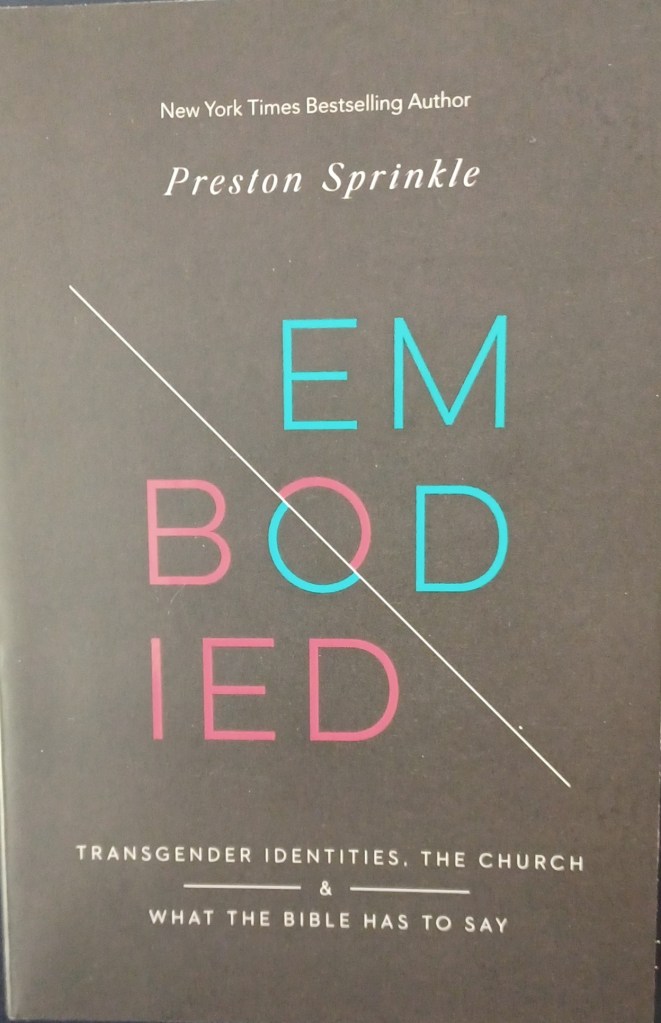
EMBODIED: Transgender Identities, the Church and what the Bible has to say – by Preston Sprinkle
Sprinkle asks the question: If someone experiences incongruence between their biological self and their internal sense of self, which one determines who they are – and why?
He then walks through a thoughtful and biblical journey of defining the transgender issue, understanding what the real issues are, and looking at how the bible speaks to this struggle many people face. He finishes by addressing some of the realities of how to love transgender people in a way that is kind and reflects Jesus. A great book for one of today’s tough struggles.
Many issues arise in our world today because of our search for the answer to the question: What is the truth? Theological issues may come about when we search for answers in teachings we have not heard before. Political issues can begin when we as Christians question what our place is in politics or responding to decisions our governments make. Moral and lifestyle issues are often found when the church is unsure how to respond to what is becoming acceptable in the world around us and even in the church that has historically not been accepted. What is the truth?
While there are many today who pretend we can have different truths to guide us, truth doesn’t work that way. If I am driving down the highway and decide that my truth is that I am in England so I will drive on the left-hand side of the yellow line, my truth will be quickly confronted by another truth when the traffic in that lane comes hurtling towards me. That is a silly simple example, but the fact is, what we believe about things makes a difference, and impacts our relationship with others. Truth, as God has laid it out, affects all of us.
As people of God, and as leaders of churches, we need to recognize that our answers need to be found in God’s Word. His Truth must be upheld in our churches. I do understand that sometimes we need to do some work to determine how God’s truth impacts the questions we face. But our answers should be informed by God’s Word – the Bible.
How might we find answers in the Bible?
Read the Bible.
The first priority to actually read the Bible. Read it regularly and search it for answers to your questions.
As you read, ask God, through the Holy Spirit, to give you correct understanding of what you are reading. We recognize that the Bible is more than a story book, though it contains many stories. Whether we are reading biblical stories, or a teaching section, or even some of the poetic books like Psalms and Proverbs, we want God to help us understand what the truth is and how it applies to my life and to the church where I serve as a leader.
Consult with others on difficult passages or topics.
We are blessed to have the results of many experts at our fingertips. We can find commentaries where others have worked through scripture and give their expert opinions. We can make use of tools that help with word studies and guide us through some of the definitions of the original language. We can read books by people who are struggling through some of the same questions we are. We cannot interpret scripture completely on our own, there is importance in reading scripture in community. Whether we agree or disagree, there is benefit in seeing how others have processed biblical truth in light of this topic. I’m presently reading a great book on how to respond biblically to those living a gay lifestyle. There are many other topics that others have been able to work through in more detail than we have so we can learn from them. Just make sure their teaching is arrived at by careful study of scripture.
And one of the simplest ways to consult others is to have conversations with others in your church as you work through scripture to find the answers you need. Find some other believers and read the Bible together. Work through scripture as a leadership team and ask God to guide you to the correct understanding and application.
Do what it says.
The hardest part of allowing the Bible to guide our leadership, is to then do something about what it says. If it means leadership needs to confront false teachers or people living contrary to truth in your church, then do it. If it means changing policies on how volunteers are screened, then change the policies. If it means teaching the church what it means to live out truth and love in light of Gods Word, then teach your church that.
If we are going to allow the Bible a prominent role in church leadership, then we need to make sure we read it regularly. We need to do the work of understanding it clearly, and then we need to follow through on what God is asking us to do as a result.
If we are Christian leaders, whether in the church or elsewhere, our leadership must be informed by the truth of God’s Word.


 Elevate with Andy