Grief and Hope

As I’m thinking about Christmas and the family celebrations, I am well aware that my mom will not be around this year. She passed away a few months ago. Going to see my Dad at Christmas time will not be the same. There will be an empty spot at the table and a big hole in our conversations where mom would have been.
Blue Christmas Services are special services held in December. Maybe you have had the privilege of taking in one of these services which are designed especially for those who have lost loved ones in the last year. The service includes carols and scriptures like other Christmas services, but it also takes time to acknowledge the pain that many in the service are facing. It is meant to be a time of healing and encouragement for those who are grieving and to give them encouragement as they enter their first Christmas without that loved one present.

The service is a time to remember the hope we have in Christ. All who have put their faith in Christ, if they are gone from here, are present with the Heavenly Father. We have a hope, a certain understanding that to die here is only the doorway into God’s presence.

Brothers and sisters, we do not want you to be uninformed about those who sleep in death, so that you do not grieve like the rest of mankind, who have no hope. For we believe that Jesus died and rose again, and so we believe that God will bring with Jesus those who have fallen asleep in him.

1 Thessalonians 4:13-14

As believers in Jesus, we believe that His death and resurrection was for us. We put our faith in Him and receive eternal life. We get a taste of this eternal life already, but don’t experience it’s fullness until we are with Jesus in God’s presence.

When believers die, they are immediately with God. They are immediately ushered into a place of “no more death or mourning or crying or pain” (Revelation 21:4). Not only are they experiencing the joy of being in God’s presence, but they are also immediately removed from all death or mourning or crying or pain. My mom was suffering a lot of pain regularly. She was taking many different medications. Life was difficult at times. But now she is no longer suffering any crying or pain. That is encouraging even as I grieve.

Knowing that she is with Jesus gives me hope. My grieving is not for her, but for my own loss. I am excited and glad for her, but there are times when I feel the loss. We grieve with hope. We feel the loss but are encouraged by the certainty of where we believe she is now.

Are you feeling the pain of missing a loved one this Christmas season? May it not be a grieving without hope. If they had put their faith in Christ, we know that they are with Jesus. And if you have done the same, you will join them eventually as well.

Yes, we grieve. We may go through the different stages of grieving numerous times as we continue to adapt to this person not being around anymore, and still rejoice that they are now in a place of no more crying and pain in the presence of the Heavenly Father. As believers in Jesus and the promises of a future with Him in heaven, we grieve with hope.

Keep looking up,

Andy Wiebe

Getting it All Done!

Life and ministry can be busy times. Maybe you have taken on too many commitments. Maybe someone else piled responsibilities on you that you can’t ignore. Maybe you thought you had time for everything until an unexpected demand popped up. This happened to me recently. I had accepted a number of responsibilities and thought I could manage them until I found a leak in my shower. Now I had the added work of dealing with house repairs that I am not skilled at and do not love doing. I was beginning to feel quite overwhelmed and wondered how I would get everything done.

As my anxiety started to rise, I paused my day to spend some time with God. As I was praying, I began to get some clarity and peace, trusting God to help me get done what had to be done by the appropriate deadlines while also dealing with my house. Here are some of the steps I took to focus on one thing at a time:

Pause the “doing” to be with God

    I took on the various responsibilities because I believed God was guiding me in accepting them. With that in mind, I handed it all over to Him and asked him to give me the time necessary to get it all done on time. I was reminded too, that God was not surprised by my house issues. So if God put these responsibilities in my lap, then he will give me the capacity to get them done.

    Remove anything from your to do list that is not important for now

    Sometimes we feel a duty to do something that we don’t really need to do. I had to reevaluate some of my goals and responsibilities and either eliminate some, or push them to next week.

    Plan my day and week.

    With God’s help, I began plotting all my responsibilities, along with their deadlines, onto my calendar. I tried to spread out the different requirements across the whole week. Then I considered all that I felt I had to accomplish for today. As I looked at the list, I started listing them in order of priority. If I could not complete all the tasks, at least the ones that had to get done today would get done.

    Focus on one thing at a time.

    When we get loaded down with responsibilities, we can get overwhelmed because we see it all in front of us. If we can break it down to what must be done this week, and this day, and this morning, we begin to narrow our focus. And if we tackle one thing at a time, giving it our full attention, we can begin to whittle away at the pile.

    It doesn’t matter how big the pile is, you can only deal with one thing at a time, so choose one thing and give it your best. You could even tell yourself you are focusing on this for a certain amount of time, and when that time is up, you will tackle something else before coming back to the first task.

    Celebrate your accomplishments

    I find it quite exhilarating to be able to check off the items on my calendar as I complete them. It feels good to see the momentum beginning to build toward completion of all the different tasks.

    Yes, life can be very busy at times, busier than we had planned, but God can help us grow in capacity so that we can get things done faster than we thought and can complete our list one task at a time. If God wants us to do it, he will help us to get it done.

    Keep looking up,

    Andy Wiebe

    Reconciliation or a Bumpy Rug?

    The other day, I was speaking with someone who mentioned a “bumpy rug.” She was referring to the practice of ignoring problems and “sweeping them under the rug.” Another similar comment I heard recently was, “Let’s just get this behind us as soon as possible.” In both cases, people were dealing with sin in families and organizations. Both cases reflected a desire to move past the sin and the hurt it caused others as quickly as possible without a desire to actually address the sin and correct it.

    Very few people enjoy conflict. The average person will go out of their way to avoid it. It is not fun when others are mad at you, even if you are doing the right thing. Our desire to get along and please people means that we will try to move past problems without confronting the issue and dealing with it.

    We need to learn to work through the personal pain of a conflict to pursue correction, forgiveness, and reconciliation. We need to see the value of restored relationships both with God and with each other. We need to see the importance of repentance and forgiveness to help people truly get past a problem brought on by sin. We need to see the importance of pointing out sin that is affecting others in the family and in the church.

    We forget that Jesus gave clear direction on how to handle sin with a Christian brother or sister in Matthew 18: 15-17.

    “If your brother or sister sins, go and point out their fault, just between the two of you. If they listen to you, you have won them over. But if they will not listen, take one or two others along, so that ‘every matter may be established by the testimony of two or three witnesses.’ If they still refuse to listen, tell it to the church; and if they refuse to listen even to the church, treat them as you would a pagan or a tax collector.

    Jesus does not advise getting past sin quickly, and definitely does not suggest sweeping it under the rug. Jesus suggest confrontation. He gives some steps. First, go by yourself to the person you know has sinned and point out their sin. Do not tell others about it. Do not take a party with you. Go by yourself.

    The second and third steps are only taken if the first did not resolve the situation. So, second, if the sinner does not respond with repentance then take one or two others with you to confirm you are not just making a personal judgement. With two or three others, you can determine if the person really has sin they need to deal with.

    Third, if the first two steps do not resolve the issue, then tell it to the church. The hope is that the church will push for what is right and stand for truth and righteousness rather than sweep it under the rug. Too many churches prefer the bumpy rug to the pain of confronting and dealing with a sinning brother or sister.

    There is one last step. If the person does not listen and does not correct their ways, treat them as someone who is no longer part of the church. This is a very difficult step for any church to take, yet Jesus teaches this so we know there must be times when his teaching should be applied.

    We need to remove the persistent sinner from any leadership in the church yet continue to love them and pray for them and look for opportunities to draw them back to Jesus.

    Jesus did not write off tax collectors and pagans but invited them to follow him. He even called Matthew, the tax collector, to be one of his disciples. Jesus treated pagans and tax collectors as potential disciples, if only they would leave their sin behind. Even as we can’t allow the persistent sinner a place of leadership in the church, we continue to point them to Jesus, with the hope that they will repent and surrender their hearts to Jesus again.

    Let’s choose to pursue reconciliation, not allow more bumps under the rug!

    Keep looking up,

    Andy Wiebe

    A Grateful Heart

    When parents are raising their children, they teach them how to be polite and how to live into the culture around them. One of the values parents often try to instill into their children is to say thanks. Parents often remind their children to, “Say thank you.” Or they ask the child, “What do you say?” They want the child to express their gratefulness when they receive something.

    Luke 17 tells us a story of ten men sick with leprosy who met Jesus. They stood at a distance, respectful of Jesus who did not have the disease, and called out for Jesus to have pity on them. Jesus tells them to go show themselves to the priest.  As they went to do so, they were cleansed. (The Old Testament Law said the priest was the only one who could declare a person clean after a sickness.)

    We might applaud the faith of these ten in going to do what Jesus said even though they were not cleansed yet. They were only healed as they headed to find the priest. But they were healed!

    Here comes the important part of the story. Yes, they were healed, but what did they do after that? We are told that one of the men who had just been healed, instead of continuing to the priest, turned around, came back, praised God with a loud voice, threw himself at Jesus’ feet, and thanked him. Ten were healed; one came to thank the healer.

     Jesus responded, “Were not all ten cleansed? Where are the other nine? Has no one returned to give praise to God except this foreigner?” Then he said to him, “Rise and go; your faith has made you well.” (Luke 17: 17-19)

    How many times have we completely forgotten to give thanks, enjoying God’s goodness to us as if we deserved it?

    We have a special day in our year that we stop to say “thanks.” Thanksgiving is coming up shortly. While it is good to have one day a year to give thanks, we need to cultivate a grateful heart and to develop an attitude of gratitude. As Paul encourages us in Ephesians 5:20, “always giving thanks to God the Father for everything.” Can we learn to give thanks regularly and not just on special occasions?

    God is good to us in many ways every day. We take so much for granted, that we need reminders to pause and give thanks. If one wants a grateful heart, it means being intentional in giving thanks. Include thanksgiving in your prayers. Give thanks with your family around the dinner table. Thank God for His goodness in your life. Thank God for the unusual things and the answers to prayer. But also thank God for the things we receive from Him every day. The air we breathe, the food we eat, water to drink. Thank Him for creation we can enjoy. Autumne in my part of the world is a beautiful experience as the leaves change color and start to drop from the trees. Notice God’s beauty around you and give thanks.

    Every time we give thanks, we remind ourselves that we depend on God for many things in our life. It is a reminder to us that we need God, and we benefit greatly from the good gifts He gives us!

    Thanksgiving is coming soon, but don’t wait for that special day to give thanks!

    Keep looking up,

    Andy Wiebe

    Unravelling the Tangled Mess

    When I was a kid, I loved flying my kite. I remember one windy summer day in the field just down from our house, releasing my kite into the sky. It was a thrill to feel the pull of the wind on the spool of string as the kite dove back and forth. I let out more string, and more string. The kite grew smaller as the string rolled off the spool until… oh no! The string was not tied to the spool in my hand! I had let the string reel out and suddenly the string was all gone – the kite was no longer tethered to the spool in my hand! I panicked! I scrambled after the kite, desperately trying to grab the string. After a few frantic attempts I managed to snag the string. In my panic I hauled the string in, not rolling it up neatly on its spool, but gathering it in a tangled pile at my feet until I had the kite back in my hands. I never managed to untangle that pile of string again.

    Sometimes, in an attempt to control our busy lives, it seems we end up with a tangled mess of roles and responsibilities at our feet. We do everything we are supposed to do or have signed up for, but we desperately try to untangle the mess and get a sense of control back. Each of us needs to manage various roles in work and life.

    Recently I felt like my life was resembling that pile of tangled string. I had some family issues that took precedence over all my other responsibilities. Everything else got put on the shelf for a week or so. I focused on the one thing that was most important in the moment. After that week, I recognized I had some untangling to do.

    I needed to figure out which strings to pull to start unravelling the mess. I had to take out a calendar and plot out my responsibilities to make sure I was working on the right things at the right time. We can’t work on everything at once. No matter how many responsibilities we think we can handle, we can only work on one at a time. I had to break down my responsibilities into manageable periods and schedule them on my calendar. I had to plot when I would focus on my transitional pastor responsibilities. I needed to chart when I would work on my transitional coaching duties. I needed to clearly schedule when to work on my doctorate work. I needed to schedule some family responsibilities. It took some work to sort it all out, but the end result was a plan that gave me peace. I could see my way through.

    Whatever is in your tangled mess of string, you can find your way through. Ask God to help you sort it out. And ask God to give you the time you need to accomplish what is on your plate. I know from experience, that God can enable you to work faster or to somehow stretch your time to do all He is asking of you. He will help you sort it out. Don’t panic or give up. Sort it out and begin working on one responsibility at a time.

    Carve out a time of retreat. Even a hour or so away from everything may give you the necessary time to evaluate your priorities and determine what you need to focus on and in what order. Then after the retreat you can advance with a plan.

    We all have numerous responsibilities. Sometimes they pile up and its hard to know where to start in addressing all the needs, but with God’s help you can do it.

    Keep looking up,

    Andy Wiebe
    Make Sure Your Heart is Right

    Proverbs 21:2

    A person may think their own ways are right,
        but the Lord weighs the heart.

    Proverbs 3:5-6

     Trust in the Lord with all your heart
        and lean not on your own understanding;
     in all your ways submit to him,
        and he will make your paths straight.

    If we were to take a look at the discipleship methods of our churches, we might tend to think that discipleship is about knowing enough information. We preach and teach on Sunday mornings, we have Bible studies mid-week, we encourage people to read the Bible at home. We want to make sure that people know the right stuff.

    It’s as if we think that if we give Christians enough information about God, about themselves in light of their relationship with God, and what God wants us to do in the world, then we will live out what God wants us to do. Unfortunately, that is not correct. Giving people more information, and helping them to think right is important, but is not the complete picture.

    Information by itself, if it does not connect with our inner being, may never affect us or change us in any way. In the verses above we see the emphasis on the heart. In these verses, “heart” refers to “the inner man, mind and will.” This moves beyond or rational thinking to our feeling. It moves beyond knowledge to our desires. Unless we care about something, it is simply information. Once we care about it, we want to act on it.

    When I tell someone there are over 30,000 orphans in 750 orphanages across Haiti, people receive the information. When that same person gets to know an orphan who was adopted, or visits an orphanage in Haiti, that information becomes personal. They become emotionally connected to the information. Then they may move beyond just storing information in their head to wanting to make a difference somehow.

    When I hear a sermon about the fact that God answers prayer, I receive it as information. I may even believe it. When I pray, and God answers in a specific way, then I know that God answers because I have experienced it. Now when I pray, I pray with a much deeper expectation because I don’t just have information.

    When I am taught that I need to read my Bible and pray every day, I might do it occasionally, but when I have come to know Jesus in a real way, then I want to read because I hear him speaking to me. I am not just reading information but having a conversation with Jesus.

    James K. A. Smith wrote You Are What You Love. He does a good job of pointing out that information alone won’t change us. We will still do what we love. We naturally act out of our personal desires, not just by being taught to think correctly.

    May our relationship with Jesus be much more than information about Him. May we love him and choose to obey Him out of a desire to please him.

    Keep looking up,

    H. Andy Wiebe

    Book Reviews: Andy’s 2024 Reading Experience.

    I will be sharing a brief review of every book I read this year. Hope you enjoy and hope it encourages you to keep reading.


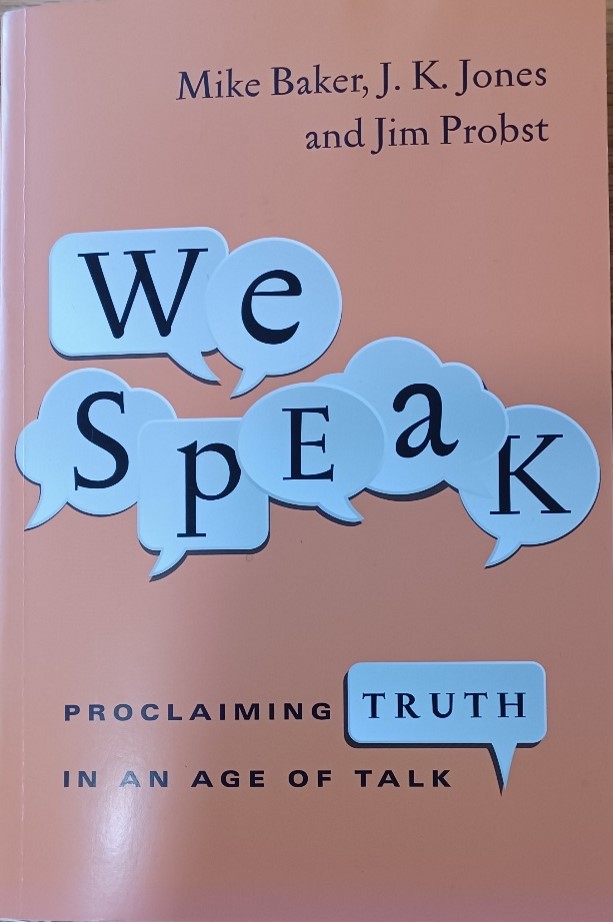
    WE SPEAK: Proclaiming Truth in an Age of Talk – by Mike Baker, J.K. Jones, and Jim Probst

    We Speak is laid out as a teaching chapter followed by five daily readings to keep the content in your mind over the week. The Discussion Guide at the back makes a book one could use for a small group or class setting. The authors remind us that “our message all these years later is still the death, burial and resurrection of Jesus.” (p. 19) As followers of Jesus, we can say many things and talk about all of who God is and what Jesus has done, but the basic message comes down to what Jesus did in bringing us salvation. This is the message we have for others. We need to recognize the urgency of speaking the message, and the responsibility that is place by God on us to share that message. We may not feel qualified to speak, but we can all talk about the hope that we have. Let’s continue to speak.

    Summer Road Signs Series: #1 Speed Signs

    Many of us will be taking road trips over the summer. Maybe you already have. There are many signs along the road that guide our driving, so over the next two months, I will use these familiar signs as reminders of how we can live our lives and honour Jesus along the way.

    I want to start with the sign that I think I like the most: speed signs. In Canada, these signs often show a maximum speed of 100km/h on the highway. I recently enjoyed a drive up to Yellowknife, Northwest Territories. While I enjoyed the trip, I did not enjoy one large section of highway that was limited to 90 Km/h. When we are fortunate to travel on divided highways, we are allowed to drive 110 km/h. I like travelling in the U.S. because often the speed limit is even higher.

    I like this sign because it is all about getting to where you want to go as fast as you can. This is not about taking a leisurely drive for no reason. The focus is on what is ahead. You don’t need your rearview mirror for this sign!

    One of the joys of my job is to help churches look ahead with clarity and purpose. Yes, we do take time to look at the past and understand the present, but we do this to clarify vision, and ultimately look at where we are headed and how best to get there. It is forward thinking and forward planning. We have a destination in mind and develop a map to get us there in the best way possible. No matter what speed you are travelling at, it is all about moving ahead.

    While we recognize the importance of brakes, we love using the gas pedal more. The goal is to keep moving forward as quickly as possible in order to get to the preferred future we have in mind.

    We set the destination. We map out the route. Maybe, if it is a longer trip, we even plan where we will stop for meals or gas, or even an overnight stay in a hotel or with friends. With a church, this means setting some short-term goals that will help us move along to the final destination, while giving us a way to measure progress along the way. If we trust God for 10 new believers this year, it is helpful to set some goals as to how we will help friends and family become new believers in Jesus first. We need to set some more immediate goals that will help us share Jesus with people regularly, praying along the way that some of those we share with will come to know Jesus.

    In our personal lives, these same reminders from speed signs might direct our thoughts to pursuing personal growth. Keep moving ahead looking for new experiences and new encounters with learning opportunities. Set personal goals that will move you in the right direction.

    In my own life, this forward momentum is evident in my love for learning. When I finished high school, I attended a Bible College. I wanted to learn what I could to become equipped for Christian ministry. I thought I would be involved in fulltime camp work or some kind of Christian education. Halfway through my Christian Education degree, God spoke through a few people and adjusted my destination to be pastoral ministry specifically. I added an extra year of education so I could get my Pastoral Degree as well. As I began ministry, I wanted to keep learning. I began taking courses at a seminary level. I was in no rush to complete the degree, wanting only to keep learning, so it took me over 20 years to get my Masters of Arts in Leadership and Ministry. Presently I am applying for the opportunity to pursue a Doctorate of Ministry.  I desire to keep moving forward, to keep growing as a person and as a pastor.

    Speed signs are about moving ahead at the highest speed allowed. I encourage you to consider where you have been going slower than you should. Maybe God is asking you to pick up the pace and keep moving forward to what is next. Trust God to guide you as you look to him for the right destination to pursue.

    And enjoy the journey!

    Keep looking up,

    Andy Wiebe

    P.S. Watch for next week’s Road Sign: Stop Sign

    Fruitful Leadership #6: Goodness

    When God created the world, Genesis tells us he made this statement five times: “And God saw that it was good.” On the last day, he looked at all he had made and the Bible declares: “God saw all that he had made, and it was very good.” The word declaring the absolute best or the perfection of what God created was “good.” Today, good seems like it’s not enough. We use words like amazing, excellent, incredible, and on and on.

    As we continue to work our way through the list of Spiritual gifts found in Galatians 5: 22 and 23 we come to the fruit of “goodness”. Again, in today’s thinking, at least in mine, “goodness” seems like a bland word compared to what one might use. So, let’s look at the word before we look at how we would invite the Holy Spirit to make it a fruit we are producing in our life.

    “Goodness” or “good,” according to Strong’s concordance, is meant to convey something intrinsically good, or something which “originates from God and is empowered by Him in their life, through faith.” (https://biblehub.com/greek/19b.htm)  This is not a bland statement but one that is intended to show the goodness of God, all the good of the creator being lived out in his creation. Really, it is reflecting the goodness of God in our life.

    If we want to lead with the Spirit’s fruit of goodness in our leadership, we look to lead like God would in the situations we find ourselves in. We ask the Spirit to make us good like God in how we act toward other people and how we live our lives before them. As we lead, we do so from the goodness of God already in us through the Holy Spirit’s presence in our lives.

    To lead with the fruit of goodness in our lives is impossible unless we have come into fellowship with God through faith in Christ. Then, as his Spirit takes up residence in our lives, we can invite him to express himself through us in our words and actions.

    While kindness is focused on others and how we care for them, goodness is a focus on God that allows his Spirit to work through us as we put God first in all of our lives. As we focus on God, he works through us.

    The development of this fruit then begins with a continued desire to know God better. Goodness, that intrinsic, God-empowered fruit, depends on how well we get to know God and allow him to fill us with his goodness. A leader who desires to produce the fruit of goodness cannot just try harder or look at ways to be good and nice to people. It will not happen by our own efforts. It cannot be the result of a seminar or training exercise. It is only the result of spending time with God in his Word and in prayer.

    As you are filling yourself with goodness in your relationship with God, you can then produce goodness in your interactions with your team and others you serve. It can only be an overflow of spending time in God’s goodness first.

    Leading with goodness is a great desire. Spend time with God regularly so the Holy Spirit will produce goodness in you and your leadership.

    Keep looking up,

    Andy Wiebe

    Fruitful Leadership #5: Kindness

    The spiritual fruit of kindness in a leader is different than how we often think of kindness.

    We tend to think of kindness as “being kind” or “being nice” to someone. It is the opposite of being mean or rude. It is the sense of treating each other as we would like to be treated. This is recognizing each other as humans who need to respect and care for each other as such.

    The spiritual fruit of kindness, though, is not so much about holding back our anger and frustration and being nice to those around us. Kindness, as presented in Galatians 5: 22 in the list of spiritual fruit evident in those who are filled with the Spirit, is about practical care for others.

    While the word portrays goodness and gentleness, it could be thought of as “useful kindness.” This is about practically being kind by doing something nice for another person that is useful to them.

    A simple example would be to show up with coffee and donuts for your team at coffee time. Not only are you doing something nice, but it could also be useful to them, especially if they need a little energy.

    So how can we be kind in this way as a Christian leader? How can we meet real needs of those we are leading?

    Why not begin by finding out what the real needs are?

    Instead of assuming, take time to talk with people and get to know them and what is going on in their lives. If your team is too big to talk personally with everyone, talk with a few. Or send out a brief survey or questionnaire inviting your people to let you know how you can be of help.

    Here are a few thoughts on how you could extend useful kindness to the people you work with.

    • Have an open-door policy – even for certain hours if it doesn’t work all the time.
    • Offer financial help to those who might benefit from counselling.
    • Make lunchtime easier. Provide a small kitchen for staff to use. One employer I had brought in a catered lunch occasionally.
    • A businessman offered free childcare in a facility connected to his business for his staff.  If you are not able to do this, can you offer some help?
    • Provide appropriate training regularly.
    • Ensure your team has the tools and resources they need to do their job well.
    • Keep organizational structure and communication clear.

    The spiritual gift of kindness can be a powerful tool in a leader’s pouch to build loyalty and camaraderie with the people you lead. As you extend mercy and grace in practical ways, people will respond with respect and loyalty. As you reach out with benevolence and generosity, they will respond with a desire to do their best for the team.

    We should be nice to those we lead, but we can go beyond that and provide useful and practical help as well.

    Keep looking up,

    Andy Wiebe