Reconciliation or a Bumpy Rug?

The other day, I was speaking with someone who mentioned a “bumpy rug.” She was referring to the practice of ignoring problems and “sweeping them under the rug.” Another similar comment I heard recently was, “Let’s just get this behind us as soon as possible.” In both cases, people were dealing with sin in families and organizations. Both cases reflected a desire to move past the sin and the hurt it caused others as quickly as possible without a desire to actually address the sin and correct it.

Very few people enjoy conflict. The average person will go out of their way to avoid it. It is not fun when others are mad at you, even if you are doing the right thing. Our desire to get along and please people means that we will try to move past problems without confronting the issue and dealing with it.

We need to learn to work through the personal pain of a conflict to pursue correction, forgiveness, and reconciliation. We need to see the value of restored relationships both with God and with each other. We need to see the importance of repentance and forgiveness to help people truly get past a problem brought on by sin. We need to see the importance of pointing out sin that is affecting others in the family and in the church.

We forget that Jesus gave clear direction on how to handle sin with a Christian brother or sister in Matthew 18: 15-17.

“If your brother or sister sins, go and point out their fault, just between the two of you. If they listen to you, you have won them over. But if they will not listen, take one or two others along, so that ‘every matter may be established by the testimony of two or three witnesses.’ If they still refuse to listen, tell it to the church; and if they refuse to listen even to the church, treat them as you would a pagan or a tax collector.

Jesus does not advise getting past sin quickly, and definitely does not suggest sweeping it under the rug. Jesus suggest confrontation. He gives some steps. First, go by yourself to the person you know has sinned and point out their sin. Do not tell others about it. Do not take a party with you. Go by yourself.

The second and third steps are only taken if the first did not resolve the situation. So, second, if the sinner does not respond with repentance then take one or two others with you to confirm you are not just making a personal judgement. With two or three others, you can determine if the person really has sin they need to deal with.

Third, if the first two steps do not resolve the issue, then tell it to the church. The hope is that the church will push for what is right and stand for truth and righteousness rather than sweep it under the rug. Too many churches prefer the bumpy rug to the pain of confronting and dealing with a sinning brother or sister.

There is one last step. If the person does not listen and does not correct their ways, treat them as someone who is no longer part of the church. This is a very difficult step for any church to take, yet Jesus teaches this so we know there must be times when his teaching should be applied.

We need to remove the persistent sinner from any leadership in the church yet continue to love them and pray for them and look for opportunities to draw them back to Jesus.

Jesus did not write off tax collectors and pagans but invited them to follow him. He even called Matthew, the tax collector, to be one of his disciples. Jesus treated pagans and tax collectors as potential disciples, if only they would leave their sin behind. Even as we can’t allow the persistent sinner a place of leadership in the church, we continue to point them to Jesus, with the hope that they will repent and surrender their hearts to Jesus again.

Let’s choose to pursue reconciliation, not allow more bumps under the rug!

Keep looking up,

Andy Wiebe

Leakage Causes Damage!

Our shower had mushrooms growing next to it. This happened a few months ago, so I did my best to seal up places where they were growing and places where water seemed to have leaked from the shower. All was good for a few months, until recently, the mushrooms were back.

I am not a renovator or construction worker of any kind, but I had to step and deal with this. My temporary fix was just that – temporary. I had to tear out the whole shower, piece by piece until I got down to the bare bathroom floor. I tore out the wet, damaged drywall and put some fans to work drying everything out. I was glad to see there were no other leaks. Whoever installed the shower just didn’t seal things well. I’m now in the process of replacing drywall, mudding, and painting in preparation of reinstalling the shower. This time I will ensure that everything is sealed. Leakage causes damage.

“Leakage” can happen in a number of ways in our lives, as something begins to deteriorate but it happens so slowly we don’t recognize it until a “mushroom” or other weird side-effect pops up that tells us something is wrong.

It could be that we are experiencing leakage in a relationship with a friend. We realize that something is wrong. The friend seems to be avoiding you. Maybe you have even tried a temporary fix like I did with my shower, trying to address the issue without creating a problem, yet you realize something is still wrong. More drastic measures need to be taken for a satisfactory resolution is reached. You need to face the issue head on and ask your friend directly about what is wrong, and how the relationship can be repaired to its original closeness and openness.

Leakage may happen in one’s spiritual life. Sometimes we get lazy in our walk with God. We allow sinful habits to creep in. If we recognize something is wrong, it may already mean it is time for some drastic measures. We can gradually allow others to influence us in directions that are not good and honorable. There are times we need to assess our friendship with Jesus and determine new patterns and habits to address the leakage. It may be beneficial to start practicing a few spiritual disciplines to get us back on track. Depending on the situation, we may want to find a friend or small group to help hold us accountable to the corrections we make.

An organization, a team, a church may all experience leakage of vision and purpose. Over time, the organization, including the leadership team, can forget what their vision is all about. Team members begin to do things that no longer match up with the values and vision agreed to at first. Sometimes a little adjustment of a reminder may be all that is required. Other times, a more drastic measure may be needed. It may require a full day of “re-visioning” with your team, returning to or reviving the vision that you all adopted in the beginning.

Leakage is often not noticeable until the issue is big, because leakage happens gradually over time. Once noticed, it must be addressed.

Leakage can be addressed with a few steps. First, like with my shower, you may recognize something happening that does not line up with the original purpose of the shower. I had no intention of growing mushrooms in my bathroom. Something was wrong.

Second, if a simple fix doesn’t cure the problem, drastic measures may be needed. I had to tear the whole shower out. You may need to address the issue head on.

Third, make sure you get a clear picture of what the problem is so you can then address it correctly.

And, fourth, do the difficult and time consuming work or correcting the problem. You will be glad you did.

Leakage causes damage. Don’t ignore the signs when you see them and address them appropriately as soon as you can.

|Keep looking up,

Andy Wiebe

Unravelling the Tangled Mess

When I was a kid, I loved flying my kite. I remember one windy summer day in the field just down from our house, releasing my kite into the sky. It was a thrill to feel the pull of the wind on the spool of string as the kite dove back and forth. I let out more string, and more string. The kite grew smaller as the string rolled off the spool until… oh no! The string was not tied to the spool in my hand! I had let the string reel out and suddenly the string was all gone – the kite was no longer tethered to the spool in my hand! I panicked! I scrambled after the kite, desperately trying to grab the string. After a few frantic attempts I managed to snag the string. In my panic I hauled the string in, not rolling it up neatly on its spool, but gathering it in a tangled pile at my feet until I had the kite back in my hands. I never managed to untangle that pile of string again.

Sometimes, in an attempt to control our busy lives, it seems we end up with a tangled mess of roles and responsibilities at our feet. We do everything we are supposed to do or have signed up for, but we desperately try to untangle the mess and get a sense of control back. Each of us needs to manage various roles in work and life.

Recently I felt like my life was resembling that pile of tangled string. I had some family issues that took precedence over all my other responsibilities. Everything else got put on the shelf for a week or so. I focused on the one thing that was most important in the moment. After that week, I recognized I had some untangling to do.

I needed to figure out which strings to pull to start unravelling the mess. I had to take out a calendar and plot out my responsibilities to make sure I was working on the right things at the right time. We can’t work on everything at once. No matter how many responsibilities we think we can handle, we can only work on one at a time. I had to break down my responsibilities into manageable periods and schedule them on my calendar. I had to plot when I would focus on my transitional pastor responsibilities. I needed to chart when I would work on my transitional coaching duties. I needed to clearly schedule when to work on my doctorate work. I needed to schedule some family responsibilities. It took some work to sort it all out, but the end result was a plan that gave me peace. I could see my way through.

Whatever is in your tangled mess of string, you can find your way through. Ask God to help you sort it out. And ask God to give you the time you need to accomplish what is on your plate. I know from experience, that God can enable you to work faster or to somehow stretch your time to do all He is asking of you. He will help you sort it out. Don’t panic or give up. Sort it out and begin working on one responsibility at a time.

Carve out a time of retreat. Even a hour or so away from everything may give you the necessary time to evaluate your priorities and determine what you need to focus on and in what order. Then after the retreat you can advance with a plan.

We all have numerous responsibilities. Sometimes they pile up and its hard to know where to start in addressing all the needs, but with God’s help you can do it.

Keep looking up,

Andy Wiebe

Summer Road Signs Series – #7: Playground and School Zone Signs

Playground and school zone signs are similar in that they warn drivers to be aware that there are children in the area. This is one of the road signs that I seem to miss easily.  In fact, I got two photo radar tickets in the mail because I had not slowed down for a playground I passed twice in the same morning.

While many signs are intended for driver safety, these signs are all about the safety of other people, often children. And that is why I got my tickets, because I was focused on finding a doctor’s office that morning, not paying attention to others around me, and speeding in a playground zone. Churches, and pastors like me, could learn a few things from this sign.

First, remember that there are other people around. It is so easy to get focused on tasks we are engaged in that we don’t notice others. We are so focused on “driving” the church that we forget the importance of people in the process. Yes, pastors need to prepare for this Sunday’s sermon and monthly board meetings. There are projects to undertake and budgets to plan. All these are good and important things to engage with, but don’t forget that the first priority – the reason we exist as a church – is to help people. There are times we would benefit from a sign that would remind us to slow down and notice people.

Secondly, beyond just noticing people, we need to be aware of their needs – to stop driving and make sure we don’t hit them if they stumble on our path. Our desire should be to help these people get safely back off the road.

Thirdly, as we notice people and make sure they are safe, it is important that we do not view these people as distractions, but as the priority right there in the moment. Instead of yelling at kids to “get off the road,” or being frustrated with people who want some of our time, we need to see our interactions with people – even the unannounced ones – as an opportunity to fulfill our priorities as churches and church leaders. Other people are not inconveniences interrupting us on the way to what is really important.

Jesus tells a story that might help us see the outworkings of this sign in our church and pastoral ministry. In Luke 10: 25-37, Jesus tells the story of a man who is beaten, robbed, and left on the side of the road. A couple of religious leaders see the man but are so intent on their destination they ignore him and keep on going. Then along comes a Samaritan, who obviously was also on a journey somewhere, but is willing to delay it in order to ensure this stranger is okay and cared for. The Samaritan bandages the beaten man, puts him on his own donkey, takes him to an inn, and pays for all his needs.

Church leaders and pastors, let’s notice people and see them as the priority, not as an inconvenience to deal with quickly and get out of our way. Let’s notice them and care for their needs.

Keep looking up,

Andy Wiebe

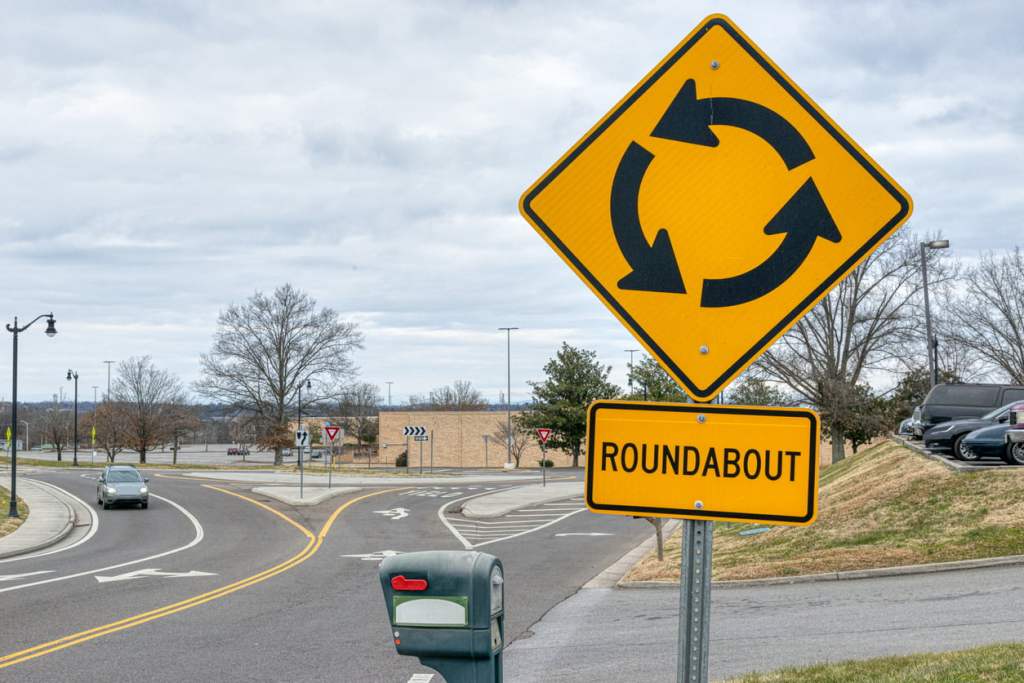
Summer Road Signs Series #6: Roundabout or Traffic Circle Signs

Roundabouts and Traffic Circles are similar in that they help keep traffic moving without forcing anyone to come to a complete stop. I was pretty nervous the first time I encountered traffic circles. There were not any traffic circles in the small town where I learned to drive. I knew how to come to stop, watch for traffic, and then proceed. The idea that I was supposed to merge into this moving traffic and then leave the circle at the right spot was a little unnerving. I have since learned the benefits of traffic circles and roundabouts.

Roundabouts have become more common in the province where I live, not just traffic circles in the congested areas of a city but also at major intersections on highways. These have replaced 4-way stops, allowing traffic to keep moving. Traffic must slow down, yet doesn’t need to stop completely, which I’m sure large trucks appreciate especially. They don’t have to come to a complete stop and then get their heavy load moving again.

This made me think of how sometimes churches or organizations need to make wholesale changes to deal with problems that negatively affect them. Do they need to come to a complete stop or can they make changes on the fly? I’m reminded of observing how some hockey teams who are no longer winning regularly try to make changes. Some give up and trade away any player of value to try to do a complete restart. Others make significant tweaks in their organization without losing seasons to a restart. A roundabout is an example of making changes as you keep moving forward.

When churches have suffered a loss of member for an extended period, it becomes clear that changes need to be made. Often, if they have lived in denial for too long, they will need to come to a complete stop and start over. In some situations, a complete stop means a change of pastoral staff and a period of renewing vision and resetting strategy. In some situations the complete stop means completely stopping all functions of the church, even closing the doors for a brief period of time in order to start a new work down the road.

Like a roundabout, slowing down is preferable to the complete. Yes, the church must slow down. Maybe there are programs that need to be shut down or reworked completely. A pastoral transition might be required. Often someone outside the church needs to come and coach the church through to a better future. The church stops almost all activity for a time, while still maintaining regular Sunday worship services and a physical presence in the community. The church doesn’t come to a complete stop but slows down enough to consider the reality of what they are facing.

Most roundabouts have at least three alternatives for drivers to leave the circle. You may leave the roundabout at the exit that keeps you going straight ahead, or you can take a turn to the right or left. A church too, needs to consider if some simple realigning is all that is needed, and they can keep moving ahead in the direction they were already going. On the other hand, it may be the time to take a turn a little to the right or left. A complete stop is not required, but some restructuring on the fly may mean a change in vision and replacing some programs with others that fit better with the new vision and the current culture of the church and its community.

Like my first experiences with traffic circles, when a church realizes it needs to change, trying something new can be quite unnerving. Hopefully though, most churches will recognize that slowing down to make changes can help them avoid a complete stop.

Church leaders, be willing to adjust your vision and programming when necessary. Church members, work with your leaders as they guide you to a better future. Trust God to guide you as you ask Him to help you make the right changes.

Keep looking up,

Andy Wiebe

Summer Road Signs Series – #5: No U Turn Signs

There were a few times this summer where I was driving in unfamiliar territory and realized too late that I should have taken an earlier turn. I was headed the wrong direction and unsure how to safely turn around. Many intersections have “No U Turn” signs, sometimes with just the symbol, other times with the words “No U Turn” also posted. I would have loved to just turn around and go back to the starting point.

In my experience working with churches in transition, I could have used No U Turn signs a few times. Some churches long for the “good old days.” There is a hope that if only they could get back to what they were like and the programs they ran some years ago, when the church was growing, then things would turn around in the church and it would start to grow again.

In my experience working with churches in transition, I could have used No U Turn signs a few times. Some churches long for the “good old days.” There is a hope that if only they could get back to what they were like and the programs they ran some years ago, when the church was growing, then things would turn around in the church and it would start to grow again.

The reality is a church cannot forget the last few years and the experiences they have gone through and just start over. Time moves on. Culture changes. The congregation changes, and so does the community around the church. Instead of looking backwards, the church must learn how to move forward with clarity and purpose.

I love working on vision with churches. I love to help them see the reality of today and the possibilities of tomorrow. Instead of churches looking back to a certain period of history as the high point for the church, I want them to see that God has great things in store for them, so the best times are still ahead. It may take some work, and prayer, and trusting God, but looking back will not help. I tell churches that as we work on vision, I do not expect there to be radical change from what has happened in the past and what is going on in the church at the present. Instead, I believe God has the church on a trajectory that may need some adjusting here and there but the future will generally be consistent with their history.

The same applies to our personal lives. Many of us can look back to certain periods of our life where we felt things were going really well. Looking back, those seemed like stress-free times, times of excitement and joy. As tempting as it may be to somehow replicate what we once had, life moves on. We have new experiences. We have new responsibilities and new relationships. As we grow our family and develop our careers, we can’t just drop all of that to return to a more carefree time. Instead, we need to find a way forward, to try new roads and look for what God is going to do in our lives in the future.

U-turns are tempting because they seem like a quick and easy fix. Let’s just get back there and try again. This is usually not an option if we are leading a church or setting direction for our personal future. Time moves on like water under a bridge. Our past is not a static thing we can return to. We need to keep looking ahead.

The reality of being human is that we cannot start over. Yes, we can come back to some original principles to live by. We can reorient ourselves to God and His Word. We can re-establish guidelines for our life that served us well in the past, but we cannot remove history and start over. Sometimes a map directory in a mall has a little icon stating “you are here” so you know where you are starting from. The reality is, we are where we are. Now we need to know how to move on from here. We cannot change the past, but we can make changes for our future.

May God help us to learn from the past and keep moving ahead. U-turns to an earlier period in our life or in our church are not possible. Keep moving ahead.

Keep looking up,

Andy Wiebe

Summer Road Signs Series – #4: Merge Signs

I noticed a driver sitting at an intersection, treating a merge lane like a stop sign. There was an open lane in front of her, but she was stopped, waiting for the traffic to end. She did not seem to understand that the lane she was about to enter was wide open. It was only as she entered the lane that she would be able to accelerate to the traffic speed and merge over into the lane she was hoping to get into. And at times I have done the same thing. I know I should merge but hesitate because it seems like there is no room, especially if I have not driven that road before.

Merge signs generally indicate two roads or lanes joining into one. Two common places these signs are used is at intersections where they assist in free flow turning and, on the highway, where a multiple lane highway narrows to one less lane. These signs alert drivers to cooperate and allow those in the lane that is ending to enter their lane.

There are two roles for drivers when encountering a merge sign that reminds me of two experiences in life.

ONE: Merging from one lane into the other

      Some of us are cautious drivers. We do not want to force our way into traffic. It seems too dangerous to use the merge lane when others are going by at the speed limit – or faster. An introvert can relate.

      This is how introverts often feel in life. Merging into new situations brings fear of the unknown. They do not want to force themselves into new situation or new relationships. It seems dangerous. The others already all know each other. Will they welcome me? It is tempting to not even try new situations or to get to know new people. What if it doesn’t work out well?

      If we are caught in a merge lane in life and are hesitating to move over into the main flow of traffic, we need to recognize that the merge lane eventually ends, and with it, your opportunity to make friends with that person or try that new experience. Sometimes, as we hesitate, life moves on by. Do not be too afraid to try something new. And if it doesn’t work out, try something else.  Push yourself to continue to learn and grow. It doesn’t matter whether we are introverts or extroverts, we need to develop perseverance to keep trying new things and looking for new friendships.

      TWO: Allowing others to merge into my lane

      I am not naturally a courteous driver – just ask my wife. I have to work at reminding myself to allow others into my lane and not just push ahead with no consideration for others.

      Some of us need to learn how to consider the needs of others and allow them to merge into our lane. This applies to more than smooth and safe traffic. This applies to life as well. We need to be aware of those around us who are having a hard time fitting in. It may be at church, or at work, or even in our neighbourhood. We need to open our circles to others who need a place to connect.

      Sometimes we get frustrated with people who are not aware or understanding of what we try to do as leaders. Slow adopters annoy us because we have a plan and want people to follow us at our pace. It may be that there needs to be space and time given for those who are still figuring out how to merge into your lane. Leadership requires clear communication of vision and patience for people to get it and move into pursuing it. Let’s learn to make room for others.

      We need to make sure we do not treat merge signs as stop signs but slowly and steadily move into the traffic flow. We can ask God to give us determination to push ahead when we are scared, and ask God to give us patience for those who are slow to merge in.

      Keep looking up,

      Andy Wiebe

      Summer Road Signs Series – #2: Stop Signs

      We began the Summer Road Signs Series with speed signs. Now we’ll go to the opposite: stop signs. While moving forward and heading toward new adventures and new goals is exciting, there are times when we must stop. Eventually we have to take our foot off the gas, apply the brakes, and stop.

      Stop signs remind us of a few things. Sometimes we need to stop because we are coming to an intersection, and other traffic may be coming through. If we don’t stop, we may be hit by other traffic. There are times when we need to slow down and stop in life. We have all kinds of distractions and frustrations and even opportunities coming our way all the time.

      Sometimes we need to stop to just reset ourselves, to get our bearings. We need to remember to watch out for what is going on around us. Are there dangers we have been ignoring? Are there opportunities we have missed because we have been going forward with such passion and determination, we never recognized them? Slow seasons can give opportunity for us to stop and assess where we have been, where we are, and where we are going.

      For ourselves and our families, stopping to spend time reconnecting is valuable. Summer can be busy chauffeuring kids to camp or swimming lessons or tutoring. It can fill up with family gatherings and other expectations. But take time to spend with your family doing very little except being together. Instead of working on another project or chasing another busy thing, slow down and just listen to each other and talk about each other’s dreams and desires, hurts and frustrations. Pause to listen to each other.

      In our desire to move ahead, have we left people behind? Do we need to give time for our team to catch up with us? As pastors, we set vision and direction for our churches. Are we giving time for our teams and churches to capture that vision and move with us? As leaders, our jobs include thinking about our goals and our vision all the time, but the reality is that those lead have other things on their minds too. They are not necessarily prioritizing moving towards these goals at the pace we are. A stop sign may remind us to give time for those we lead to catch up.

      A stop sign could be at a T-intersection where we need to choose right or left. In our desire to move ahead, there are times we need to stop to figure out our next direction. What’s next? Just blindly choosing a direction in order to keep going may take us in the opposite direction of where we should be heading. Even if you are confronted with two equally good options, the stop will give space to allow you decide which one to take.

      A stop sign may also be a reminder to just pause. We all need, in biblical terms, an occasional sabbatical. When God created the world, the seventh day, the final day, was a day of rest. It was a time to recognize that the work that had been done was enough. It’s okay to stop. To rest from busyness and take a break. A sabbatical is a reminder that our worth is not found in what we produce or what we do. When the work stops, you are still loved by God and valued as a person, a child of His.

      There is also value in having other “sabbath” times. Taking a vacation can be a sabbath as we stop doing and pursing and producing and enjoy the people around us and take pleasure in the world God has created.

      Yes, it is fun to move ahead at full speed, but it is important to recognize the stop signs and take the important breaks that refresh and reorient us for the next part of our journey.

      Enjoy the stops signs!

      Keep looking up,

      Andy Wiebe

      P.S. Next week’s road signs: Watch for Wild Animals

      Four Suggestions for A Good New Start

      While beginning a new job is both exciting and overwhelming, it is important to take time in the midst of the busyness to identify your values in the new role. The duties of the job can quickly fill your schedule and begin to pull you in a direction you may not necessarily want to go.

      What is important to you that you do not want to ignore as the demands of your new position grow? What do you need to schedule now before your schedule fills up?

      1.  Get Your Family Settled

      When moving to a different community for your work, make sure you take adequate time to get your family settled. Unpack as quickly as you can so that your family can see familiar photos on the wall and fridge that help them feel somewhat at home.

      Help your family get settled in school and in other sports or community activities that will help them get connected to the community and to new friends. The more settled your family feels, the more settled you will feel.

      Schedule important family dates onto your calendar before the job demands overwhelm you and you forget special days. 

      2. Be Clear on Your Personal Priorities

        In the process of accepting a new role, you have an opportunity to review the job description that will define your responsibilities. But you most likely have some personal values or priorities that you hold. If you, as a new pastor, want to spend regular time in prayer, schedule it into your calendar. If you love mentoring others, you might already be looking for whom to mentor. If you want to keep on growing in your skills and personal development, you might want to determine a plan that will work in this new setting and will not interfere with the responsibilities you agree to when you accepted the position.

        Make sure you know the requirements of your new role. Begin to plan and dream and schedule dates as you look at what you need to work on.

        3. Begin New Friendships

        When you begin a new position in a church, there may not be a lot of demands on you at first as you begin to make your way into your new role. Because you do not have many projects to work on at first, focus on getting to know people. Get to know the people you will work closely with. Get to know your board. Get to know other staff. Get to know the leaders who volunteer in the ministries of the church. You can do this on your own, or if you have a spouse or family, meet together with couples and families.

        Good friendships will help your job to be an enjoyable experience.

        4. Develop a Schedule That Fits the New Role

        While your new job may be similar to what you have done before, each new role comes with various changes that affect how you fulfill your new role. Each new job comes with different expectations and different schedules. Because of the expectations of your new role, you may need to take a different day off than you have before. Maybe you are better off coming to work earlier and going home earlier in the afternoon as well. Figure out the schedule that will work for you now.

        It can be a lot of fun starting a new job. I believe you will have a better start if you can follow the suggestions above.

        Keep looking up,

        Andy Wiebe

        The Privilege of Being a Pastor #3: Making Disciples of Jesus.

        One of the unique opportunities of a pastor is to walk with people as they take significant steps in their journey with Jesus. It is humbling to think that God allows me to be part of these times when people are making decisions that will impact their eternity. Let me share a few stories.

        I remember a teenage girl who was searching for answers. She came from a difficult home situation and loved the acceptance she was experiencing in the youth group and church. Her friend brought her to me and together we introduced her to Jesus! She knew there was something better than what she was experiencing at home.

        One young man had gone through many hard things. You could tell, just by looking at him, that life had been hard on him. I got to know him and tried to help answer his questions until the day that he asked to be baptised. Just as we headed to the washrooms to change for the baptism, he pulled out a cigar and handed it to me. What a fitting gift! He was so excited about what was about to happen and wanted to celebrate it with a gift for me.

        I love the excitement of those preparing for baptism. One teenage girl was determined we would have an outdoor baptism in the river near the church even though it was fall already. The special day arrived, and there was already a skiff of snow on the ground, but she was not backing down. We made sure to have plenty of extra towels to wrap up after and went down into the cold river for the baptism. It was one of the quickest baptisms I ever did!

        I remember reading the Bible with a new friend. He didn’t know the Bible but wanted to just read it together. This was not a Bible Study or in-depth lesson. We just started by taking turns reading in the Gospels. As we read the stories of Jesus, we stopped when he had a question or clarification was needed, and then kept going. I loved seeing his responses to a story that I was so used to but was brand new for him!

        I have preached many sermons in my life. There are many I have forgotten, but others stick in my mind because of how people responded. One Sunday, I preached on receiving the Holy Spirit from the book of Acts. I pointed out that sometimes people had leaders lay their hands on them and pray for them to receive the Holy Spirit. I made it clear that there was nothing special about me, but if there were any who wanted to have me lay hands on them and pray for them, to come on up as I closed. One man actually ran to the front! Then others started coming up. There were so many  people who wanted to receive more of the Holy Spirit, that I had to recruit a couple of elders to lay hands on and pray for people with me. What a joy to see people respond to God’s word!

        Working on vision with church leaders is one of the things I get excited about as I serve as a Transitional Pastor. I love seeing leaders begin to hear God together and get a sense of how God is leading their church. I served one church where leaders put in two planning and dreaming sessions of five and six hours each, working together to hear from God on His direction for the church. It was amazing to watch as they listened and heard from God together, coming up with the right words to describe who the church was and where the leaders felt God calling them as a church. The time of prayer and listening and discussing together brought a clear sense of direction that guided the church moving forward. What a privilege to coach the leaders through this process of listening to God.

        Walking with people as they make decisions to follow and honour Jesus has given me opportunities to develop some great friendships. One friend and I spent many hours together in the church and serving in the community and just doing life together. It was a joy to eventually baptise him as he said yes to Jesus. Another friend was struggling with a desire to be holy and feeling he was far from it. As we walked through this time together, not only was I able to encourage him to continue to follow Jesus and go deeper with him, I also found a great friend.

        I hope these stories show you what a gift it is to walk with people as they make big spiritual decisions and take steps in spiritual growth.

        Keep looking up,

        Andy Wiebe